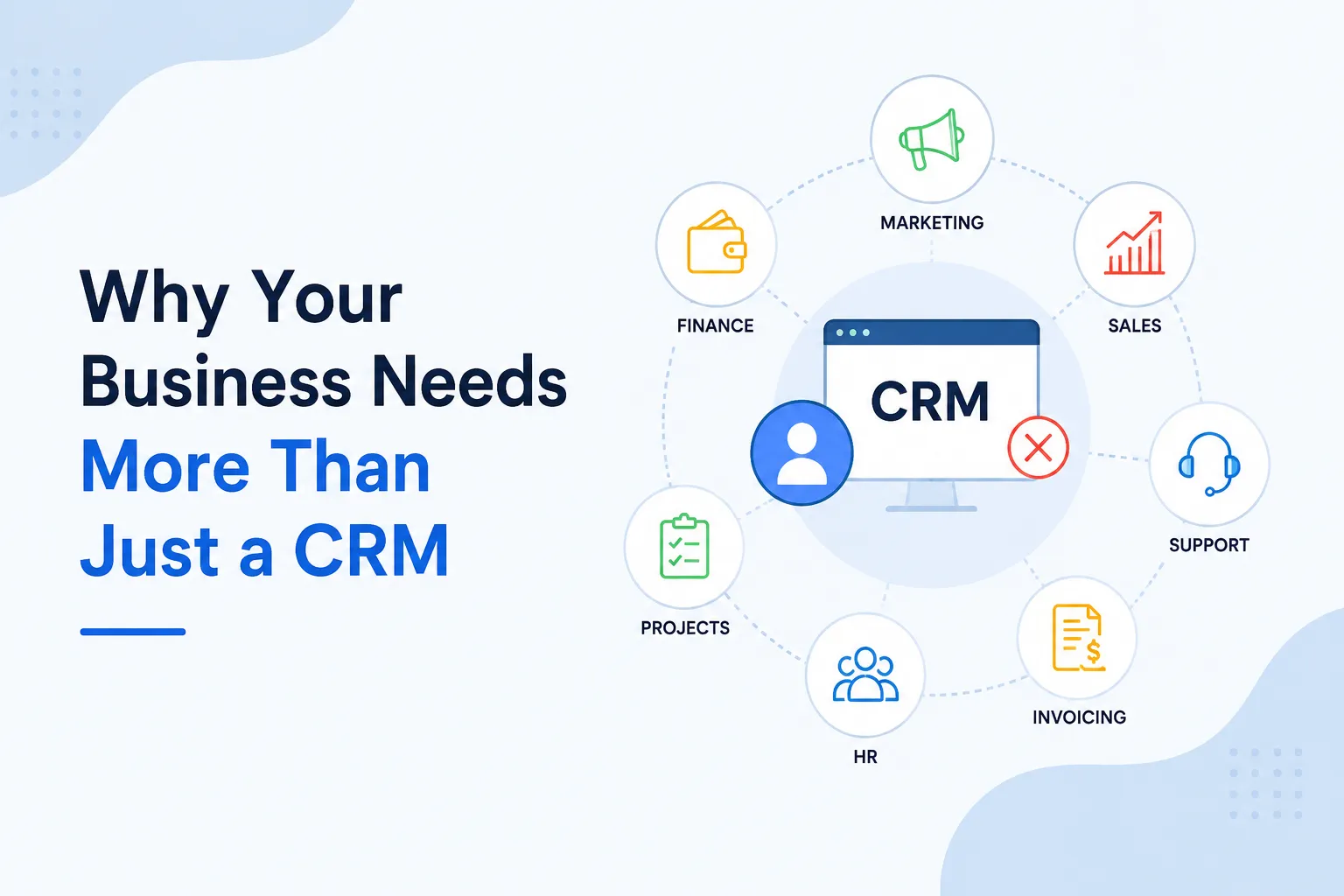

A CRM is often the first major step businesses take toward becoming more organized. It brings customer information into one place, helps sales teams manage leads, tracks conversations, and gives managers better visibility into the sales pipeline.
But as a business grows, something interesting happens: the CRM starts solving one part of the problem while other parts of the business remain disconnected.
Your sales team may have a CRM. Your finance team may use separate accounting software. Marketing may work from another platform. Customer support might have its own system, while HR, project management, and internal collaboration happen somewhere else.
The result? You have a CRM—but your business still feels fragmented.
That's why modern businesses increasingly need more than just a CRM. They need an interconnected ecosystem of applications that can support the entire business, not just customer relationships.
A CRM Is Important—but It Isn't Your Entire Business
A CRM is designed primarily to manage relationships with prospects and customers. It is excellent at handling activities such as:
- Lead and contact management
- Sales pipeline tracking
- Follow-ups and communication
- Customer history
- Sales forecasting
- Workflow automation
- Reporting and analytics
However, closing a deal is only one part of the customer journey.
Once a salesperson closes a deal, someone needs to create an invoice, collect payment, deliver the product or service, manage projects, provide support, and maintain the customer relationship.
If each of these activities happens in a different system, employees spend valuable time moving information from one application to another.
That's where the limitations of a CRM-only approach become visible.
The Hidden Cost of Disconnected Business Tools
Imagine a typical customer journey.
A prospect fills out a form on your website. Marketing captures the lead. Sales follows up and converts it into a customer. Finance creates an invoice. The operations team starts the project. Customer support handles questions. Management wants to know how profitable that customer is.
Now ask yourself: Is all of that information connected?
If the answer is no, your teams may be relying on spreadsheets, emails, manual data entry, and multiple disconnected applications.
This creates several problems.
1. Data Gets Trapped in Silos
When departments use separate applications, important information becomes scattered.
Sales may know what the customer purchased, while finance knows what they paid and support knows what problems they experienced.
Nobody has the complete picture.
2. Employees Waste Time on Repetitive Tasks
Teams often spend hours copying customer information between systems, updating spreadsheets, creating reports, and sending internal notifications.
These tasks may seem small individually, but collectively they can consume a significant amount of working time.
3. Errors Become More Likely
Manual data entry creates opportunities for incorrect information, duplicate records, missed updates, and inconsistent customer details.
The more systems your teams use, the more difficult it becomes to keep information accurate everywhere.
4. Customer Experience Suffers
Customers don't care which department owns a particular piece of information. They simply expect your business to know who they are and what they need.
When systems aren't connected, customers may have to repeat information or wait while employees search across different platforms.
5. Technology Costs Keep Growing
Adding a separate application every time a department has a new requirement can quickly create a complicated technology stack.
You don't just pay for subscriptions. You also pay through integration, maintenance, training, administration, and the time employees spend switching between tools.
What Businesses Actually Need: A Connected Business Ecosystem
The solution isn't necessarily to replace your CRM.
Instead, businesses should think beyond the CRM and ask a bigger question:
How can we connect the systems that run our entire business?
This means bringing together the functions that support the customer and the organization—from marketing and sales to finance, operations, support, HR, and collaboration.
A connected ecosystem can allow information to move between departments automatically.
For example:
Marketing → Sales → Finance → Operations → Support → Customer Success
Instead of every team working with isolated information, each stage can build on the previous one.
This creates a more complete view of the customer and a more efficient way of running the business.
Also Read: Zoho One: The Business Suite of 50+ Applications
CRM + Automation: A More Powerful Combination
A connected application ecosystem becomes even more valuable when automation is introduced. Consider what happens after a sales representative converts a lead.
Instead of manually notifying finance, creating a project, updating customer records, and informing the support team, automated workflows can trigger the appropriate actions.
For example:
Deal Closed → Customer Record Updated → Invoice Process Initiated → Project Created → Internal Teams Notified
This reduces manual work while helping teams respond faster.
Automation also allows employees to spend less time managing systems and more time focusing on activities that require human judgment—such as building relationships, solving customer problems, and making strategic decisions.
More Tools Don't Always Mean Better Technology
It's important to make one distinction: having more applications isn't the same as having a better technology stack.
Businesses can easily fall into the trap of buying separate tools for every requirement.
One tool for CRM.
Another for email marketing.
Another for accounting.
Another for projects.
Another for support.
Another for HR.
Another for analytics.
Before long, employees are managing the tools instead of the business.
The goal should be connected technology, not more technology.
A good business ecosystem should make processes simpler, information easier to access, and collaboration easier—not add another layer of complexity.
How to Know If Your Business Has Outgrown Its CRM
Your CRM may still be working perfectly, but your overall business technology may be holding you back.
Here are some signs that it's time to think beyond CRM:
- Employees frequently move data between applications.
- Teams maintain separate spreadsheets for the same information.
- Sales and finance use different customer data.
- Managers struggle to get a complete view of business performance.
- Customer information is spread across multiple platforms.
- Your teams rely heavily on manual processes.
- You keep adding new software to solve individual problems.
- Employees spend too much time switching between applications.
- Integrations are becoming increasingly difficult to manage.
- Your business is growing faster than your existing systems can support.
If several of these sound familiar, the problem may not be your CRM.
The problem may be that your CRM is being asked to do a job it was never designed to do alone.
The Future Is Connected
A CRM remains an essential part of modern business technology. It gives companies the tools they need to understand customers, manage sales, and build stronger relationships.
But today's businesses operate across far more functions than sales alone.
Marketing generates demand.
Sales converts it.
Finance manages revenue.
Operations delivers the promise.
Support maintains the relationship.
HR enables the people behind the business.
Analytics helps leadership make better decisions.
When these functions operate in isolation, growth becomes harder to manage.
When they work together, businesses can create smoother processes, better customer experiences, stronger visibility, and greater operational efficiency.
Your CRM should be part of your business ecosystem—not the entire ecosystem.
And for organizations looking to bring more of their business operations together, platforms such as Zoho One offer a way to move from a collection of disconnected tools toward a more unified approach to business management.




























Sign in to leave a comment.