
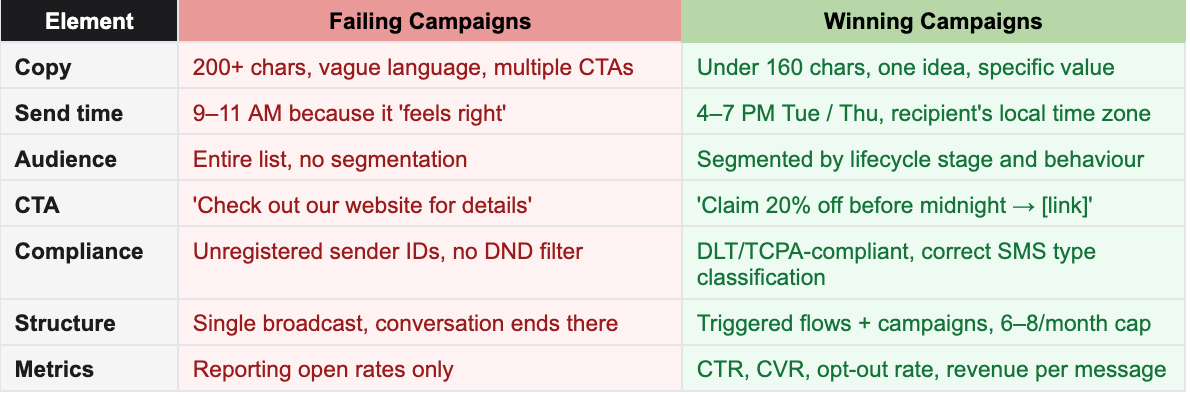
Failing vs. Winning: A Side-by-Side Comparison
SMS marketing has a near-mythical reputation — industry research consistently shows 90–98% open rates and messages read within minutes of receipt.
Yet many marketers see disappointing click-through rates, rising opt-outs, and a CRM full of broadcasts that generated zero pipeline.
The channel isn't broken. The execution is. This article identifies the seven most common reasons SMS campaigns fail, corrects several widely-circulated misconceptions, and gives you specific, evidence-based fixes for each problem.
The 6 Reasons Your SMS Campaigns Are Underperforming
1. You're Writing SMS Like an Email
Long copy, multiple CTAs, HTML-style language, and clichés like 'AMAZING DEAL!!!' are email conventions wrongly applied to a completely different medium. SMS is an intimate, high-trust channel that people associate with personal messages. The moment your message reads like a broadcast ad, you've broken that implicit contract.
A standard SMS supports 160 characters. Longer messages get split into multiple segments, increasing costs and reducing deliverability. More importantly, recipients don't read long SMS messages — they scan for the point and either act or dismiss.
THE FIX
Apply one rule: one SMS = one idea = one action. Strip everything else.
Replace vague superlatives with specific value: "Save ₹500 today only → [link]" outperforms "Check out our incredible offers!" every time. If you can't make it clear and compelling in 160 characters, the offer may need rethinking — not more characters.
2. You're Sending at the Wrong Time
Morning blasts feel intuitive but data disagrees. Attentive's analysis of over 25 billion SMS messages found that 4 PM–7 PM drives the highest revenue per send. Vibes' research confirmed 5 PM and 6 PM consistently outperform the popular 10 AM window — with 5 PM beating 10 AM by 18% on click-through rate.
Day of week matters too. Tuesday and Thursday rank as the highest-performing days across multiple large-scale studies. Monday is broadly identified as the worst day for promotional SMS — people are in task mode and treat marketing texts as interruptions.
THE FIX
Shift your default send window to 4 PM–7 PM, Tuesday or Thursday, always in the recipient's local time zone. For transactional messages (OTPs, order confirmations), timing is less critical — they're expected and opened immediately.
Note: TCPA in the US legally restricts promotional SMS to 8 AM–9 PM recipient local time. Use 4–7 PM as your starting point, then A/B test against your own audience data to refine.
3. You're Blasting Your Entire List
Mass SMS without segmentation burns subscriber lists efficiently. Sending a win-back offer to an active customer, or a product announcement to someone who opted in for logistics updates only, signals that you don't know your audience. Relevance is the currency of permission-based channels.
Research from Emarsys (2025) found that 73% of consumers will unsubscribe from a brand that sends irrelevant or too-frequent messages. Unlike email unsubscribes, SMS opt-outs are permanent and immediate — there's no re-engagement campaign possible once someone has opted out.
THE FIX
Start with three segments: new subscribers (0–30 days), active customers (last 90 days), and lapsed customers (90+ days).
As you scale, add behavioural triggers — cart abandonment, post-purchase, re-engagement — which Omnisend data shows generate up to 30× more revenue per recipient than one-off blasts.
This is especially critical for promotional SMS campaigns, where audience relevance directly determines conversion vs. opt-out.
4. Your Call to Action Is Vague or Missing
Check out our new collection" is a suggestion, not a CTA. "Visit our website for details" tells people what to do but gives them no reason to do it right now. SMS recipients make split-second decisions — your message either earns an immediate tap or gets dismissed. There is very rarely a "later."
SMS conversion rates range from 21% to 32% for well-optimised campaigns, and abandoned cart SMS specifically converts at 24.6%–39.4% (Optimonk, 2025–2026). These numbers only hold when the CTA is specific, clear, and time-bound.
THE FIX
Build every SMS around three elements: value (what the recipient gets), urgency (why now), and action (exactly what to do).
Example: "Your 20% discount expires at midnight → [link]". Use a branded short URL — generic shorteners suppress CTR because they look like spam to both recipients and carrier filters.
For reply CTAs: "Reply YES to confirm your appointment" beats "Let us know if you're interested" every time.
5. You're Not Managing Compliance Properly
Compliance failures in SMS are uniquely consequential. In India, TRAI's DLT framework requires businesses to register their entity, sender IDs, and message templates before any commercial SMS can be delivered unregistered messages are simply blocked.
In the US, TCPA requires prior express written consent and restricts send times. Violations create legal exposure and permanent deliverability damage.
This isn't one-size-fits-all. Promotional SMS (offers, discounts, marketing) and transactional SMS (OTPs, order confirmations, account alerts) are regulated separately in most markets — different registration requirements, different sender ID categories, different DND exemptions.
THE FIX
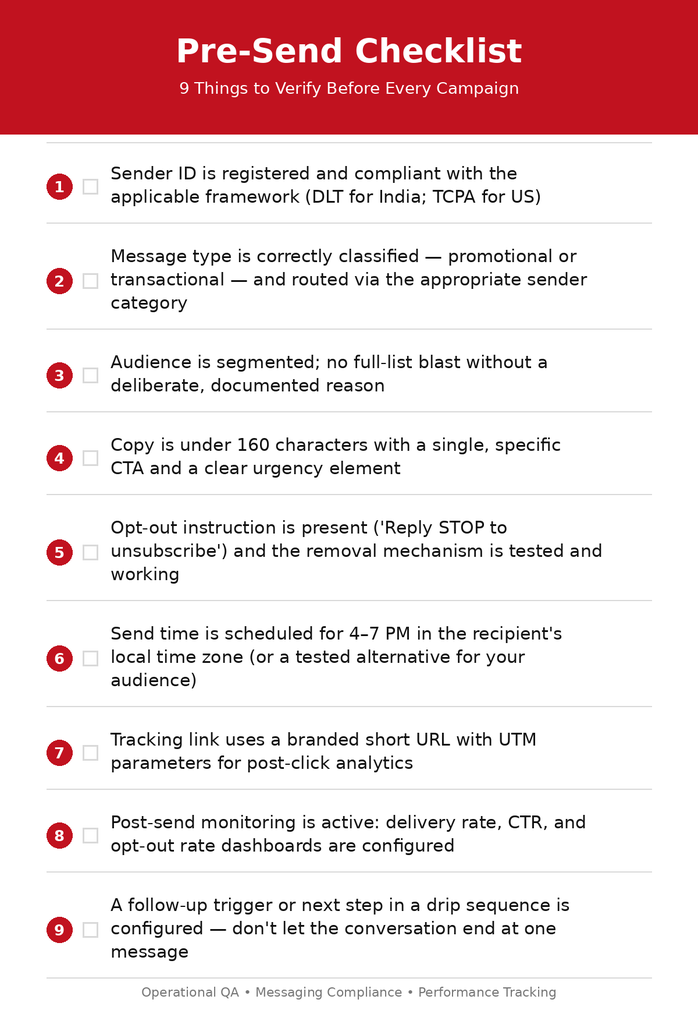
Audit four things before scaling any SMS programme:
(1) how consent is collected and documented
(2) whether sender IDs are correctly registered
(3) that every promotional message includes a working opt-out mechanism, and
(4) that your promotional and transactional flows are correctly classified and routed via the appropriate sender type.Use a platform with built-in DLT management — this is not an area to improvise.
6. You're Measuring the Wrong Metrics
Open rate is near-meaningless for SMS because virtually everyone opens a text message. Reporting '97% open rate' tells you nothing about whether the campaign drove any business outcome.
The metrics that reveal actual SMS campaign health are different from the ones most marketers inherit from their email reporting habits.
THE FIX
- Track five metrics for every campaign:
- Delivery rate (target >95%) ·
- Click-through rate (industry avg: 19–20%) ·
- Conversion rate post-click (well-optimised: 21–32%) ·
- Opt-out rate per campaign (warning sign if >2%) ·
- Revenue per message (automated flows: $3.46–$10+).
Tag every link with UTM parameters so post-click behaviour is tracked in your analytics platform, not just inside your SMS dashboard.

























Sign in to leave a comment.