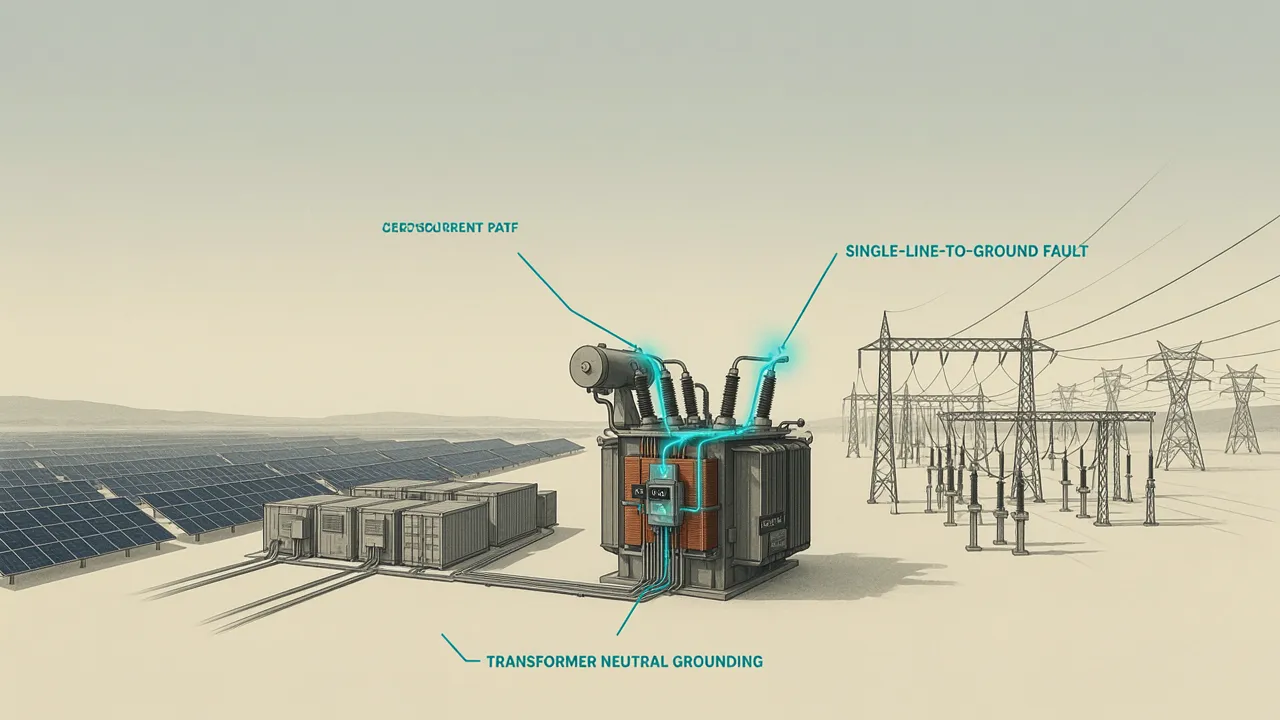

As renewable energy projects expand, inverter-based resources (IBRs) such as solar PV plants, battery energy storage systems, and wind farms are becoming an increasingly important part of modern power networks. Unlike conventional synchronous generators, these resources use power electronic controls that can respond very differently to faults and unbalanced system conditions.
One often-overlooked aspect of IBR performance is zero-sequence current. Understanding how zero-sequence components behave can be critical for grounding, protection, transformer selection, fault analysis, and overall system reliability. For engineers working on renewable interconnection and grid studies, zero-sequence current considerations are therefore becoming increasingly important.
What Is Zero-Sequence Current?
In symmetrical-component analysis, an unbalanced three-phase system can be represented using positive-, negative-, and zero-sequence components. Zero-sequence currents consist of three phasors that have equal magnitude and are in phase with one another.
Unlike positive- and negative-sequence currents, zero-sequence current requires a return path. Depending on the network configuration, this path may exist through the neutral conductor, transformer winding connections, grounding transformers, cable shields, or the earth.
This makes zero-sequence behavior particularly important during ground faults. A line-to-ground fault, for example, can produce significant zero-sequence current when the system provides an appropriate grounding path.
In conventional power systems, engineers can often estimate ground-fault behavior from generator and transformer characteristics. IBRs introduce additional complexity because their fault-current contribution is influenced by converter controls, current limits, grounding arrangements, and plant-level equipment.
Why Inverter-Based Plants Behave Differently
A conventional synchronous generator naturally produces electromagnetic responses to disturbances based on its physical characteristics. An inverter-based plant, however, relies on power electronics and control algorithms to determine how current is delivered.
During a fault, an inverter may limit current to protect semiconductor devices. Its response may also depend on voltage conditions, controller settings, grid strength, and the specific type of fault.
The result is that the ground-fault contribution from an IBR cannot always be represented accurately using assumptions developed for traditional rotating machines.
For example, an inverter may provide limited negative- or zero-sequence current, or its response may be controlled differently depending on the manufacturer's implementation. Transformer connections can further restrict or redirect zero-sequence components.
Therefore, engineers need to evaluate the complete electrical path rather than simply assuming that an inverter will contribute fault current in the same manner as a synchronous generator.
Zero-Sequence Current and Ground-Fault Analysis
Ground faults are among the most important applications of zero-sequence analysis. When a fault involves ground, the available zero-sequence network can have a major effect on the resulting fault current.
For an inverter-based plant, engineers typically need to consider:
- Plant transformer winding configuration
- Neutral grounding arrangements
- Collector-system configuration
- Cable and overhead-line characteristics
- Grounding transformers and zig-zag transformers
- Inverter current-control behavior
- Plant controller response
- Utility-side grounding
- Fault location and system operating conditions
These factors determine whether zero-sequence current can flow and how much current reaches the fault.
A properly developed inverter-based plant zero-sequence current model can therefore provide valuable information for protection and grounding studies. It helps engineers understand how the plant interacts with the surrounding network during ground faults rather than relying solely on generic fault-current assumptions.
Protection and Grounding Implications
Protection systems depend on reliable information about fault-current magnitude and direction. Ground-fault protection in particular can be affected by the amount of zero-sequence current available.
If an inverter-based plant contributes less ground-fault current than expected, traditional protection settings may not operate as intended. Conversely, certain transformer or grounding configurations can create paths for zero-sequence current that significantly influence protection behavior.
Zero-sequence current can also affect ground-fault relays, directional protection, neutral overcurrent elements, and sensitive earth-fault detection schemes.
This is why zero-sequence current considerations should be incorporated early in the engineering process. Reviewing them only after protection settings have been developed can lead to unnecessary redesign and coordination challenges.
Grounding design is equally important. Engineers need to determine how zero-sequence current travels through the plant under both normal and fault conditions. A detailed assessment can help identify potential circulating currents, grounding-system requirements, and equipment stresses.
Modeling Challenges for Modern Renewable Plants
Accurate modeling is one of the biggest challenges associated with zero-sequence behavior in IBR facilities.
Many renewable projects contain multiple layers of equipment, including inverter units, step-up transformers, medium-voltage collector circuits, plant transformers, transmission connections, and utility-system equipment. Each element can influence the zero-sequence network.
The inverter manufacturer's model may also need to represent fault-current behavior accurately. Depending on the study objective, engineers may use different modeling approaches for steady-state, short-circuit, electromagnetic transient, or protection studies.
For detailed investigations, zero-sequence analysis for inverter-based plants should consider both the plant configuration and the characteristics of the connected grid.
This can be especially important for weak-grid applications, large solar and wind facilities, and battery energy storage projects where converter controls can have a substantial influence on fault response.
Building More Reliable IBR Studies
Zero-sequence analysis should not be treated as an isolated calculation. It works best as part of a broader power-system engineering process that includes short-circuit studies, protection coordination, grounding analysis, load flow, dynamic modeling, and interconnection studies.
Engineers can improve study quality by verifying equipment data, confirming transformer connections, reviewing grounding assumptions, and obtaining appropriate inverter models from manufacturers. Comparing calculated results with expected equipment behavior can also help identify modeling inconsistencies.
For renewable developers and utilities, these studies provide a clearer understanding of how inverter-based facilities behave under abnormal operating conditions. They can support better protection decisions, more appropriate grounding designs, and smoother interconnection processes.
As the share of inverter-based generation continues to increase, zero-sequence behavior will remain an important engineering consideration. Understanding the available fault-current paths and the influence of converter controls can help power-system professionals design renewable facilities that operate reliably within increasingly complex electrical networks.
For organizations developing or connecting solar, wind, and battery projects, detailed zero-sequence and power-system studies can provide the technical foundation needed for dependable plant performance and grid integration.























Sign in to leave a comment.