
Even in this era of AI automation, composable architecture, and headless content delivery, there remains a single platform that is still engaging businesses with the same energy: WordPress. Although new digital experience platforms (DXPs) and proprietary CMSs seem to be developed, WordPress CMS is still the enterprise's preference for 2026.
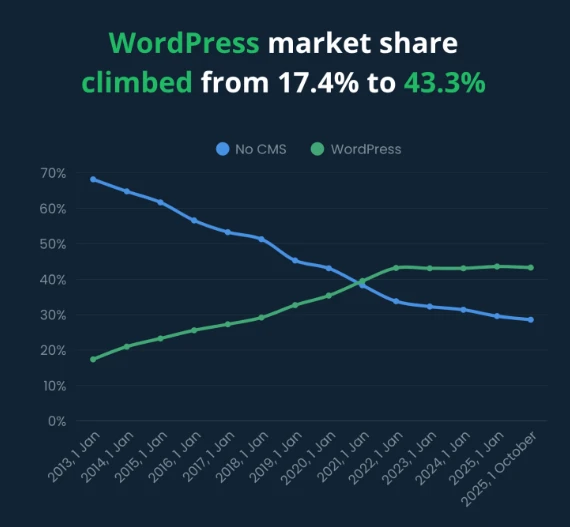
Organizations don't only need content management; they need a scalable, secure, and custom digital platform for a competitive advantage. WordPress provides exactly that. It has a global presence that serves more than 43% of the web, including some of the most famous Fortune 500 brands. Its applicability has not waned; instead, it has been transformed to serve enterprise modern needs.
This blog delves into why WordPress is still relevant for enterprise websites in 2026 and how businesses are using it to meet digital transformation and business agility.
How WordPress has Evolved from Simple CMS to Enterprise Platform
WordPress has transitioned a long way from being recognised as a blogging platform. It has grown over time to become an enterprise-level DXP with the ability to serve global ecosystems through consistent innovation and grassroots development.
Over the past years, the WordPress adoption in large enterprises has seen a major surge, all because of its headless, REST APIs, and cloud-native scalability. Today, modern businesses are focusing on the composable experiences in which WordPress CMS integrates smoothly with CRMs, ERPs, marketing automation platforms, and AI analytics platforms. WooCommerce, the most popular eCommerce plugin for WordPress, powers 13% of all online selling platforms across the globe.
Such growth has made WordPress a foundation of enterprise web development, allowing organizations to integrate digital assets, manage experiences across multiple channels, and push global campaigns with agility.
Key Reasons Large Businesses Rely on WordPress
Enterprises choose WordPress because it offers all the features a business needs to support complex digital ecosystems and operate at scale without sacrificing creativity or performance.
1. Scalability and Performance
Modern enterprise WordPress solutions, with containerized deployments (Docker, Kubernetes), CDN integrations, and caching layers (Redis or Varnish), can easily support millions of requests per day. It is this level of scaling that enables enterprise-level websites to deliver optimized performance during uptime and peak traffic. One of the primary reasons why large organizations utilize WordPress to build enterprise-wide mission-critical websites.
2. Security and Compliance
The security standard of WordP ress has changed radically. Enterprise frameworks that enable multi-factor authentication, role-based access controls, and use of the SSL/TLS protocol follow international standards such as GDPR, HIPAA, and SOC 2. AI-driven threat detection has become the new norm, rather than plugin-based security. Its defense mechanism is further optimized with continuous security audit and WordPress maintenance services.
3. Enterprise Content Management
In addition to the publishing role, WordPress is currently being adopted by businesses as a complete enterprise content management system. WordPress has a strong ECM platform due to its flexible taxonomy, permissions, and workflow management, as well as global brand management of localized multilingual content.
4. Integration and Extensibility
WordPress, as an online enterprise solution, with the help of APIs and Plugins, can easily integrate with existing enterprise systems like Salesforce, HubSpot, SAP, or Microsoft Dynamics. WordPress's customization and integration features ensure companies will not be locked into one vendor while scaling their online ecosystem.
5. Multi-Site and Multi-Global Management
In the case of international companies with numerous regional websites, the multi-site feature of WordPress allows a single governance and decentralized control. This is a great feature for big brands that operate in several geographies and languages.
Business Benefits of Investing in WordPress as Your Enterprise CMS
Choosing WordPress for enterprise website development provides a scalable, secure, and future-ready foundation for desired ROI. When you hire WordPress developer, organizations can leverage deeper customization and seamless system integrations with reduced operational cost.
1. Reduced Total Cost of Ownership
The proprietary DXPs have high licensing fees, along with renewal fees, unlike WordPress, which is an open-source platform. Businesses can use savings for innovation, scalability, and performance upgrades rather than overhead on their platforms.
2. Less Time-to-Market for Digital Initiatives
WordPress enables sites to be launched quickly, perform micro-experiments, roll out campaigns, and expand locally, without the heavy development cycles. This is one of the WordPress assets to enterprises that want to speed up the delivery of digital experiences.
3. Smooth Scalability for Businesses
Current WordPress architectures are containerized, cloud-hosted, and CDN layers. This makes the enterprise sites scale well with increased traffic, seasonal spikes, or international market expansion. It is a major strength of the WordPress platform to support enterprise scalability and security.
4. Customization and Brand Control
Presence of enterprise WordPress customization features, organizations are able to customize workflows, UX elements, integrations, and governance models. This gives companies the ability to ensure brand consistency, yet offers the ability to flexibly deploy content within departments.
5. Advanced Content Management and Governance
Being a centralized enterprise content management platform, brands can have an organized control over the ownership of the content, approval processes, user groups, and lifecycle management, which is essential in compliance-intensive organizations.
Future of Enterprise Web Development with WordPress
The future of enterprise web development with WordPress is defined by increased modularity and AI-driven automation. With the support of WordPress consulting services guiding strategy and modernization, the platform is positioned not just as a CMS, but a foundation supporting next-generation digital transformation.
1. Artificial Intelligence Native Content Processes
WordPress is no longer manual in terms of publishing content; it is now AI-assisted. Generative AI will be used to draft content, optimize their search engine algorithms automatically, personalize their UX in real-time, and create chatbots - making responses faster and more consistent.
2. Headless and Composable Architectures
The next-generation enterprise stack is module-based. WordPress will go on to be the content engine of WordPress enterprise modernization, independently of the other services. This enables businesses to create engaging digital experiences with frameworks such as React, Next.js, and Vue.
3. Security Hardening and Zero-Trust Adoption
As the cybersecurity policies are getting tighter, the WordPress deployment will follow zero-trust security, state-of-the-art identity authentication, automated vulnerability scans, and CI/CD pipelines that are driven by DevSecOps. This is very much required for protection against emerging threats.
4. Deep Integrations with Data & Analytics Platforms
WordPress will become the key data publisher and experience coordinator, integrating with CRMs, CDPs, AI analytics, DAMs, and automation suites. This will open the door to more customer insights and next-best-action personalization.
5. Cloud-Based Performance Optimization
The distributed cloud and edge computing environments will migrate WordPress workloads to enterprises. It refers to microsecond-level load times among geographies, which is a critical requirement for brands operating in multi-region markets. This WordPress performance optimization feature is highly integral for brands looking to scale business operations without any geographical barriers.
Conclusion
Amid countless flashy options and niche platforms in the digital world, one of the many essential advantages that WordPress offers is reliability, scale, flexibility, and growth ability. As niche platforms fulfill an increasing number of specific needs, WordPress maintains a firm grip on more than its share of the market. WordPress is still the preferred platform serving the demands of everyone, from bloggers to eCommerce merchants.
Whether you want to build a website from scratch or revamp your existing website, enterprise WordPress development services can serve your business needs with their expertise and technical skills. They have relevant resources that can customize, optimize, and even make your website SEO-friendly for higher engagement. In 2026, this won't merely be about market dominance; it is smart business.


























Sign in to leave a comment.