

Introduction
When analyzing high-profile network compromises that disrupted global supply chains and compromised millions of customer identities, a clear technical pattern emerges. Security researchers studying these failures are forcing a vital question: Would Zero Trust Have Prevented Major Data Breaches? Most massive data thefts succeeded not because the initial entry point was highly sophisticated, but because the target’s internal architecture allowed unverified users to move laterally across the network unchecked.
In legacy networks, compromising a single low-level system — such as a third-party vendor account — gives an attacker a direct path to core financial databases. Shifting to an uncompromising, identity-validated setup blocks this path completely. To see how continuous session auditing stops fast-moving attacks early, see our core cluster master resource:
Why Zero Trust Security Is the Future of Cyber Defense.
Neutralizing the Attacker Playbook with Structural Isolation
To evaluate how strict authentication rules alter attack timelines, let’s look at standard intrusion steps.
Consider a scenario where an attacker steals executive credentials via an advanced phishing link. In a standard setup, that credential grants wide access to corporate shares. Under a Zero Trust framework, the system challenges every single asset request. If the account suddenly attempts to access deep backend source code repositories from an unusual device profile, the system instantly revokes authentication tokens.
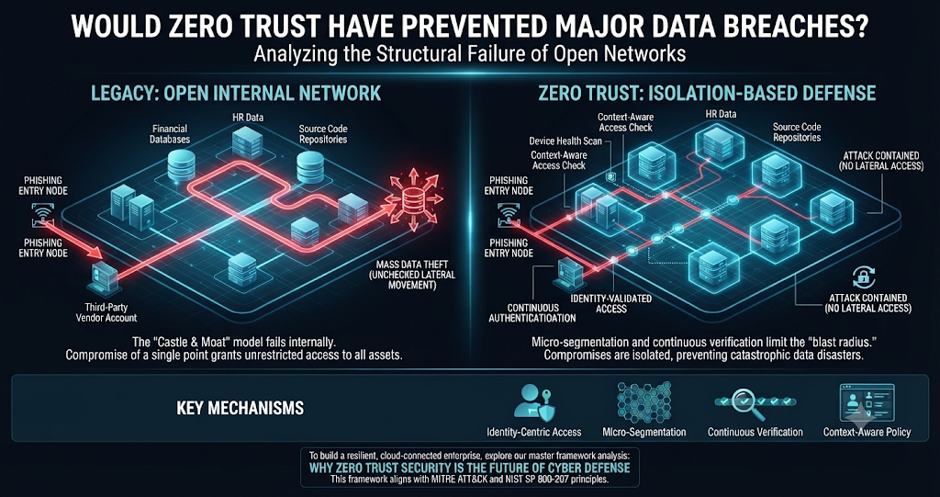
[ Phishing Entry Node ] (Old School: Open Network) [ Mass Data Theft ]
VS.
[ Phishing Entry Node ] [ Zero Trust: Block Lateral Access ] [ Attack Contained ]
Figure 1: How Micro-Segmentation Contains Active Internal Exploitation
To help enterprises proactively uncover hidden access flaws before adversaries exploit them, companies deploy the specialized VAPT Solutions platform to safely simulate multi-stage network attacks. This continuous offensive stress-testing validates internal boundaries against techniques cataloged in global databases like the external MITRE ATT&CK Framework.
Conclusion
When asking if would Zero Trust have prevented major data breaches, the technical consensus is clear. While no security framework stops every single initial credential phish, continuous verification limits the blast radius. Isolating compromises within small, microsegmented containers prevents basic entry-level exploits from escalating into catastrophic data disasters.

























Sign in to leave a comment.