

ISO 27001 Controls Explained: The Definitive Implementation & Reference Guide
Enterprise Risk Governance, Administrative Protections & Technical Hardening Standard
1. Introduction
In today’s highly complex corporate environments, data boundaries extend across multi-cloud ecosystems, remote networks, and third-party vendor integrations. Safekeeping intellectual assets from advanced adversarial campaigns requires a robust governance model rather than relying purely on localized IT firewalls. The global gold standard for organizing this defensive posture is the ISO/IEC 27001 framework, which establishes the blueprints for a trustworthy Information Security Management System (ISMS).
While the core standard defines general managerial responsibilities, the true technical, physical, and administrative defenses are housed within its reference control repository. This extensive guide provides a detailed analysis of the **ISO 27001 Controls Explained**, breaking down the four modern structural pillars to help your engineering teams close implementation gaps seamlessly.
2. The Evolution of the ISO 27001 Control Landscape
To execute a successful compliance roadmap, implementation teams must understand how the standard organizes its defensive safeguards. The modern iteration streamlined the historical control registry into four clear categories. This consolidation eliminated redundant clauses and focused heavily on real-world threat indicators.
Rather than managing hundreds of isolated parameters, organizations evaluate their systems against 93 structured controls grouped by their operational domain. This makes it easier to match active technology architectures with business continuity goals, turning abstract compliance into measurable operational security.
3. The Four Control Domains Deep Dive
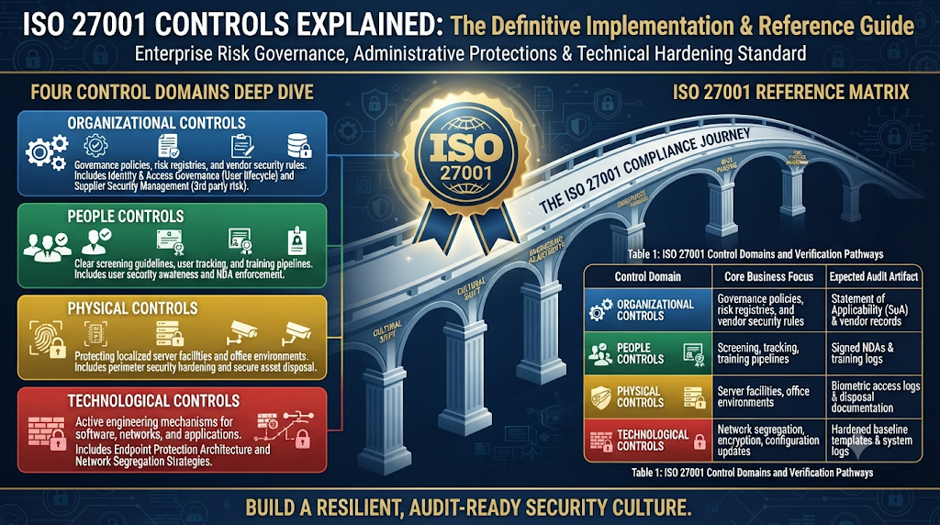
Every control within the modernized framework falls into one of four key domains, each addressing a specific layer of an organization’s defense perimeter.
3.1 Organizational Controls
Organizational safeguards establish the governance, policies, and procedural frameworks required to manage corporate risk over time. These parameters outline how data is classified, who retains administrative accountability, and how operations behave during a breach.
- Identity and Access Governance: Mandates strict rules governing the lifecycle of user profiles, ensuring that access privileges match current business needs.
- Supplier Security Management: Forces organizations to monitor the risk profiles of third-party vendors, SaaS tools, and external contractors who process corporate data streams.
- Perimeter Security Hardening: Deploys biometric locks, alarms, and surveillance monitoring systems around high-value facilities.
Asset Protection Rules: Establishes clear desk policies and device encryption requirements to protect corporate laptops outside the office environment.
3.2 Technological Controls
Technological controls provide the active engineering mechanisms needed to protect software networks, databases, and application pipelines from malicious access.
- Endpoint Protection Architecture: Mandates central endpoint software configuration management to stop malware and track suspicious process lifecycles.
Network Segregation Strategies: Groups internal subnets logically to isolate high value payment card repositories from public-facing employee interfaces.
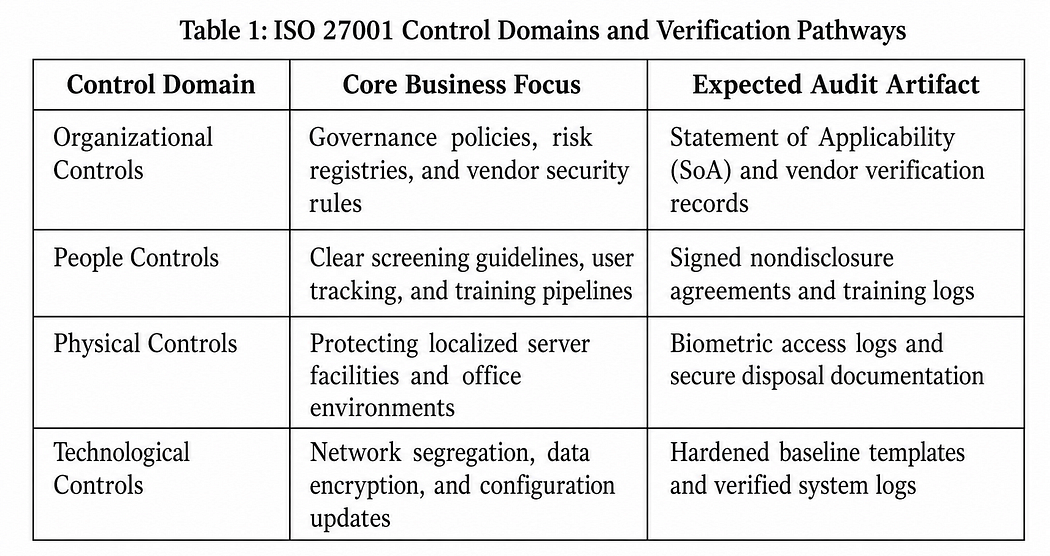
4. ISO 27001 Reference Matrix
Review this comprehensive control index to align your technical deployment roadmap with international audit requirements:
5. Correlating Compliance Controls with Validation Engineering
Implementing these 93 controls requires more than just drafting policy handbooks. Organizations must continuously test their active controls to ensure they function properly against real-world threat actors. Reviewing a detailed ISO 27001 Certification: Complete Implementation Guide helps administrative teams scope programmatic manual testing alongside continuous surveillance pipelines.
Furthermore, defensive scripts must be tuned to look for predictable software bugs. Training your engineers to identify the top security vulnerabilities found during VAPT stops threat actors from exploiting broken access control or unpatched cloud variables to bypass active monitoring blocks.
To ensure your technical environments match validated global standards, align operational processes with a recognized penetration testing guide and up-to-date CISA Cybersecurity Standards. Executing a routine, targeted network security audit eliminates the logging clutter caused by system misconfigurations, allowing your parsing engine to highlight legitimate alerts.
Ultimately, feeding an optimized cybersecurity assessment pipeline into a long-term vulnerability management blueprint guarantees that your monitoring choice remains resilient and fully compliant year-round.
6. Conclusion
The updated ISO 27001 control catalog provides organizations with a robust framework to balance organizational governance, staff responsibilities, facility defenses, and network configurations. True protection requires treating these guidelines as a continuous operational loop rather than a static compliance exercise. By implementing and validating these technical parameters, modern businesses can protect their intellectual capital and maintain operational resilience.
7. Optimize Your Compliance Posture
Safeguard your corporate boundaries with the right operational framework. Contact our certified technical compliance experts today to schedule a comprehensive evaluation of your environment and design an controls roadmap.



























Sign in to leave a comment.