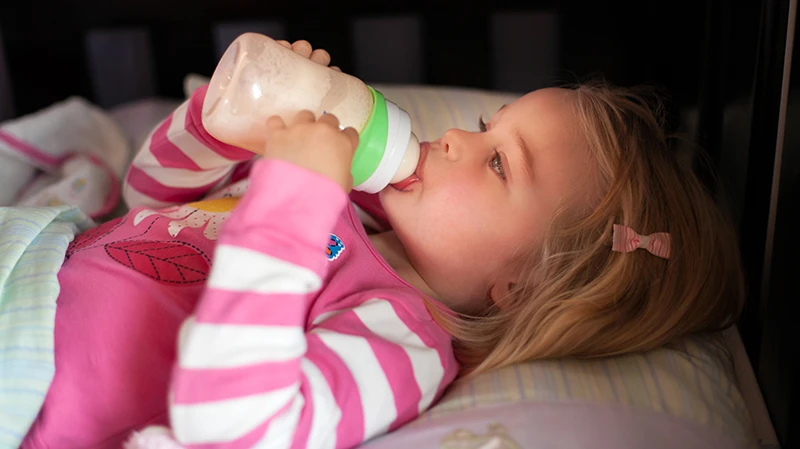

Babies, from the very first day of their life, get habituated to drinking milk – breastmilk to start with. However, 6 months down the line, sometimes, the new mothers combine breastfeeding with bottle-feeding.
Yes! To not make the babies become completely dependent on the mother’s milk, the new mothers, either punch their milk in the bottle or try to fill up the bottle with formula milk (a nutritious alternative to breastmilk, which contains some vitamins and nutrient supplements, to fulfill the babies’ requirements).
However, the fact remains that, just the way it’s not that easy for mothers to wean their baby off the breasts and make her bottle-feed, once the babies get habituated with bottle-feeding, they hardly want to give up on the bottles, quite easily.
In fact, many infants continue to drink milk from the bottles, long after their recommended 12 months of age.
Therefore, to help the babies develop healthily and be mature, just like the other kids in the block, it’s important for the babies to stop bottle-feeding completely.
But the question is, why and how?
Read on to find out:
Let’s the first question.
Why should the babies need to say a “No” bottle-feeding?
Babies learn through a lot of repetitions, around their developmental months. In fact, once they learn how to drink their favorite milk from their bottles, they start loving it, develop a sense of attachment with it, and ultimately don’t want to let go of the bottle, even after they are done with their feeding. Not just that! Few health-related factors are also involved, which makes it necessary to wean the babies off the bottle including:
Increases the chances of ear infection in babies
During the early stages of bottle-feeding, even though many infants must have learned to sit up, they still tend to lie down on their back and feed on the bottle in that position. And according to the doctors, feeding continuously in this position tends to increase the chances of infections in babies’ ears.
Boost babies’ teeth decay
Some babies have the habit of sticking to the bottle, even after they are done with their fill. They may or may not suck on it, but the feeling of the nipples of the bottle in their mouth makes them feel comfortable. However, tiny puddles of milk on the nipples of the bottle keep reaching their mouth comes in contact with the teeth of the baby, and the lactose (a type of sugar) causes the babies’ teeth to decay.
Makes babies obese
Since bottles cannot regulate the amount of milk the babies drink, they tend to drink a lot more than is actually necessary, thus making them overeat and end up growing obese. Research, in fact, has it that, babies who are 2 years old and tend to feed on the bottle are comparatively more obese than the others.
Develop aversion towards solid food
Babies are given solid food once they are 6 months old. In fact, by the time they are 7 or 8 months old, mothers can experiment with a variety of food. But, due to the addiction to the bottle, babies might feel an aversion to trying solid food.
Being aware of all the reasons for not being able to wean the babies off the bottle, there are a few ways which can help the mothers to wean the babies.
Ways to wean the babies of the bottle?
Try to introduce a sipper or a spoon slowly:
It is either necessary to understand the babies’ reaction to the changes. Or else, while the mothers introduce the babies to the sippy cups, they can completely put the babies off the bottle and bear their crankiness. Moreover, the babies who are below or above 1 year, giving less amount of milk in the cup they are introduced to and serving water in the same cup, one feed at a time, will surely be a suitable way out.
When the babies can sit and interact
Yes! Once the babies are prepared to sit in a chair, and are ready to interact with the mothers, offering them some breast milk or formula milk out of the cups at regular mealtimes, is a fairly good idea. This will help the babies eat their food at the table just like their parents. Staying consistent is the way
It may so happen that, at the first instance the babies might refuse and push the spoon or cup away. Keeping the bottle hidden and out of their sight is a good option, to tackle this behavior in the babies. Hiding the bottle might make the babies yearn less for it. And, the mothers can arrange some tempting cups with lovely straws and sipping options for the babies. Time it well For a baby, her bottle is a very big comfort. So, it’s better not to introduce the babies to a cup or spoon when they are sick, tired or hungry, or had a stressful routine.
To Conclude
The process of weaning can take along. Sometimes weeks or even months. So, all the mothers on the block are patient and keep rewarding your baby with some claps, hugs, more playtime, and an even an extra bedtime story after each feed or sip. However, if your baby is 2 years old and the transition is still taking longer, take the help of the pediatrician.





























Sign in to leave a comment.