
Every real estate leader has faced this moment. You've invested years into planning a township. The master plan is solid, the amenities are differentiated, and the pricing is competitive. But when a buyer walks onto the site, there's nothing to validate that vision. Just land, ambiguity, and questions that cannot be answered visually.
At that point, marketing doesn't fail — the experience does.
This was exactly the situation for Ma Sarada as they entered Bengaluru with House of Sapiens. An established developer from Kolkata stepping into a new market with a large-scale township, but without any physical progress on site. The challenge wasn't awareness or positioning. It was how to compress years of future construction into a single, convincing real-time experience that could drive confident decisions.
The Zero-Construction Reality
Ma Sarada isn't just another residential project. It's a township spanning 205,907 square feet with three residential towers, a four-floor clubhouse acting as a lifestyle anchor, and more than 40 amenities across indoor and outdoor environments. Tower A stands at 17 floors. Tower B rises to 19 floors with dual wings.
At launch, none of this existed physically.
The site sat 90 minutes from Bangalore city center, surrounded by open farmland. Construction status: zero excavation. Not a single pillar standing.
This created a layered business problem that most developers face but few talk about openly:
- Buyers couldn't understand scale or density from flat renderings
- Location concerns remained abstract without visual proof
- Sales teams had to rely on explanation rather than demonstration
- Decision timelines stretched because clarity required imagination
For leadership, this is where sales velocity begins to drop. Not because of demand, but because of uncertainty.
What 3D Visualization for Real Estate Actually Solves
The solution required a fundamental shift in thinking. Instead of improving how the project was explained, the goal was to eliminate the need for explanation entirely.
The mandate was clear: create a real-time digital twin that behaves like a built township, allowing buyers to explore the project in a fully immersive 3D environment.
This meant something specific:
- Buyers should navigate the entire project freely, not follow a scripted path
- Amenities should be experienced in context, not shown in isolation
- Units should be understood spatially, not through floor plans
- Landscape and surroundings should feel complete, not like green patches
The digital twin wasn't positioned as a supporting tool — it became the primary sales environment.
Engineering Real-World Performance
Building a township-scale visualization is straightforward. Making it perform smoothly in real-time during sales presentations is something else entirely.
The Ma Sarada digital twin was built with 6,688,395 polygons representing full architectural and environmental detail, plus 6,137,328 vertices ensuring geometric precision. This level of fidelity was necessary to achieve spatial clarity, but the real challenge was ensuring this data could run smoothly in an experience centre setting.
The system had to deliver instant responsiveness during buyer interaction, stable frame rates across long sales sessions, seamless navigation across large environments, and consistent visual quality across all touchpoints. This required a tightly engineered rendering stack built on Unreal Engine 5.7.
Handling vegetation at scale
The most demanding layer in the entire system was the landscape. Foliage introduces disproportionate computational load. A building might average around 10,000 polygons, but a single tree can exceed 300,000 polygons. Scaling vegetation across a township multiplies this complexity significantly.
Voxelisation was implemented as a targeted solution. Complex tree geometry was converted into simplified volumetric representations, reducing rendering cost per asset while maintaining visual presence. This allowed vegetation density to increase without increasing computational load — critical when you're selling lifestyle through landscape.
Context beyond the project boundary
The project location presented another challenge: an open area with few surrounding structures. To create believable context, the environment was extended significantly using procedural systems. Terrain and environmental context extended up to 10 to 15 kilometres. Road networks and spatial references created depth and continuity. This ensured the project felt integrated into a larger ecosystem rather than isolated in farmland.
From Technology to Experience
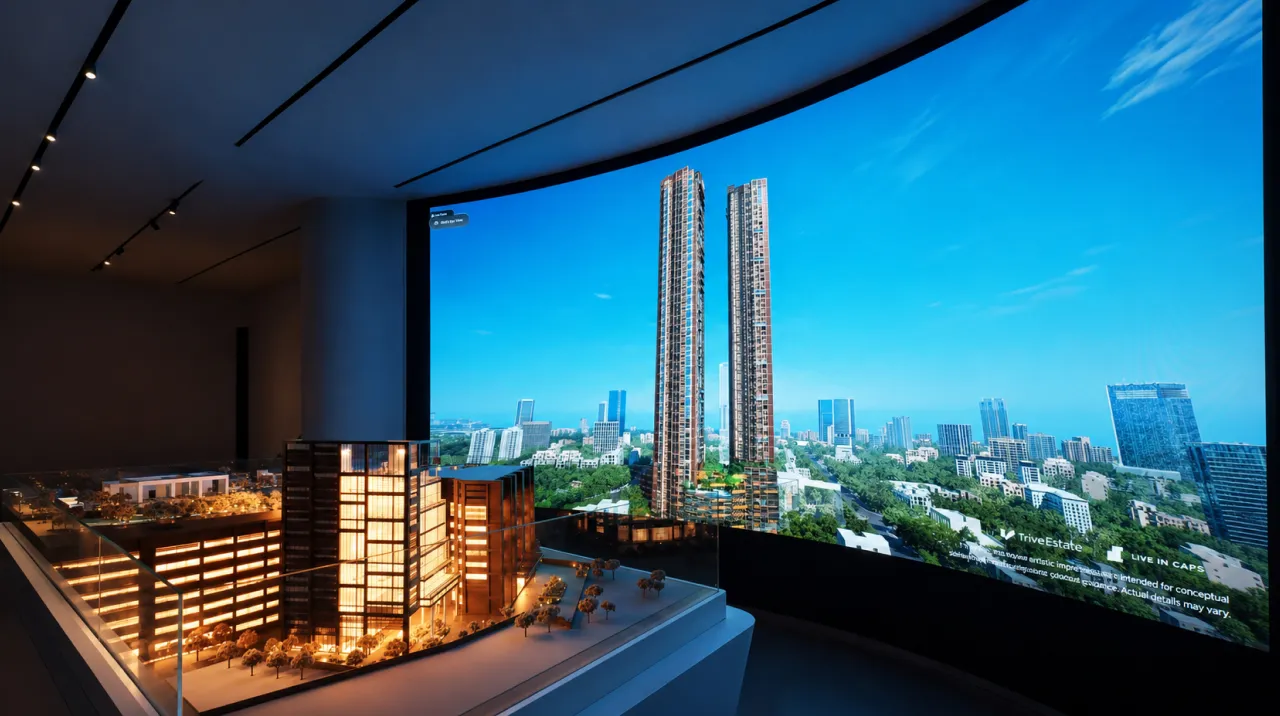
The digital twin was deployed inside a carefully designed experience centre, not handed to sales teams as software.
First impact zone
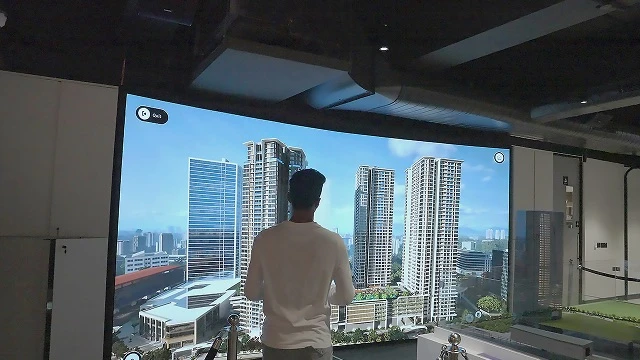
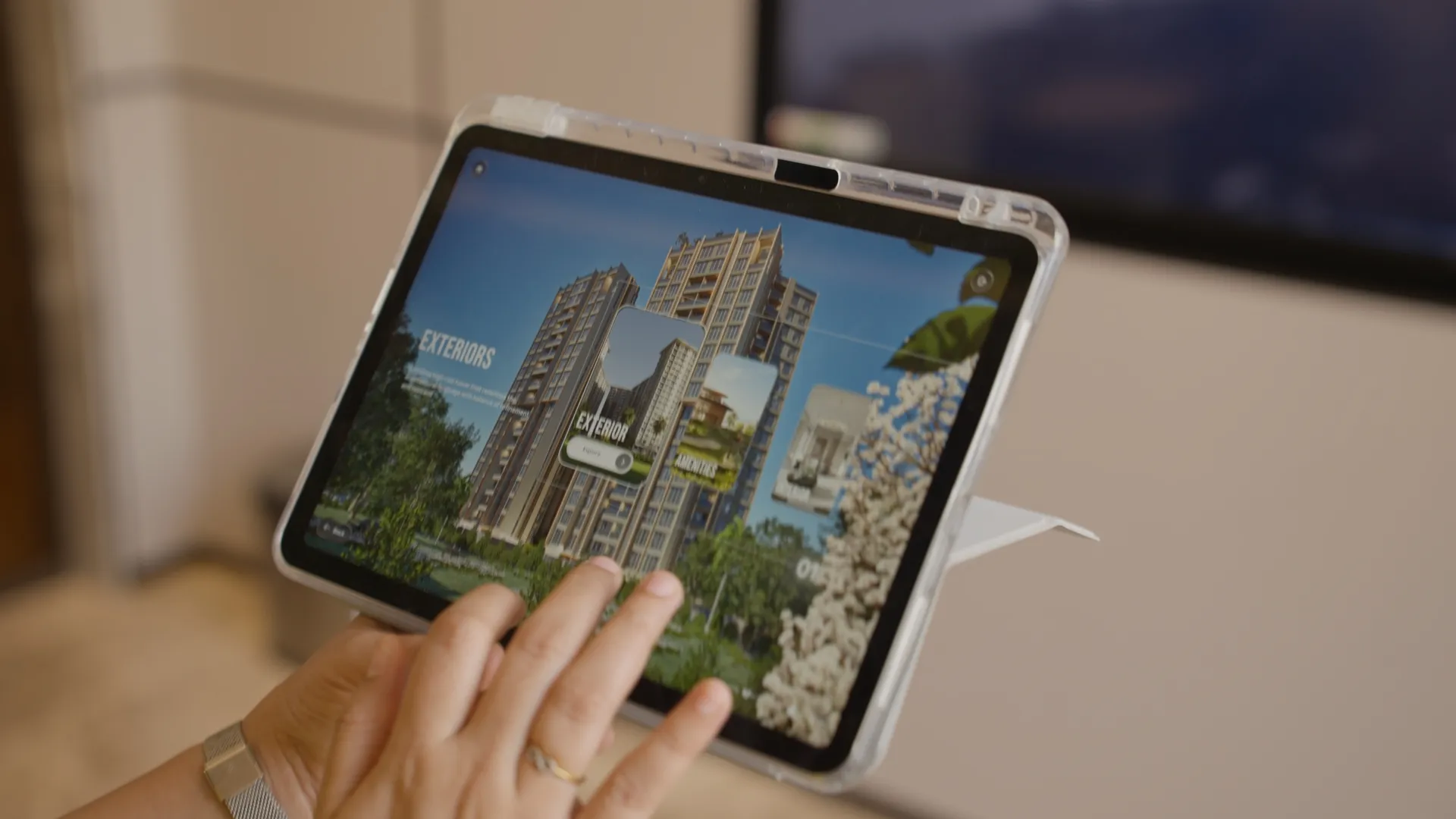
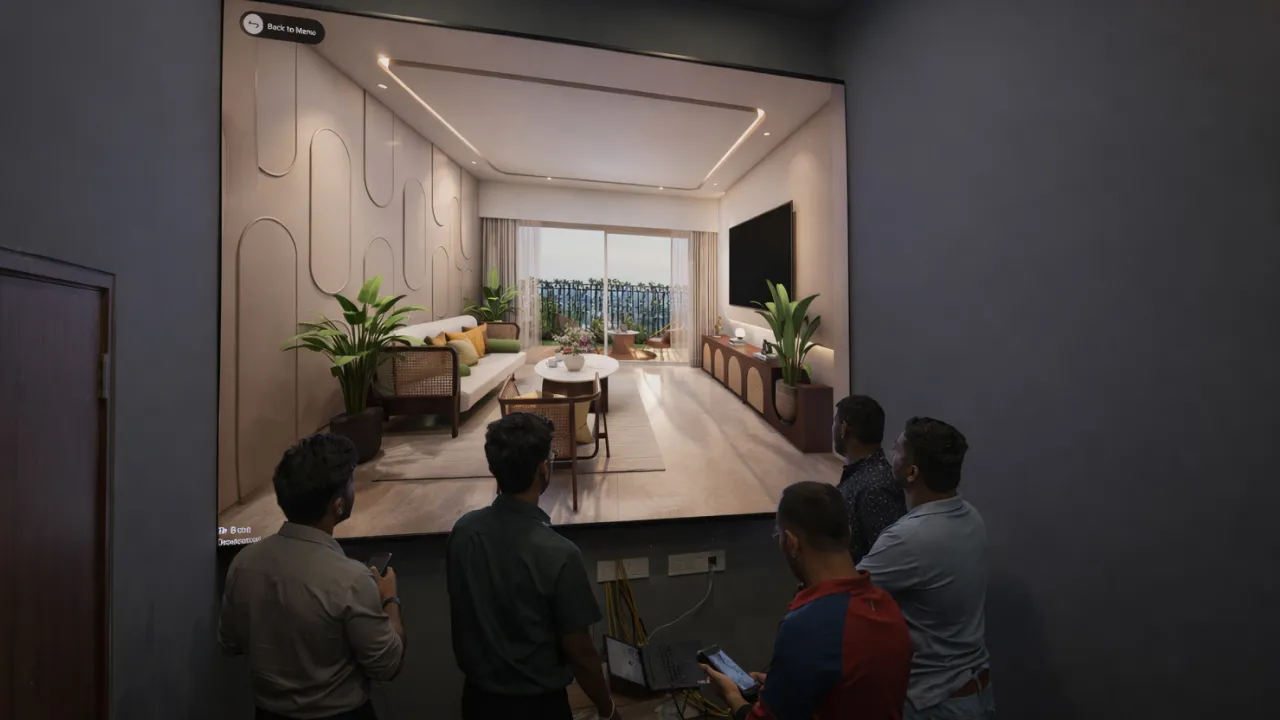
An AV room introduced the project and established context. A 10-foot by 8-foot LED screen with a pixel pitch of 1.8 delivered high-clarity visuals. iPad integration enabled seamless, interactive presentations before deeper exploration began.
Sales pods for real-time exploration
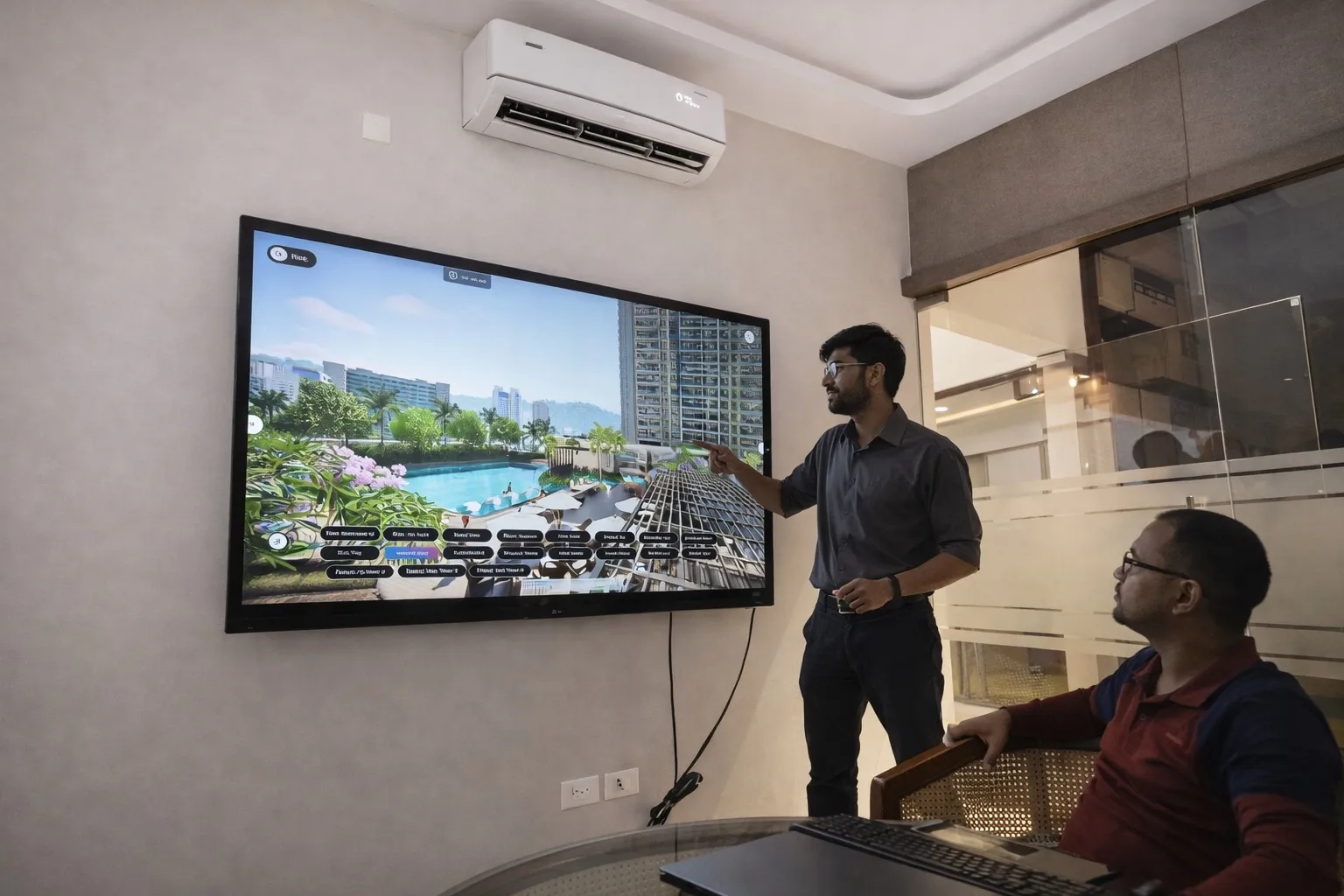
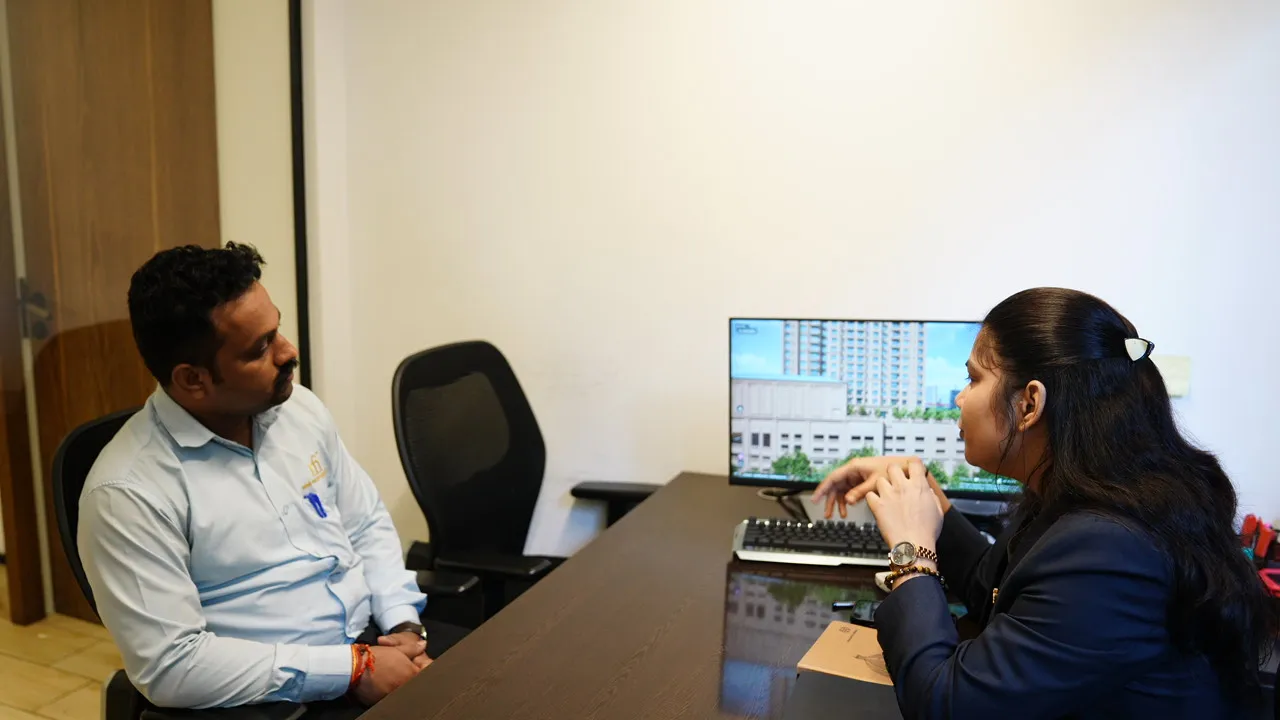
Three dedicated sales pods, each equipped with a 65-inch LG touchscreen display, enabled direct navigation of the digital twin. Sales teams could respond instantly to buyer queries. Conversations shifted from explanation to exploration.
Advanced photo mode
This feature extended the usability of the digital twin significantly. Buyers could adjust lighting conditions — daytime versus evening scenarios — control visual parameters, and capture screenshots directly from the environment. Sales teams provided immediate visual answers to specific queries instead of promising follow-up emails.
Aligning digital and physical
The experience centre included two physical test flats — a two-bedroom unit and a three-bedroom unit. The interiors inside the digital twin were designed to match these exactly. This ensured consistency between what buyers saw digitally and physically, reduced the gap between expectation and reality, and created higher confidence during decision-making.
What Actually Happened
The shift from static presentation to interactive experience had direct impact:
- Buyers could understand the project without relying on imagination
- Queries were resolved visually and instantly
- Sales conversations became more efficient and focused
- Decision timelines shortened due to increased clarity
The digital twin saw 100% adoption across five sales executives, who used it for every single walk-in. It became a core part of the sales process, not an optional tool.
In one instance, a sales executive closed four clients in four consecutive meetings over two days — demonstrating the platform's effectiveness in driving conversions even with zero on-site development.
The Hard Truth About Early-Stage Sales
For C-suite teams, the takeaway is clear. Demand doesn't limit early-stage projects. They're limited by clarity.
A real-time 3D visualization real estate platform addresses this by making the unbuilt project explorable, reducing cognitive load for buyers, creating transparency across all aspects of development, and strengthening trust during the decision-making process. However, such an approach requires engineering depth, not just visual output.
House of Sapiens demonstrates how experience can replace uncertainty at the earliest stage of a project. When buyers can navigate, explore, and understand a township before construction begins, the conversation shifts from possibility to confidence.
That shift is what accelerates sales.
Ready to transform how your next project is experienced and sold? At V-Estate, we engineer real-time digital environments that convert complexity into clarity and interaction into decisions. From concept through deployment, we build visualization platforms that drive confident decisions before construction begins.
Your project deserves to be experienced, not explained. Let's build that clarity together.























Sign in to leave a comment.