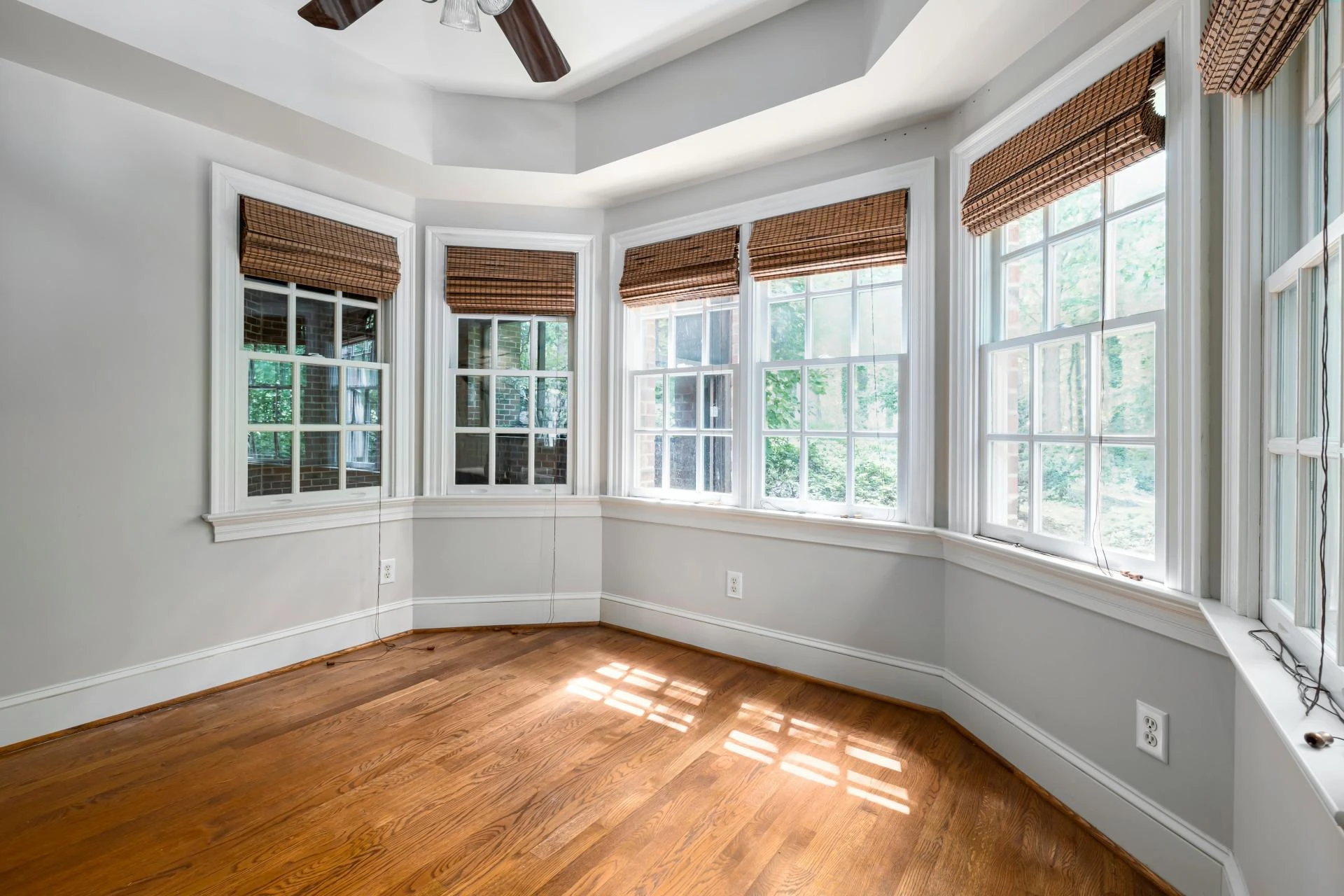

Windows let sunlight and air in, so they’re important for ensuring living spaces have natural light and ventilation. However, left untreated, windows can let in more light than you want as well as curious gazes, noise, and pollution.
Thus, windows are often covered. Window treatments serve different purposes and provide varying levels of light, noise, and privacy control. This is why default window treatments vary depending on location (also season) and why it’s typical to see drawn heavy curtains in Dubai and mid-sheer curtains in places like Copenhagen.
There are many types of window treatments, but you can classify them into drapes/curtains, blinds, shades, and shutters.
Drapes and Curtains
People often use the terms “drapes” and “curtains” interchangeably, and that’s okay. Both are window coverings made of fabric panels.
They can’t work any simpler. You hang them through a rod or hook them onto tracks on the wall so the fabric drapes over the window. Do you want to let the light and breezes in? Pull them back. Do you want to block the light, noise, or heat from outside or enhance your privacy? You draw them closed.
For the sake of precision, however, it should be made clear that curtains and drapes are similar but not identical.
Curtains are shorter than drapes. They’re cut to fit the height of windows, with maybe a few centimeters of allowance on the bottom.
Drapes are longer than curtains, typically covering the entire wall instead of just the window. Thus, they may hang from near the ceiling and fall into a puddle on the floor. They’re usually (but not always) thicker and heavier than curtains.
In other words, the primary difference between drapes and curtains is the length and fit. If the fabric panels are cut to fit the window, they’re curtains. If they hang from the top of the wall to the floor, they’re drapes. While drapes are often made with heavier and thicker fabrics, this is not always the case. Thus, there can be blackout curtains as well as semi-sheer drapes.
Blinds
Blinds are window treatments of wood, plastic, or metal slats stacked horizontally or vertically on a frame. They are usually equipped with a lift cord. When pulled, it lifts the slats to pull the blinds open or drops them down to pull them shut. Meanwhile, a rod or wand may control the angle of the slats. You can turn the wand to change the angle of the slats to allow as much or as little light as you want.
Blinds give you a more granular control over light and privacy than curtains and drapes. If you want maximum light, pull up the blinds. For minimum light, pull it down shut. You can also leave your blinds completely down but still let in some (or a lot of) natural light and make the interior space slightly (or considerably) visible from the outside by partially tilting open the slats.
Blinds have varying innate light-blocking abilities. Some, especially lighter-colored ones made of thinner materials, still let light in, but soften and filter it in the process. There are also blinds that come with a blackout lining to completely block natural light.
Shades
Shades are window treatments made of a solid sheet of fabric. There are non-fabric shades. For instance, natural woven shades are made of materials like wood, bamboo, grass, and rattan. There are also multilayered shades.
Zebra shades, for instance, are multilayered. They’re composed of two overlaying layers of fabric, which have alternating translucent and opaque bands. To block the most amount of light and ensure maximum privacy, you can pull the shade up (or down) until only the opaque bands overlap and all translucent bands are hidden from sight.
The typical shade can be pulled down to provide maximum light and privacy control, or it can be pulled up to reveal the entire window and let in as much light as possible. Shades may also be drawn partially to provide partial coverage.
Shutters
Shutters are architectural elements, not mere window treatments. First, they are permanent fixtures, although they may be removed if you want. They are tailored to fit. Arched windows will often get arched shutters, too.
They look similar to regular blinds in that they have louvered slats. Just like you can tilt the slats on blinds to filter and direct the natural light coming into your home, you can also tilt the louvers on shutters to control the amount and direction of light they allow through.
However, with blinds, you can put the slats completely out of the way to uncover the window by pulling the lift cord or pushing up the rail mechanism. You can’t do the same with shutters. The louvers on a shutter are affixed to a hard frame. They can be tilted open and closed, but they remain in place.
That said, shutters can be hinged and installed on a track so they can fold out of the way. Some shutters operate like casement windows, completely opening inward or outward on a hinged side. There are also sliding shutters, with individual panels that slide and stack, one over another. Finally, there are metal shutters, typically external window treatments, that roll down on side tracks to provide full and complete coverage.
Choose Your Window Treatment
Window treatments allow nuanced control of light, privacy, and ventilation. Choose among curtains/drapes, blinds, shades, and shutters. Do you live in Dubai? Consider getting remote control curtains in the UAE for superior light and heat-blocking, as well as maximum convenience.




























Sign in to leave a comment.