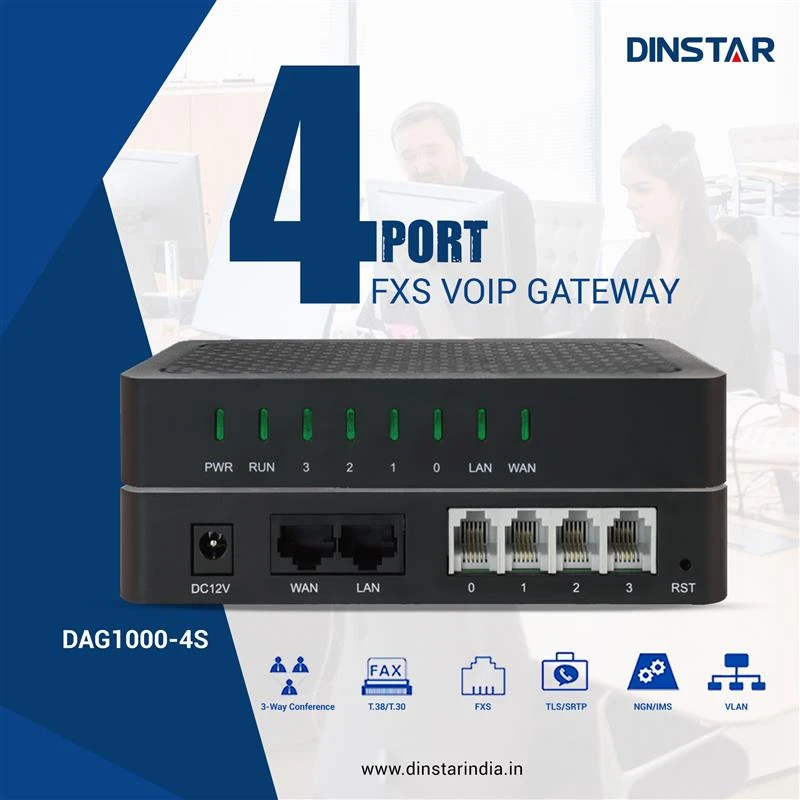

In today's fast-paced business environment, reliable and cost-effective communication infrastructure is a necessity. Whether you're running a small office, a startup, or a branch of a larger enterprise, managing analog telephone systems in the era of VoIP can be challenging without the right tools. This is where the 4 Port FXS Gateway becomes indispensable. Offering compatibility between legacy analog phones and modern VoIP systems, a 4 Port FXS Gateway can streamline voice communication while keeping costs under control.
In this blog, we’ll explore what a 4 Port FXS Gateway is, how it works, its benefits, key features, and ideal use cases. If you’re looking to bridge the gap between analog and IP-based telephony, this guide will help you make an informed decision.
What Is a 4 Port FXS Gateway?
A 4 Port FXS Gateway is a compact device that connects analog telephone devices, such as traditional desk phones and fax machines, to a VoIP (Voice over IP) network. “FXS” stands for Foreign Exchange Subscriber, which refers to the port that delivers analog line-level signals to the end user’s device.
Each FXS port allows one analog device to connect to the VoIP system. A 4 Port FXS Gateway, therefore, supports up to four analog devices simultaneously. It acts as a bridge that converts voice signals from analog to digital and vice versa, allowing analog phones to work over an IP-based PBX system or SIP trunk.
Key Features of a 4 Port FXS Gateway
- SIP Protocol Support
- Most 4 Port FXS Gateways support Session Initiation Protocol (SIP), ensuring broad compatibility with IP PBX systems, SIP servers, and hosted VoIP services.
- Web-Based Configuration
- An intuitive web interface allows easy configuration and monitoring. Admins can update firmware, manage call routing, and monitor status remotely.
- Echo Cancellation and Voice Quality Enhancement
- Built-in G.168 echo cancellation, jitter buffer, and voice compression codecs (G.711, G.729, G.723.1) ensure high-quality audio performance.
- Flexible Deployment
- With its compact form factor, a 4 Port FXS Gateway can be wall-mounted or rack-mounted, making it suitable for SOHOs (Small Office/Home Office) and remote branches.
- Failover and Redundancy
- Some models include SIP failover and automatic call rerouting in case of network failure, ensuring uninterrupted communication.
- T.38 Fax Support
- T.38 protocol support allows reliable fax transmissions over IP networks, crucial for businesses that still rely on fax machines.
Benefits of Using a 4 Port FXS Gateway
- Cost Savings
- Businesses can continue using existing analog phones, avoiding the expense of upgrading to IP phones. This is especially useful in remote sites where budget constraints are a concern.
- Simplified Migration to VoIP
- The 4 Port FXS Gateway allows a phased migration to VoIP by integrating legacy analog devices into the IP infrastructure.
- Centralized Communication Management
- All voice traffic can be managed from a single VoIP platform, simplifying administration and enhancing control over communication systems.
- Enhanced Compatibility
- These gateways work well with major VoIP platforms and SIP-based systems, reducing the risk of compatibility issues.
- Scalability
- As your business grows, you can easily expand by adding more gateways or transitioning fully to IP-based endpoints.
Top Use Cases for a 4 Port FXS Gateway
- Small Offices and Startups
- Ideal for businesses that want VoIP functionality without replacing all analog phones.
- Hotels and Hospitality
- Many hotels use analog phones in guest rooms. A 4 Port FXS Gateway enables these to connect with a modern VoIP system for streamlined management.
- Educational Institutions
- Schools and colleges often have analog phones in administrative departments. These can be integrated into a VoIP system without infrastructure changes.
- Remote Branches
- Companies with satellite offices can deploy a 4 Port FXS Gateway to connect local analog phones to the central VoIP PBX, ensuring unified communication across locations.
- Healthcare Facilities
- In hospitals and clinics, legacy analog devices (e.g., emergency lines, nurse stations) can be integrated with IP-based systems for efficient communication.
Choosing the Right 4 Port FXS Gateway: What to Look For
When selecting a 4 Port FXS Gateway for your business, consider the following:
- Compatibility: Ensure the gateway supports your VoIP platform and SIP version.
- Voice Quality: Look for features like echo cancellation, jitter buffer, and QoS controls.
- Management Interface: A user-friendly interface simplifies installation and maintenance.
- Security Features: TLS/SRTP encryption, IP filtering, and VPN support help protect your communication network.
- Warranty and Support: Choose a reputable brand that offers technical support and firmware updates.
Why Dinstar’s 4 Port FXS Gateway is a Smart Choice
Dinstar offers a reliable line of FXS gateways tailored for businesses of all sizes. The Dinstar 4 Port FXS Gateway stands out for its robust design, high compatibility, and excellent voice quality. Key features include:
- Support for multiple SIP accounts
- Wide codec support (G.711, G.729A/B, G.723.1)
- Secure SIP with TLS and SRTP
- Comprehensive web interface and remote management
- Low power consumption and efficient performance
Dinstar gateways are widely used in government offices, call centers, financial institutions, and enterprise branches. The flexibility of their 4 Port FXS model makes it a preferred solution for cost-effective VoIP deployments.
Conclusion
A 4 Port FXS Gateway is more than just a transitional device between analog and digital communication—it’s a strategic tool for modernizing your business telephony while maximizing existing investments. Whether you are setting up a new office or upgrading your current system, this device ensures seamless integration, reliable performance, and long-term savings.




























Sign in to leave a comment.