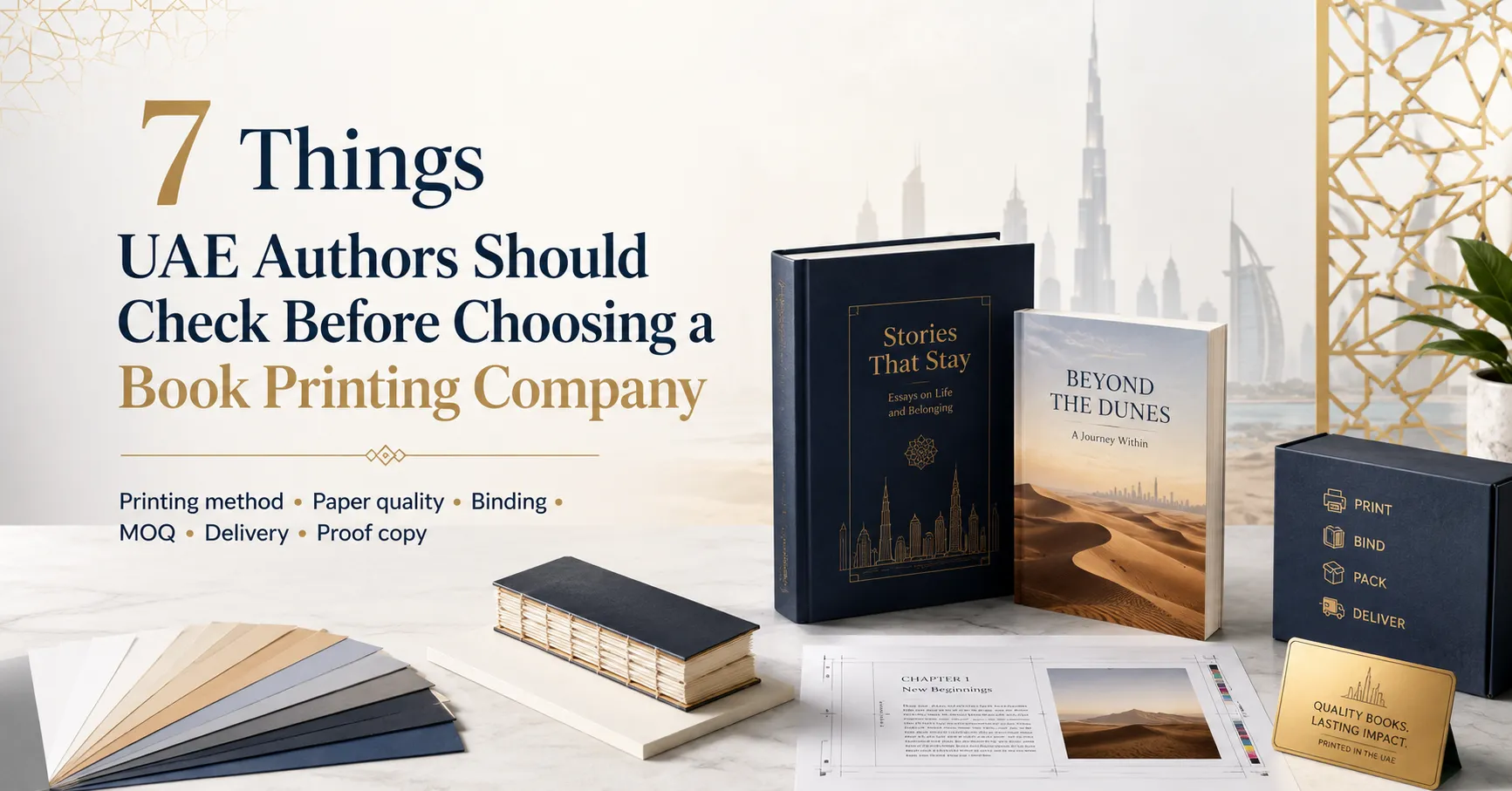

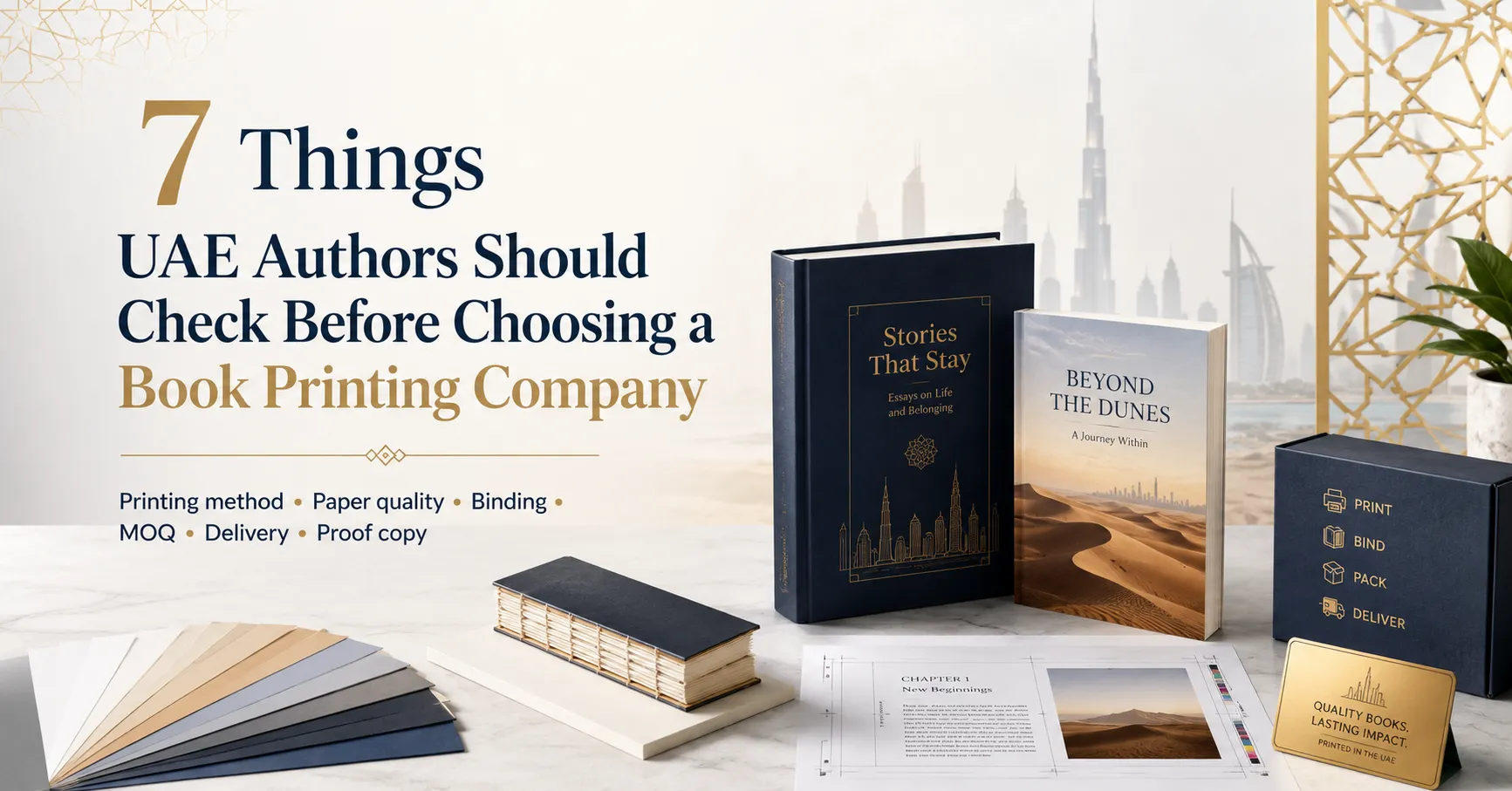
Finishing a manuscript is a major achievement, but turning that manuscript into a professionally printed book requires another set of important decisions. The printing company you choose can affect your book’s appearance, durability, production cost, and delivery schedule.
This is especially important for self-published authors who may be printing a book for the first time. A low quotation may appear attractive, but the final result can become expensive if the pages, colours, cover, or binding do not meet your expectations.
Before choosing a book printing company in the UAE, examine these seven areas carefully.
1. Ask Which Printing Method Will Be Used
The two primary methods used for book production are digital printing and offset printing. Neither method is automatically better; the right choice depends mainly on your quantity, budget, timeline, and quality requirements.
Digital printing is generally suitable for small print runs. It requires less setup and allows authors to order a limited number of books without committing to hundreds of copies. This can be useful when printing advance reader copies, testing market demand, or producing books for a private event.
Offset printing normally becomes more cost-effective when printing larger quantities. It requires more preparation, but its per-copy cost may decrease significantly as the order volume increases.
Ask the printer:
- Which method is recommended for my quantity?
- Will colour consistency remain the same across every copy?
- What is the cost per book at different quantities?
- Can I reorder a small number later?
A trustworthy printer should explain why a specific method is appropriate rather than simply choosing the option that is easiest for production.
2. Compare Paper Quality, Not Just Paper Thickness
Paper influences how a book looks, feels, opens, and reads. Authors should not choose paper based only on its GSM, which refers to the paper’s weight.
A text-heavy novel may work well on lightweight, uncoated cream or white paper. A children’s book, photography book, or illustrated guide may require thicker coated stock that reproduces colours more effectively.
When discussing paper, consider:
- Paper colour
- Coated or uncoated finish
- Opacity and show-through
- Texture
- Weight
- Suitability for colour or black-and-white printing
Request physical paper samples whenever possible. A description such as “premium paper” is subjective, while an actual sample lets you assess the texture, brightness, thickness, and print quality yourself.
The right paper should support the purpose of the book. Using glossy stock for a long novel, for example, may create glare and make extended reading less comfortable.
3. Decide Between Hardcover and Paperback Carefully
Hardcover and paperback books serve different audiences and budgets.
Paperbacks are normally lighter, more affordable, and easier to transport. They are commonly selected for novels, guides, workbooks, educational books, and first editions from independent authors.
Hardcovers provide greater durability and a more premium appearance. They may be better suited to coffee-table books, commemorative publications, children’s books, corporate books, photography collections, and gift editions.
However, authors should compare more than the initial price. Ask how the cover will be constructed, which board thickness will be used, whether endpapers are included, and what protective finish will be applied.
For paperbacks, check the cover thickness and whether matte or gloss lamination is included. A cover that is too thin may curl, crease, or become damaged quickly.
A company offering custom book printing in the UAE should be able to provide several format, paper, cover, and finishing combinations instead of forcing every project into the same specification.
4. Choose a Binding That Matches the Book’s Purpose
Binding affects durability, usability, appearance, and cost. The most appropriate choice depends on the page count and how readers will use the book.
Perfect binding is widely used for paperback novels, manuals, and business books. The pages are secured at the spine and attached to a wraparound cover, producing a clean and professional finish.
Case binding is used for hardcover books and provides greater strength and longevity.
Saddle stitching uses staples through the fold and is suitable for short booklets, catalogues, programmes, and publications with relatively few pages.
Spiral or wire binding allows a publication to lie flat, making it useful for workbooks, training manuals, cookbooks, notebooks, and instructional materials.
Do not select binding based on appearance alone. Ask the printer whether your page count and paper thickness are compatible with the proposed method. A binding style that works for a 40-page booklet may not be suitable for a 300-page novel.
5. Confirm the Minimum Quantity and Price Breaks
Some printing companies specialise in bulk orders, while others accept short runs or even single-copy projects.
Before requesting a quotation, estimate how many books you realistically need. Consider pre-orders, launch events, direct sales, retailer requirements, promotional copies, and storage space.
Request quotations for several quantities, such as 25, 50, 100, 250, and 500 copies. This will show how the unit price changes as the volume increases.
The cheapest cost per book does not always produce the best overall decision. Ordering 1,000 copies may reduce the unit price, but it can create storage and cash-flow problems if the books sell slowly.
Your quotation should clearly identify what is included, such as:
For a broader understanding of the variables that influence pricing, review a detailed guide to book printing cost in the UAE before comparing quotations.
6. Verify Turnaround Time and Delivery Arrangements
A production estimate should cover the entire process, not only the time spent printing.
Ask the company how long it will take to inspect your files, prepare the proof, receive your approval, print the books, complete the binding, package the order, and deliver it.
Turnaround can be affected by:
- Order quantity
- Paper availability
- Custom finishes
- Hardcover production
- Proof corrections
- Delivery destination
- Seasonal demand
Authors preparing for a launch, exhibition, school event, conference, or book fair should build additional time into their schedule. Avoid approving files at the last moment based on an optimistic verbal promise.
Obtain the production and delivery dates in writing. Also confirm whether delivery is available to your location in Dubai, Abu Dhabi, Sharjah, Ajman, or another emirate and whether shipping is included in the quotation.
7. Never Skip the Proof Copy and Quality-Control Process
A proof copy is one of the most important safeguards in book printing.
Reading a PDF on a screen is not the same as examining a physical book. A printed proof can reveal problems involving margins, page order, image resolution, colour reproduction, trimming, cover alignment, spine width, font size, and binding.
When checking the proof, inspect:
- Front and back covers
- Spine alignment
- Copyright and title pages
- Page numbering
- Chapter openings
- Image quality
- Text near the trim or binding
- Blank pages
- Colour accuracy
- Overall binding strength
Ask whether the proof will use the same paper, dimensions, printing method, and finishing planned for the final production run. A proof produced under different specifications may not accurately represent the finished books.
After approving the proof, keep a written record of the accepted version. The final order should be checked against that approved copy before dispatch.
Final Checklist for UAE Authors
Before placing an order, make sure you can answer these questions:
- Which printing method will be used?
- Have I examined the actual paper?
- Is hardcover or paperback more appropriate?
- Is the binding suitable for the page count?
- What is the minimum order quantity?
- What does the complete quotation include?
- When will the books be delivered?
- Will I receive a physical proof?
- How will defects or damaged copies be handled?
Choosing a book printing company should not be based on price alone. A reliable provider will explain the production process, provide clear specifications, answer technical questions, and allow you to evaluate the book before the full quantity is printed.
Taking time to compare these details can prevent expensive reprints and help ensure that your finished book reflects the work you invested in writing it.
Frequently Asked Questions
What information should I send when requesting a book printing quote?
Provide the finished book size, page count, printing colour, paper preference, binding type, cover finish, required quantity, and delivery location. Supplying complete specifications makes quotations easier to compare.
Should a first-time author choose digital or offset printing?
Digital printing is usually more practical for a small initial quantity, while offset printing may offer a lower unit cost for larger orders. The decision should be based on quotations for your exact specifications.
Is a digital PDF proof enough?
A PDF proof can identify layout and text errors, but it cannot fully demonstrate paper feel, physical size, binding strength, trimming, or printed colour. A physical proof is safer before a substantial production run.
























Sign in to leave a comment.