

RRB NTPC Exam Syllabus: Detailed 2026 Breakdown & Strategy
This Indian Railways recruitment drive is one of the most competitive exams around the globe. With thousands of candidates competing for a limited number of post-technical and non-technical ones, the margin of error is nil. For serious applicants the success of their application depends less on the amount of time spent studying and more on what's done to study.
Knowing how to read the RRB NTPC Exam Syllabus is the initial step on this path. It provides a blueprint for preparation and helps distinguish between hard work and intelligent work. This guide gives a detailed outline of the curriculum and examination pattern's nuances, as well as an objective analysis of the impact of a structured approach to preparation on outcomes.
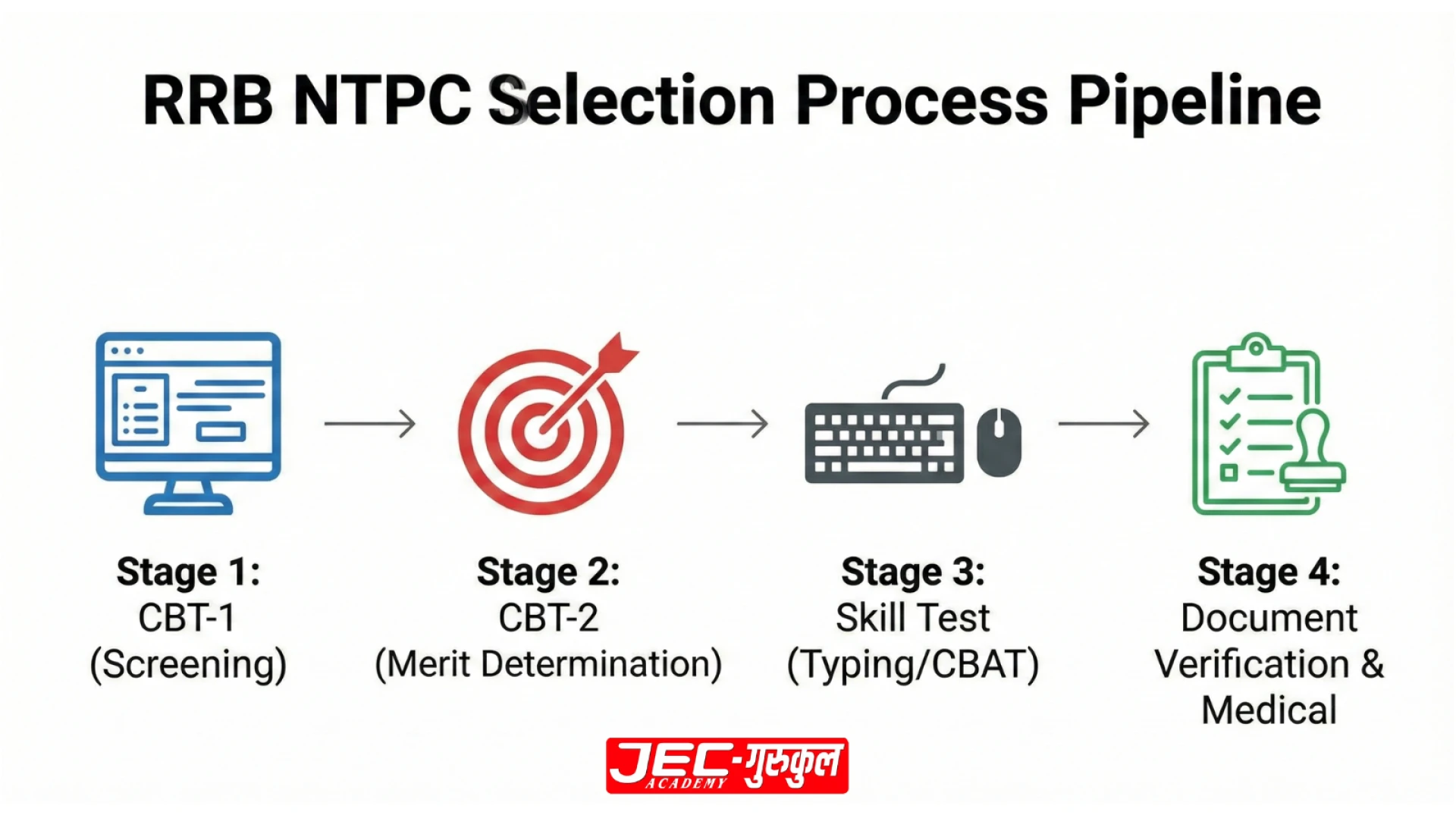
RRB NTPC Selection Process (4 Stages)
It is the Railway Recruitment Board (RRB) that uses a multi-tiered filtration system. As opposed to exams that are single-stage, the NTPC (Non-Technical Popular Categories) recruitment process is intended to measure reliability over a period of time.
- CBT-1 (Screening Round): This is a stage for filtering. The marks here do not generally count towards that final list of merits. However, getting the cut-off cleared is a must to move on.
- CBT-2 (Scoring Round): This is the most crucial stage. The difficulty levels increase significantly and these marks determine your ranking.
- Skills Test (post-specific) for roles such as the Station Master (CBAT) as well as Clerk (typing test).
- Verification and Medical: The last health check.
RRB Exam Pattern (CBT-1 vs. CBT-2)
The main difference between the two stages is the intensity.
Feature
CBT-1 (Screening)
CBT-2 (Merit)
Total Questions
100
120
Duration
90 Minutes
90 Minutes
Questions per Minute
1.1
1.33
Difficulty Level
Moderate
Moderate to Difficult
Positive Marking Both of the stages come with negative markings of 1/3rd for each wrong answer. This penalty mechanism was intended to penalize the act of guesswork. The accuracy, therefore, is more important than the number of attempts.
Complete RRB NTPC Syllabus Breakdown
This syllabus has three major sections. The most frequent mistake students make is to give the same weightage to all subjects. A more analytical approach demands focus on areas with high yields.
1. Mathematics (Quantitative Aptitude)
Mathematical standards are technically "high school level," but the problem is in the processing speed needed.
- Arithmetic (High Weightage): Time & Work, Time, Speed & Distance, Percentage, Profit & Loss, Simple & Compound Interest. These subjects form the basis of this paper.
- Advanced Maths (Moderate Weightage): Elementary Algebra, Geometry, Trigonometry, and Mensuration.
- Emerging Trends: Recent studies have revealed a greater attention to Data Interpretation (DI) and Elementary Statistics (mean, median, mode) that a lot of students skip.
2. General Intelligence and Reasoning
This section tests the logical capacity of the candidate. It is usually the highest-scoring section for candidates who have been well-prepared because the questions are controlled by specific rules, not extensive knowledge.
- Verbal Reasoning: Analogy, Coding-Decoding, Series (Number/Alphabet), Blood Relations, Syllogism.
- Analytical Reasoning: Venn Diagrams, Statement-Conclusion, Statement-Courses of Action, Decision Making.
- Critical Topics: Seating and Puzzles Questions about arrangements have become longer and more complex over the last few CBT-2 cycles.
3. General Awareness (GA)
It can be the most unstable portion in the RRB NTPC Exam Syllabus. It is the one with the highest individual importance in the CBT-2 (50 marks).
- The static GK includes history (modern India-focused), geography (Indian physical geography), polity (constitution & articles), and art & culture.
- General Science: General Science Chemistry and Biology until the 10th level CBSE level.
- Current Affairs: The events of the past 12 months with a special emphasis on science & technology, sports, awards, and Indian Railways changes.
Self-Study vs Coaching: Which is Better for RRB NTPC?
The most frequent debate among students is whether they should study on their own or seek out professional guidance. Both options have brought out top performers, but the decision is contingent on the student's base discipline and their foundation.
The Challenge of Self-Study
Self-study is flexible but is accompanied by some of the "Curator's Burden." Students must invest valuable time searching for the appropriate sources, confirming the authenticity of PDFs online, and making their own plan. In the absence of external accountability, consistency often diminishes after the first few months.
The Educational Environment
Learning environments that are structured focus on specific tactical and psychological demands:
- The syllabus: Institutions guarantee that syllabus-mandated subjects (like permutations or particular science theorems) are not left out.
- Speed Techniques Achieving the Time & Work problem in three minutes is simple, and solving it in 30 seconds is a challenge that requires particular Vedic Math or Ratio techniques that aren't often included in textbooks that are commonly used.
- In solitary one could think that a student feels that their score of 70/100 is outstanding. In a group of peers, they may realize that an average of 75/100 is triggering enough to make a change in their approach.
For many, those who are in the process of figuring out that they require an environment that is competitive come later. It is normal for students to reach the same level of their scores on mock tests, and they are forced to search for RRB NTPC coaching near me to find coaches who are able to identify weak points and then break through that stagnation.
4-Phase Winning Strategy for RRB NTPC 2026
To successfully pass the RRB NTPC exam, consider this four-step approach:
- Phase 1 (Foundation): Complete the NCERT fundamentals for science as well as standard texts for math. Do not attempt to use shortcuts.
- Second phase (Topic Mastery): Choose a subject each day. View a video on the concept, then you must answer 50 questions within a minute.
- Third Phase (The Mock Loop): Two months prior to the test, switch to full-length exams. Study the questions you haven't attempted more closely than the wrong ones.
- Phase 4 (Consolidation): In the final week, do not learn new subjects. Concentrate solely on revision of the formulas as well as current affairs notes.
Summary
This RRB NTPC is not just an examination of knowledge; it's a test of management skills, such as managing the time of applicants, controlling stress, and coping with negative marking. Although the course is not changing, the competition is always changing.
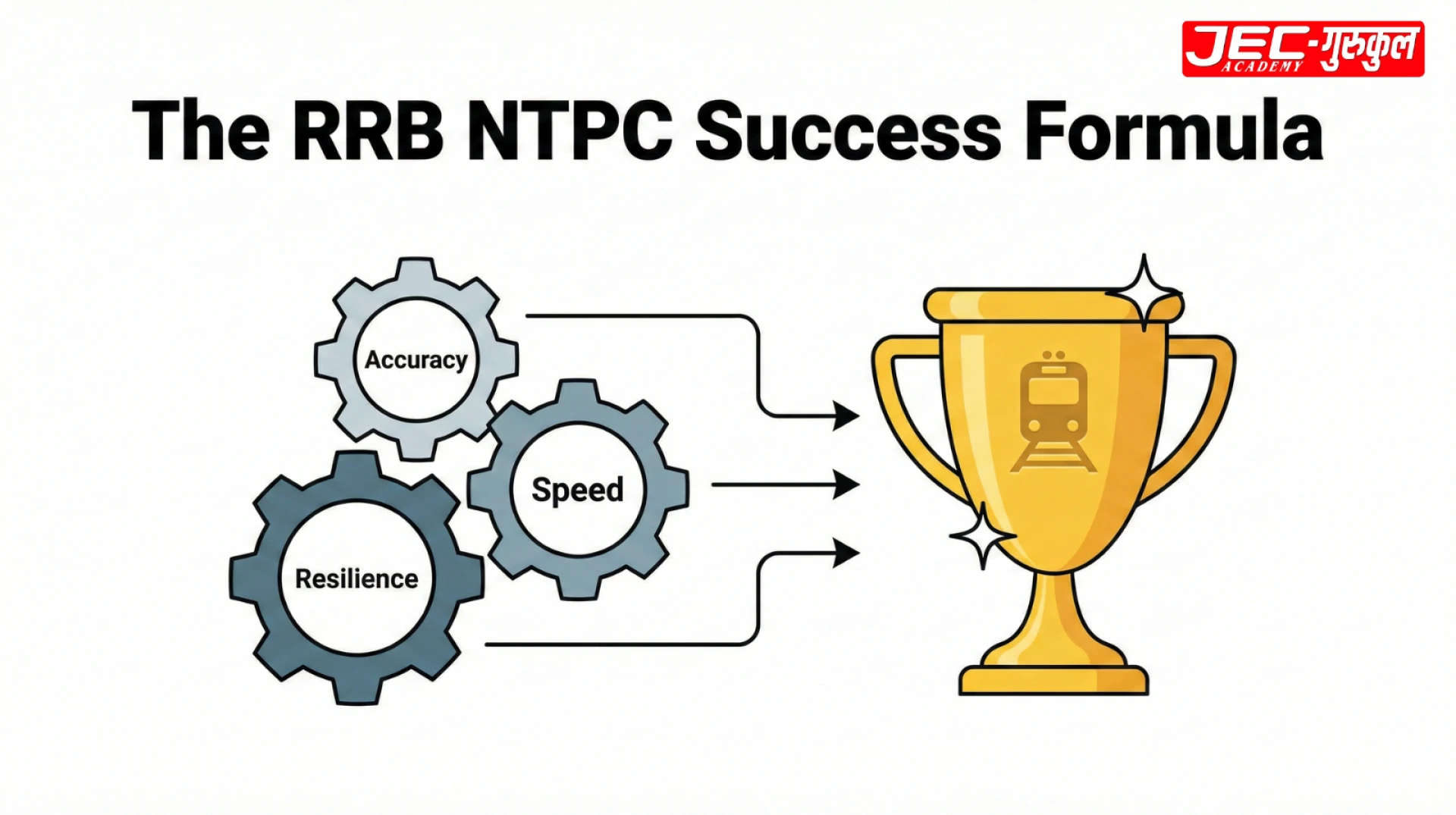
Success is best for those who adhere to the course and follow an organized, data-driven routine. If it's through self-study that is disciplined or under the guidance of knowledgeable teachers, the objective is the same: speed, accuracy, and resiliency.




























Sign in to leave a comment.