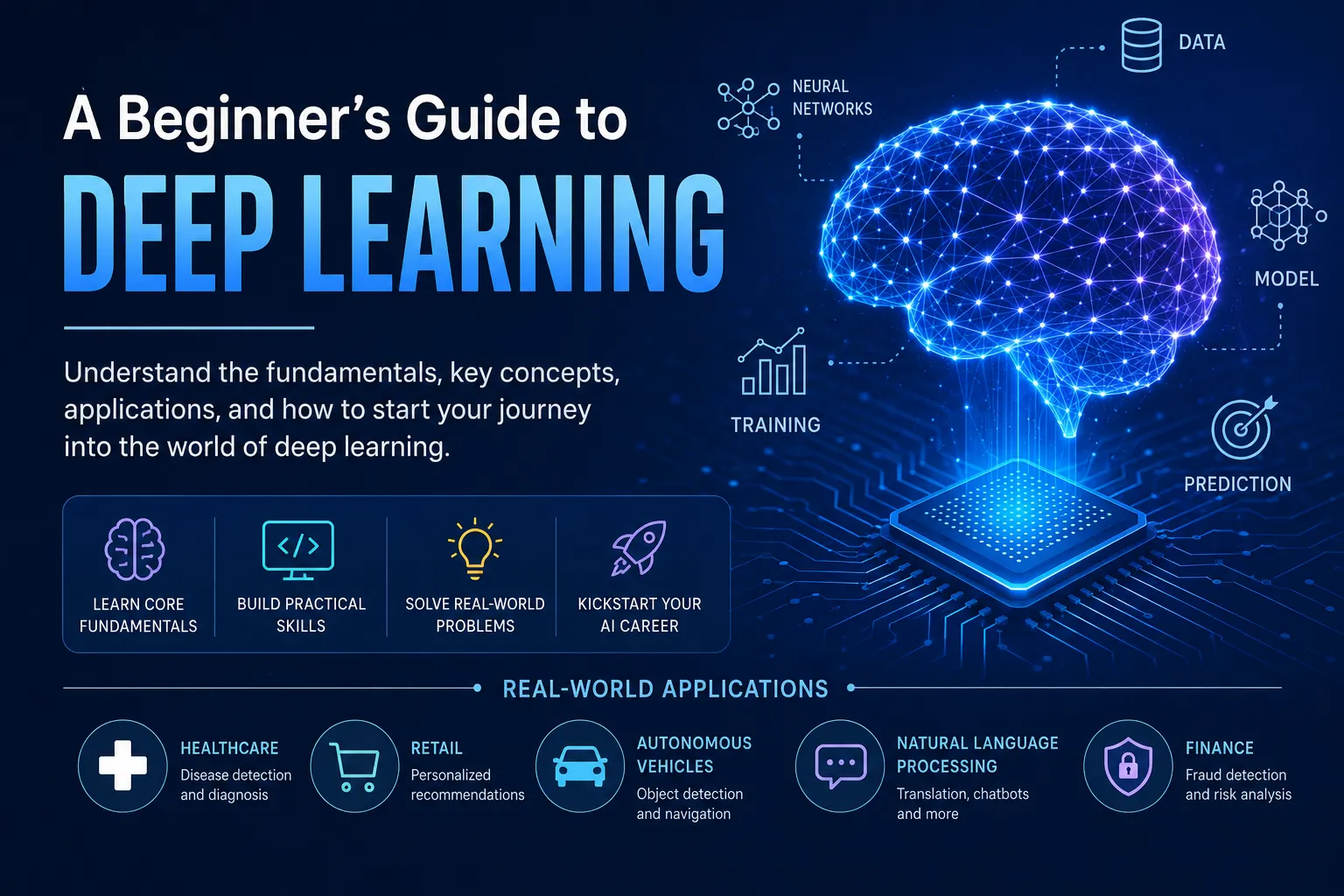

Artificial Intelligence is transforming industries, powering everything from recommendation systems and virtual assistants to self-driving vehicles and advanced healthcare solutions. At the heart of many of these innovations lies deep learning. If you are new to AI, understanding the deep learning fundamentals is one of the best investments you can make today.
This beginner-friendly guide explains the deep learning basics, how deep learning works, why it matters, and how you can start your journey confidently.
What Is Deep Learning?
Deep learning is a branch of machine learning that uses artificial neural networks to process data and make decisions. These neural networks are inspired by the structure of the human brain and are designed to identify patterns, recognize images, understand language, and make predictions.
Unlike traditional machine learning models that often require manual feature engineering, deep learning models can automatically learn relevant features from large amounts of data.
In simple terms, if you want to learn deep learning, think of it as teaching computers to learn from examples in a way that resembles how humans recognize patterns.
Why Is Deep Learning Important?
Deep learning is the driving force behind many modern AI applications:
- Voice assistants like Siri and Google Assistant
- Image recognition systems
- Language translation tools
- Recommendation engines
- Medical image analysis
- Fraud detection systems
According to industy experts, artificial intelligence is expected to contribute nearly USD 19.9 trillion to the global economy by 2030. Additionally, Grand View Research projects that AI-related markets will grow at a compound annual growth rate (CAGR) of more than 30%, with deep learning driving innovation across healthcare, finance, retail, manufacturing, and autonomous systems
This increasing adoption makes understanding deep learning fundamentals valuable for students, professionals, developers, and business leaders alike.
How Does Deep Learning Work?
To understand the deep learning basics, it helps to know the key components of a neural network:
1. Input Layer
The input layer receives raw data such as images, text, audio, or numerical values.
2. Hidden Layers
Hidden layers process information by applying mathematical transformations. The presence of multiple hidden layers is what gives deep learning its name.
3. Output Layer
The output layer generates the final prediction or decision.
For example, when identifying whether an image contains a cat or a dog, the neural network analyzes patterns through multiple layers before producing its prediction.
Understanding these concepts is essential when studying deep learning from scratch.
Key Concepts Every Beginner Should Know
Neural Networks
Neural networks consist of interconnected nodes called neurons. These neurons process information and pass it through different layers.
Training
Training involves feeding data into a model and adjusting its parameters to improve accuracy.
Data
Deep learning models typically require large datasets to achieve high performance.
Loss Function
A loss function measures how far the model predictions are from the actual results.
Optimization
Optimization algorithms help the model learn by reducing prediction errors over time.
These concepts form the foundation of the deep learning basics every beginner should understand.
Real-World Applications of Deep Learning
Deep learning has moved far beyond research laboratories. Today, it powers practical solutions across industries.
Healthcare
Deep learning assists doctors in detecting diseases from medical scans and predicting patient outcomes.
Finance
Banks use deep learning to detect fraudulent transactions and assess financial risks.
Retail
E-commerce platforms use deep learning to personalize recommendations and improve customer experiences.
Transportation
Autonomous vehicles rely heavily on deep learning for object detection and decision-making.
Studying these applications helps learners appreciate why so many professionals choose to learn deep learning today.
How to Start Learning Deep Learning?
Many beginners feel overwhelmed by the technical nature of AI. However, a structured approach makes learning much easier.
Step 1: Build Basic Knowledge
Start by understanding AI, machine learning, and the deep learning fundamentals before diving into advanced topics.
Step 2: Learn Python
Python is the most widely used programming language for deep learning because of its simplicity and extensive AI libraries.
Step 3: Understand Neural Networks
Focus on how neurons, layers, activation functions, and training processes work together.
Step 4: Practice With Projects
Hands-on projects help reinforce concepts and improve practical understanding.
Step 5: Follow Structured Courses
A beginner-friendly learning path can significantly reduce confusion and accelerate progress. Many learners start with a Coursera deep learning program that introduces neural networks, model training, and real-world applications in a guided format.
Choosing the Right Learning Resource
The internet offers countless AI tutorials, but beginners often struggle to find a clear starting point.
A practical approach is to choose a structured course focused on deep learning from scratch that gradually introduces core concepts, hands-on exercises, and real-world examples.
When selecting a course, look for:
- Beginner-friendly explanations
- Practical exercises
- Real-world applications
- Industry-relevant content
- Flexible learning schedules
These features make it easier to learn deep learning effectively without becoming overwhelmed.
Common Mistakes Beginners Should Avoid
Skipping the Fundamentals
Many learners jump directly into advanced models without understanding the deep learning fundamentals.
Focusing Only on Theory
Reading alone is not enough. Practical implementation is essential.
Ignoring Mathematics Completely
While you do not need to be a mathematician, understanding basic algebra, probability, and statistics can be extremely helpful.
Learning Without a Roadmap
A structured learning path is often more effective than consuming random tutorials online.
Final Thoughts
Deep learning is one of the most influential technologies that shape the future of artificial intelligence. Whether your goal is career growth, academic advancement, or personal curiosity, mastering the deep learning fundamentals can open doors to countless opportunities.
The best way to begin is to focus on deep learning basics, build a strong foundation, and gradually explore more advanced topics. With structured learning resources, practical projects, and consistent effort, anyone can start their journey into deep learning from scratch and develop the skills needed to thrive in the AI-driven world.






























Sign in to leave a comment.