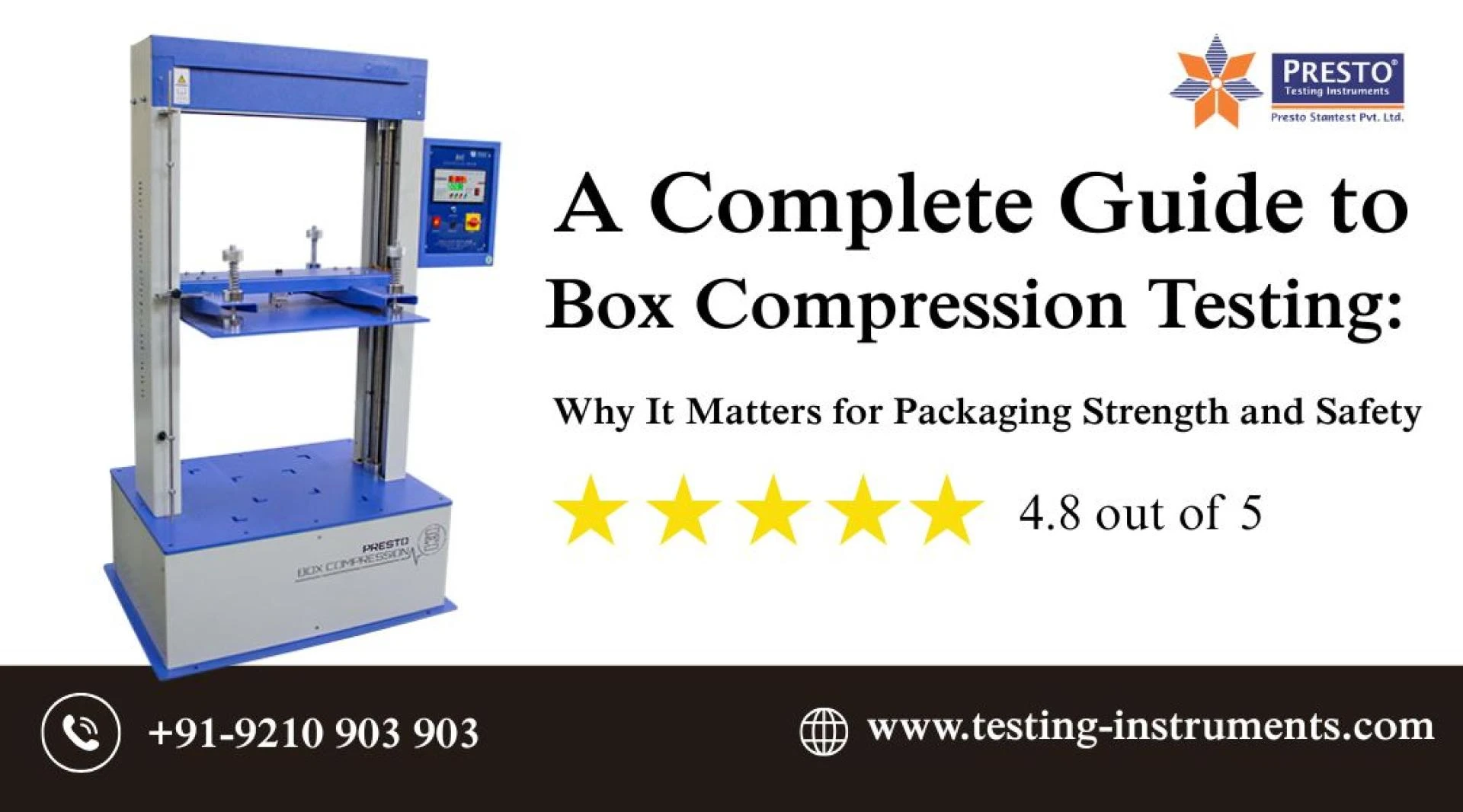

In today’s supply chain, packaging is more than just a container—it is a protector of product quality, a carrier of brand trust, and a critical factor in reducing losses during storage and transportation. Whether it’s e-commerce shipments, export cartons, FMCG products, or heavy industrial components, every box must withstand different kinds of pressure throughout its journey. One of the most important ways to measure the durability of packaging is through Box Compression Testing.
A Box Compression Tester helps manufacturers and quality teams determine how much pressure or stacking load a box can handle before it collapses. This simple yet highly effective test plays a major role in preventing damage, reducing return rates, and ensuring smoother logistics.
This article explains everything you need to know—what a Box Compression Tester is, how it works, what standards it follows, and why it’s an essential tool for modern packaging.
What Is a Box Compression Tester?
A Box Compression Tester is a laboratory instrument designed to measure the compressive strength, load-bearing capacity, and stacking strength of corrugated boxes and other packaging materials. During the test, the box is placed on a flat base, and pressure is applied from the top through a moving compression plate. The machine gradually increases the load until the box begins to deform or collapse.
The result?
A clear value showing the maximum load the box can withstand, which is crucial for deciding its stacking height, shipping stability, and safety during warehousing.
Why Is Box Compression Testing Important?
Every packaged product undergoes multiple stages before reaching the customer:
- Stacking in warehouses
- Compression during palletization
- Vibrations during transportation
- Pressure from other boxes
- Long-term storage in fluctuating conditions
A weak box can easily collapse under pressure, damaging the product inside and causing financial losses. Box Compression Testing helps avoid this risk by:
✔ Ensuring packaging durability
Manufacturers can confirm whether a box can survive real-world supply chain pressure.
✔ Reducing product damage
Strong, tested boxes reduce breakage, leaks, and returns.
✔ Meeting international quality standards
Export shipments require packaging that meets ASTM, ISO, TAPPI, and other global guidelines.
✔ Optimizing packaging materials
The test helps avoid under-designed or over-engineered boxes—reducing unnecessary material cost.
✔ Improving customer trust
Reliable packaging enhances brand image and reduces negative feedback.
How Does a Box Compression Tester Work?
Though the concept sounds simple, the machine works with high precision. Here’s a step-by-step overview:
1. Sample Placement
The corrugated box or carton is placed on the base platform. Proper centering ensures uniform load distribution.
2. Compression Begins
The upper compression plate starts moving down at a standard speed (commonly 12.5 ± 2.5 mm/min). This controlled speed maintains testing accuracy and aligns with international standards.
3. Load Is Applied
As the plate moves downward, it applies an increasing force. The box begins to resist the load, and the machine’s load cell measures the force in real time.
4. Collapse or Deformation Point Recorded
The test continues until the box collapses or reaches structural deformation. The maximum force recorded at this point is the Box Compression Strength.
5. Results Displayed
Advanced models display the results digitally, can print the readings, or export data to a computer for reports, comparisons, and quality audits.
What Does Box Compression Strength Tell You?
The compression value helps determine:
- Maximum stacking height
- Safe load capacity during shipping
- Suitability for heavy or fragile items
- Batch-to-batch consistency in manufacturing
- Whether the box meets required standards
For example, if a box collapses at 400 kgf, it should not be used in warehouses where it may need to bear higher pressure or be stacked too high.
Industries That Rely on Box Compression Testing
1. E-Commerce & Online Retail
With thousands of parcels moving daily, reliability of cartons is essential to avoid transit damage.
2. Corrugated Box Manufacturers
Consistency across production batches ensures better quality and stronger customer trust.
3. FMCG & Consumer Goods
Products like food items, cosmetics, detergents, and electronics require sturdy packaging for safe transport.
4. Export & Shipping Companies
International shipments follow strict packaging norms, making compression testing a must.
5. Warehousing & Logistics
Stacked cartons often remain under load for weeks, requiring verified box strength.
6. Automotive & Industrial Components
Heavy parts must be packed in boxes that can support high load without collapsing.
Important Features of a Good Box Compression Tester
When selecting or understanding a high-quality machine, a few essential features stand out:
👉 Strong base and twin-column structure
Ensures stable and uniform compression.
👉 High-precision load cell
Provides accurate, repeatable, and reliable readings.
👉 Standard testing speed
Allows compliance with global standards like ASTM D642, ISO 12048, and TAPPI T804.
👉 Wide platform sizes & high load capacity
Supports testing of small cartons as well as large export boxes.
👉 Digital or computer-controlled interface
Enables easy data recording, graph generation, and batch comparison.
👉 Over-travel and safety protection
Prevents machine damage and ensures operator safety.
These features ensure the test is consistent, accurate, and trustworthy.
How Box Compression Testing Helps Improve Packaging Design
Manufacturers often use test data to:
- Compare different flute types (A, B, C, E, etc.)
- Select appropriate board grades
- Evaluate the effect of moisture or storage conditions on box strength
- Design lightweight yet durable packaging
- Reduce raw material usage without compromising safety
- Predict box performance over long storage durations
In short, the Box Compression Tester becomes a powerful tool for both quality control and cost optimization.
Conclusion
Strong packaging is not optional anymore—it’s a necessity in today’s fast-paced supply chain. A Box Compression Tester allows companies to assess the strength, durability, and performance of corrugated boxes long before they enter the market. Whether you’re a manufacturer, supplier, exporter, or logistics provider, this test ensures that your packaging is reliable enough to handle real-world pressures.
By integrating compression testing into your quality process, you not only prevent product damage but also reduce operational costs, improve customer satisfaction, and strengthen your brand’s reputation.
If you work with packaging in any capacity, investing in or understanding Box Compression Testing is one of the smartest decisions you can make.


























Sign in to leave a comment.