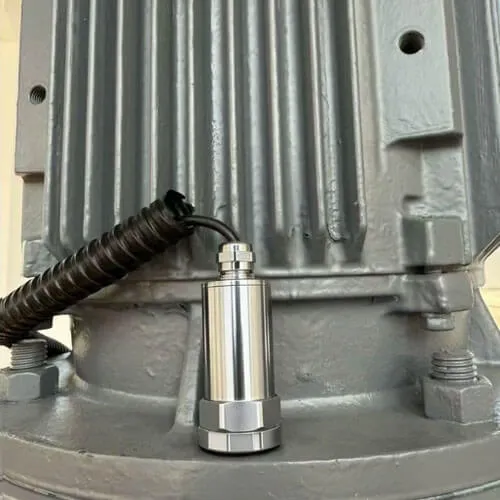

In the fields of industrial intelligent manufacturing and predictive maintenance, temperature and vibration sensors (integrated temperature and vibration transmitters) are core sensing hardware for online monitoring of rotating equipment such as motors, fans, pumps, and gearboxes. The entire unit integrates a MEMS vibration acquisition unit and a high-precision temperature probe, simultaneously outputting vibration acceleration, velocity, displacement, and casing temperature data. This provides early warnings of faults such as bearing wear, rotor imbalance, motor overheating, and lubrication failure, significantly reducing unplanned downtime losses in factories.
Based on communication methods, mainstream temperature and vibration transmitters fall into two main categories: LoRa wireless temperature and vibration transmitters and RS485 wired temperature and vibration transmitters. These are suitable for factory areas with difficult wiring and long-distance centralized networking scenarios, respectively.
What is a temperature and vibration sensor?
The temperature and vibration transmitter adopts an integrated composite sensing architecture, incorporating a three-axis MEMS accelerometer chip and an NTC temperature sensing module. It features embedded signal processing circuitry, automatically filtering industrial electromagnetic interference from frequency converters and high-power motors, and outputting standardized digital signals for integration with PLCs, industrial gateways, and equipment maintenance cloud platforms.
The device can collect three core vibration indicators: root mean square (RMS) vibration acceleration, RMS vibration velocity, and peak-to-peak (peak-to-peak) displacement. Combined with equipment surface temperature, this forms complete equipment health diagnostic data, providing the underlying hardware support for predictive maintenance.
Core Functions and Advantages of LoRa Wireless Temperature and Vibration Transmitters
LoRa Long-Range Wireless Networking with Relay Expansion Support
Spread spectrum communication boasts strong anti-interference capabilities, enabling long-distance transmission even in unobstructed factory areas. The device can be cascaded as a relay to extend coverage. A single gateway manages all measurement points throughout the plant, eliminating the need for rewiring during expansion.
Ultra-Low Power Battery Powered, No On-Site Power Supply Modification Required
Large-capacity replaceable batteries with standard interfaces allow users to replace batteries themselves without returning them to the factory, significantly reducing maintenance costs.
Multiple Installation Methods, Adaptable to Various Equipment
Supports five installation methods
Threaded fixing, magnetic adsorption, insulating base, heat dissipation base, and adhesive. The magnetic version requires no drilling and is suitable for temporary testing and high-altitude fans. A dedicated heat dissipation base is available for high-temperature applications to prevent demagnetization.
Explosion-proof IP67 Industrial Protection, Suitable for High-Risk Scenarios
Integrated aluminum alloy housing with IP67 protection rating, suitable for use in coal mines, chemical plants, and flammable and explosive dust and gas environments.
Real-time Device Status Feedback
Synchronously uploads remaining battery power, LoRa signal strength, and device online status. The maintenance platform monitors sensor offline status and issues low battery warnings in real time, allowing for early troubleshooting of communication failures.
RS485 Wired Temperature and Vibration Transmitter Core Features
IP68 all-stainless steel housing, suitable for long-term immersion in water, dustproof, and corrosion-resistant, ideal for metallurgical and washing workshops; threaded + magnetic dual installation, supports remote firmware upgrades, reducing the risks of high-altitude inspections; strong isolation circuit resists strong electromagnetic interference, suitable for mass applications in power plants and large chemical units.
Main Application Industries and Monitoring Equipment for Temperature and Vibration Sensors
Coal Mining Industry
Monitoring main ventilation fans, underground drainage pumps, belt reducers, and air compressors; explosion-proof LoRa temperature and vibration transmitters are suitable for high-risk underground environments, providing real-time early warnings of bearing seizure and equipment jamming.
Petrochemical Industry
Centrifugal pumps, compressors, and reactor motors; corrosion-resistant housings are suitable for corrosive water vapor, and wireless models solve the wiring problems of large-scale equipment in the plant area.
Thermal Power/New Energy Power Generation
Exhaust fans, forced fans, circulating water pumps, and generators; wired 485 solutions enable centralized networking, real-time monitoring of unit vibration and overheating, and prevention of power plant shutdowns.
Metallurgical Manufacturing Industry
Rolling mill reducers, dust collector fans, and cooling water pumps; for high-temperature and high-dust conditions, high-temperature heat dissipation base temperature and vibration transmitters are available.
General Processing and Cement Building Materials
Assembly line motors, cooling tower fans, and centrifuges; SMEs should prioritize high-performance, cost-effective domestic LoRa temperature and vibration sensors to build predictive maintenance systems at low cost.
The Core Value of Deploying Temperature and Vibration Sensors for Predictive Maintenance in Factories
Early Warning of Faults, Preventing Major Downtime Losses
Detecting micron-level vibration anomalies and minute temperature rises, sending alarms before bearings and motors fail, preventing equipment seizures, fires, and other safety accidents.
Reducing Manual Inspection Costs
Automated data collection 24/7, with remote cloud-based equipment status monitoring, reducing the frequency of high-risk manual inspections at heights and underground.
Extending the Lifespan of Mechanical Equipment
On-demand maintenance based on temperature and vibration data eliminates the need for fixed-cycle over-maintenance, reducing the frequency of parts replacement and major overhauls.
Digital Compliance, Meeting Safety Production Regulatory Requirements
Complete equipment operation data can be retained in high-risk industries such as coal mines, chemicals, and power plants, meeting the digital monitoring standards for safety supervision and environmental protection.




























Sign in to leave a comment.