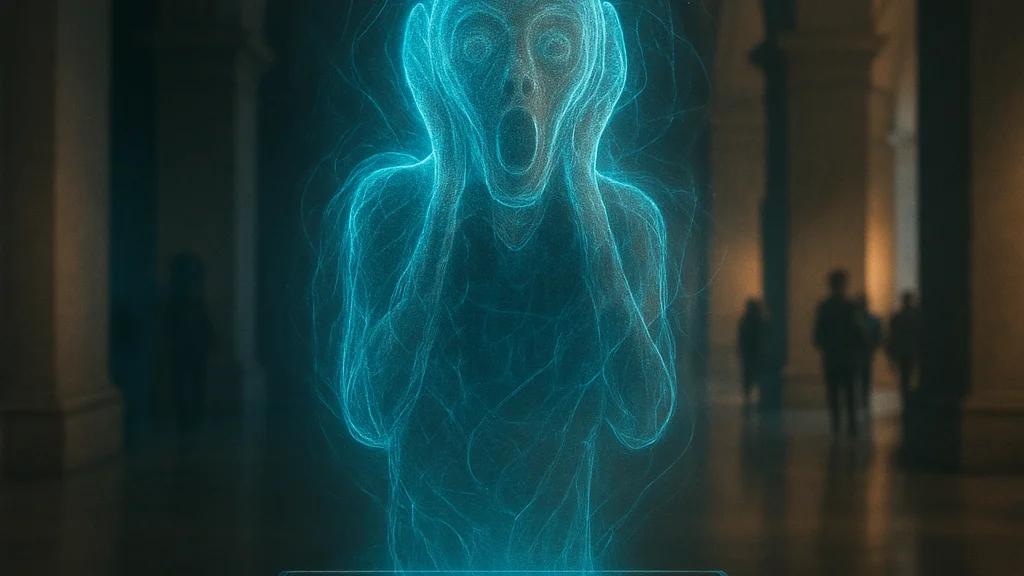

A painting built for anxiety now faces a different kind of threat
Edvard Munch’s The Scream has always looked like a warning signal from another dimension—an image so culturally sticky that it survives memes, museum gift shops, and the algorithmic churn of the modern internet. What makes the latest wave of attention different is not the painting’s emotional charge but the computational question attached to it: what will this work physically look like centuries from now if chemistry, light exposure, humidity, and material decay continue doing what they always do?
That question moved from conservation lab logic into mainstream tech coverage after reports highlighted a new simulation tool that models the painting’s future appearance. Gizmodo’s coverage of the project framed it in exactly the way Silicon Valley loves to frame cutting-edge systems: not as a static archive, but as a predictive interface. MSN also summarized the tool as a system that can forecast how The Scream may change over the next 300 years, pushing a niche conservation workflow into a broader conversation about AI, imaging, and cultural preservation.
For readers in AI and automation, the disruptive technology angle is obvious. This is not merely image generation. It is a hybrid stack—spectral imaging, materials science, environmental modeling, and machine-assisted prediction—applied to one of the most recognizable artworks on earth. That matters because it shows where machine learning is quietly becoming more consequential than the flashy chatbot cycle. Museums, archives, insurers, and restoration teams are less interested in synthetic novelty than in systems that can anticipate loss before the human eye detects it.
The result is a shift in how we think about art. Instead of asking only what a masterpiece means, researchers are asking what data says it is becoming. If that sounds like the museum world borrowing from predictive maintenance in manufacturing, that is because it is. The same logic used to monitor turbines, batteries, and semiconductor systems is now being aimed at paper fibers, pigments, and varnish layers.
The most interesting part of this story is not that a famous image can be simulated. It is that conservation is starting to look a lot like predictive engineering.
That is why this topic has legs far beyond a single headline. The tool behind these simulations hints at a future where museums do not just document deterioration—they model it, test interventions against it, and make preservation decisions with a level of computational confidence that would have sounded futuristic even a decade ago.
Why The Scream is a perfect test case for predictive conservation
The Scream is unusually well suited to this kind of experiment because it sits at the intersection of fame, fragility, and scientific interest. Munch created multiple versions of the composition, and conservators have spent years studying the vulnerabilities of the materials involved. Some versions are known to be sensitive to light and environmental conditions, which makes the work a compelling subject for long-horizon simulation. A painting that already carries visible instability gives researchers something concrete to model rather than a purely hypothetical future.
There is also a practical reason this image draws attention. Museums and conservation labs often struggle to communicate technical preservation challenges to the public. A simulation of a globally recognized artwork changing over 300 years does that instantly. It turns pigment fade, binder degradation, and environmental stress into a visual story anyone can grasp. That communication value is powerful in an era when institutions are competing for funding, digital relevance, and public trust.
The underlying concept is not new. Conservation science has long used accelerated aging tests, microscopy, spectroscopy, and environmental monitoring to estimate how objects may evolve. What is new is the interface layer and the computational sophistication. Instead of presenting decay as a spreadsheet or a lab note, the system can render a likely future image. That makes the invisible visible. It also creates a bridge between specialist knowledge and public understanding.
WriteUpCafe has already tracked this emerging niche from multiple angles, including this overview of AI simulation and The Scream and this explainer on how AI predicts the artwork’s future. Those pieces point to the same core truth: prediction in cultural heritage is becoming less speculative and more operational.
What makes this especially relevant in 2026 is the broader normalization of machine vision in high-value environments. From autonomous inspection in chip fabrication to defect detection in EV battery plants, image-based prediction has become standard industrial practice. Bringing that mindset into museums feels, frankly, very Bay Area—take a domain built on expert intuition, add sensors and models, and build a decision-support layer on top.
- High recognition value: the public immediately understands the stakes when the subject is The Scream.
- Known material sensitivity: the artwork has documented conservation concerns, making it a scientifically meaningful case.
- Strong visualization potential: future-state images communicate deterioration better than technical reports alone.
- Cross-disciplinary appeal: art history, chemistry, imaging, and AI all converge in one project.
That convergence is the real story. This is not AI replacing conservators. It is AI becoming the connective tissue between data sources that were previously hard to synthesize in a public-facing, decision-ready format.
How the tool likely works beneath the headline
Headlines often flatten systems like this into the word “AI,” but the mechanics matter. A credible future simulation of an artwork does not emerge from a text prompt and a diffusion model. It is more likely built on a layered pipeline that combines high-resolution imaging, material analysis, environmental data, and predictive algorithms trained or calibrated on known degradation pathways. In plain English: the system needs to understand not only what the painting looks like today, but what it is made of and how those materials behave over time.
That means the workflow probably starts with imaging modalities that capture more than visible light. Conservation teams increasingly use hyperspectral or multispectral imaging to detect pigment variation, underdrawing, prior restoration, and subtle chemical changes. Those image sets can then be correlated with lab measurements—such as reflectance, fluorescence, or other material signatures—to establish a baseline state. Once the baseline is robust, predictive modeling can estimate how specific regions may fade, darken, crack, or shift under different environmental scenarios.
This is where automation becomes genuinely useful. Human experts can interpret isolated findings, but software can integrate many variables at scale. A model might simulate what happens if light exposure remains within one museum threshold versus another. It could compare low-humidity stress against more stable climate control. It might even estimate uncertainty ranges, which is critical because conservation is about probabilities, not certainties.
A future image is not a prophecy. It is a scenario model built from chemistry, imaging, and assumptions about the environment.
That distinction matters because hype can distort the public’s understanding. The tool is not “seeing the future” in the mystical sense. It is running evidence-based projections. Think of it less like Midjourney and more like a digital twin for a painting. In manufacturing, digital twins mirror physical assets and forecast wear. In conservation, the same concept can mirror an artwork and forecast visual change.
Industry readers will recognize another familiar pattern: once a digital twin exists, secondary use cases multiply fast. A museum can test preservation strategies before applying them. Curators can explain conservation risk to donors. Educators can build interactive exhibits. Insurers and lenders can gain more nuanced condition assessments for high-value works. The initial simulation becomes a platform.
- Capture: high-resolution and spectral imaging record the painting’s current state.
- Characterize: material analysis identifies pigments, supports, and vulnerable areas.
- Model: software estimates degradation pathways under specified conditions.
- Visualize: the system renders likely future appearances over long time horizons.
- Compare: conservators test interventions and environmental controls against projected outcomes.
That is why this story belongs in the AI & automation tools category. The glamour is in the image, but the value is in the workflow orchestration—data in, scenario modeling, human review, decision support out.
What changed recently and why 2026 is a turning point
The timing here is not accidental. By mid-2026, several technology currents have converged to make predictive conservation more feasible and more visible. First, imaging hardware has become better and more portable. Second, machine learning pipelines for pattern recognition and anomaly detection are now easier to deploy thanks to maturing open-source ecosystems and cloud-based analysis tools. Third, cultural institutions have become more comfortable with digital-first public engagement after years of investing in virtual collections, remote exhibits, and high-resolution archives.
Coverage from Gizmodo and MSN did more than spotlight a clever visualization. It signaled that conservation technology is becoming legible to mainstream audiences as part of the broader AI wave. That matters because public attention often shapes funding priorities. When a museum can show a donor, board member, or government agency a plausible future version of a masterpiece under different preservation conditions, the argument for investment becomes far more concrete.
There is another 2026 factor in play: trust. After the generative AI boom flooded the web with synthetic images and dubious provenance, institutions have become more careful about distinguishing evidence-based simulation from creative generation. In that sense, tools like this benefit from a stricter standard. They are judged not by aesthetic novelty but by methodological transparency. That is healthy. It pushes developers toward explainable systems rather than black-box spectacle.
Silicon Valley has spent years chasing consumer-facing AI moments, from copilots to multimodal assistants. Yet some of the most durable opportunities are in specialized verticals where the data is rich, the stakes are high, and the users are experts. Conservation fits that mold. It is not mass market, but it is intellectually serious, operationally demanding, and ripe for software augmentation.
For a related angle, this WriteUpCafe piece on AI simulations revealing the painting’s future captures the growing public fascination with these tools. What has changed since earlier discussions is the framing: this is no longer just a curiosity. It is increasingly part of a larger conversation about how institutions use predictive systems to preserve fragile assets.
- Better imaging: higher fidelity scans make subtle change easier to measure.
- Cheaper compute: simulation workflows are more accessible than they were a few years ago.
- Institutional digital maturity: museums are more prepared to integrate technical tools into public programming.
- AI skepticism: stronger demand for explainable outputs favors evidence-based simulation over purely generative visuals.
In short, 2026 is a turning point because the infrastructure, the public narrative, and the institutional incentives are finally aligned.
Where the science meets the limits of prediction
Every predictive system has constraints, and responsible reporting should say that plainly. A simulation of The Scream 300 years from now can be illuminating without being definitive. Long-term forecasts depend on assumptions about storage conditions, display frequency, climate stability, restoration interventions, and even geopolitical realities that affect museum operations. Change the assumptions and the future image changes too.
That uncertainty does not weaken the tool; it defines the right way to use it. Good conservation modeling should present scenarios, confidence ranges, and sensitivity analyses rather than a single cinematic answer. If one version assumes ideal humidity control and another assumes less stable conditions, the comparison itself becomes the insight. The value lies in showing how much environmental stewardship matters—not in pretending the system has solved time.
There is also a risk of public misinterpretation. Once a future-state image circulates online, audiences may treat it as a literal forecast. That can create confusion, especially in a media environment primed for viral visuals. Museums and publishers need to explain the methodology with unusual care. According to the reporting cited above, the project is compelling precisely because it translates conservation science into something visible. But visibility can oversimplify if the caveats disappear.
Another limit is dataset scarcity. In consumer AI, vast training corpora can smooth performance. In fine-art conservation, each object is singular. Researchers must often work with small, specialized datasets and domain expertise rather than internet-scale abundance. That means expert oversight remains non-negotiable. A conservator’s judgment about a pigment’s behavior or a support material’s instability cannot simply be abstracted away.
The smartest use of AI in conservation is not replacing expert judgment. It is compressing complex evidence into a form experts can interrogate faster.
This is where the tool’s credibility will live or die. If developers present it as a collaborative instrument—part microscope, part simulator, part communication layer—it earns trust. If they market it as autonomous artistic prophecy, it loses serious users. Elon Musk-style futurism may work in product launches, but conservation professionals tend to reward rigor over theater.
That tension is familiar across AI. The most effective systems are often the least flashy: models that narrow uncertainty, structure choices, and help specialists act earlier. Predictive conservation belongs in that category.
The broader market impact for museums, insurers, and AI vendors
Once you strip away the art-world romance, this is a business story too. High-value cultural objects sit inside a web of financial and operational decisions: climate control budgets, transport approvals, exhibition schedules, insurance underwriting, restoration planning, and donor relations. A tool that can simulate probable visual deterioration under different conditions has obvious downstream value.
Museums could use predictive imaging to prioritize conservation resources. Instead of relying only on periodic manual reviews, teams could rank objects by modeled risk and intervene sooner. For insurers, richer condition forecasting may improve how policies are structured around display duration, travel, and environmental controls. For lenders and collectors, it introduces a more data-driven language around stewardship obligations. And for technology vendors, it opens a niche but premium market where accuracy and trust command higher margins than consumer apps do.
This is especially relevant because the cultural sector is not isolated from the same automation pressures reshaping other industries. Institutions are being asked to do more with constrained budgets. Tools that reduce uncertainty can justify spending by tying preservation choices to measurable outcomes. A simulation showing that one lighting strategy materially slows visible degradation is far easier to defend than a generic recommendation.
There is also an educational and audience-growth angle. Interactive displays that let visitors compare present and projected states of a masterpiece can turn conservation from a back-room function into a front-of-house experience. That matters in a media economy where attention is scarce. If museums want younger audiences raised on real-time interfaces, predictive visualization is a powerful bridge.
- Museums: better triage, planning, and public communication.
- Insurers: more granular risk assessment tied to conditions and time horizons.
- Collectors and lenders: clearer evidence for stewardship and transport decisions.
- AI vendors: a specialized market for high-trust imaging and simulation platforms.
- Educators: compelling ways to explain material science through iconic artworks.
Seen through that lens, the project around The Scream is a proof of concept for a broader category: predictive heritage tech. It is niche today, but so were many enterprise AI workflows before they became standard operating procedure.
What readers should watch next
The next phase to watch is not whether more headlines appear about famous paintings. It is whether institutions publish methodology, validation results, and cross-object studies that show these tools can generalize responsibly. One-off demos attract attention; repeatable frameworks build industries. If multiple museums begin using similar systems across works on paper, textiles, photographs, and paintings, then predictive conservation moves from novelty to infrastructure.
Another signal will be interoperability. The strongest platforms will not trap data in a glossy interface. They will connect imaging archives, environmental sensors, conservation notes, and collection management systems into a coherent workflow. That is where automation becomes sticky. Once a model can pull current climate data, compare it with historical condition records, and generate updated risk scenarios, the museum gains something much more valuable than a static visualization.
Readers should also watch for standards. As with any high-stakes AI application, credibility depends on documentation. Expect more discussion around provenance of training data, explainability of outputs, and how uncertainty is displayed. If the field matures well, future tools will show not only a projected image but the assumptions behind it—light levels, humidity ranges, material sensitivities, and confidence intervals.
There is a cultural implication too. We are moving toward a world where masterpieces may have parallel digital futures—versioned, modeled, and stress-tested long before physical change becomes obvious. That does not diminish the original object. If anything, it sharpens our awareness of its vulnerability. In a century obsessed with infinite digital replication, the fragile uniqueness of a work like The Scream becomes more emotionally potent, not less.
My takeaway is simple. The tool simulating The Scream 300 years into the future is important not because it offers a spooky before-and-after image, but because it shows how cutting-edge AI can serve preservation rather than distraction. This is disruptive technology in the best sense—quietly practical, scientifically grounded, and capable of changing institutional behavior. The museums that adopt these systems early may not look like the loudest players in tech, but they may end up running some of the most sophisticated human-machine workflows anywhere.
And that is a very 2026 story: not AI as spectacle, but AI as stewardship.

































Sign in to leave a comment.