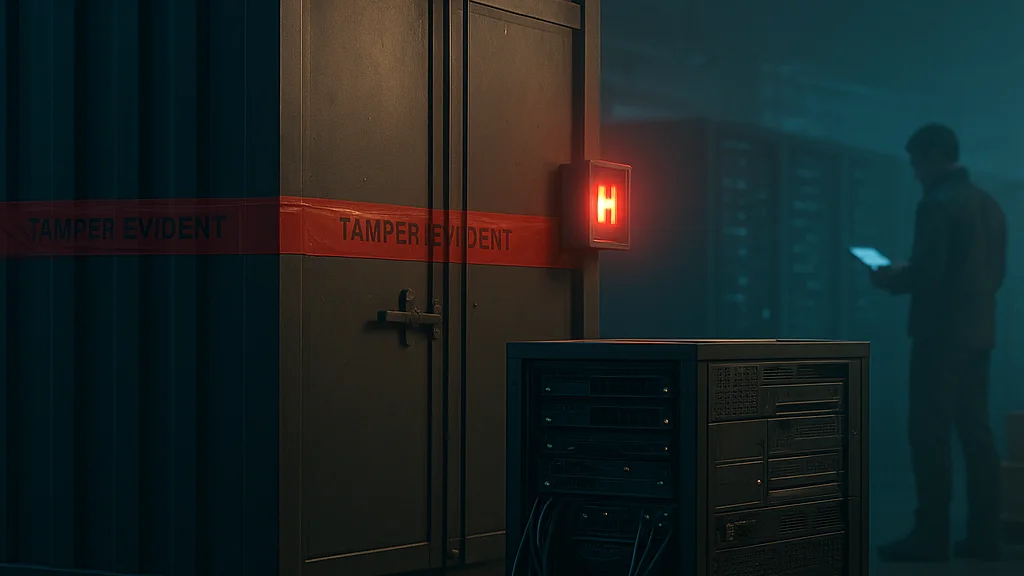

A courtroom order with outsized consequences
The judge’s decision to halt Anthropic’s supply-chain risk designation did not land like a routine procurement dispute. It hit Washington and Silicon Valley more like a kernel panic—sudden, technical, and impossible to ignore. What looked at first glance like a narrow legal intervention quickly opened a much larger argument about how the U.S. government should evaluate frontier AI vendors, how much discretion defense agencies should have when labeling software a security risk, and whether safety-oriented model behavior can become a liability in military contracting.
The immediate issue centers on a designation that could have sharply constrained Anthropic’s place in sensitive government buying channels. A supply-chain risk label is not a cosmetic warning. In federal procurement, it can function like a red flag visible across agencies, integrators, and prime contractors. Once applied, it may affect eligibility, deployment timelines, subcontractor decisions, and the confidence of enterprise buyers far beyond the original dispute. That is why the court’s intervention matters well beyond one company.
Coverage from MSN’s report on the divided appeals court hearing suggested judges were grappling with a basic but disruptive question: what evidentiary threshold should apply when the government moves against an AI supplier on national-security grounds? That question has become more urgent as agencies race to adopt large language models for coding, intelligence triage, document analysis, and workflow automation.
WriteUpCafe has already tracked the procedural stakes in Judge Halts Anthropic’s Supply-Chain Risk Designation Amid Legal Battle. The broader significance, though, is even more cutting-edge. This case sits at the intersection of AI safety, defense modernization, and administrative law. It is not just about Anthropic. It is about the rulebook for disruptive technology vendors trying to sell into the most security-sensitive customer in the world.
A temporary halt in a supply-chain risk designation can preserve more than market access—it can preserve a company’s credibility while the government is forced to explain its reasoning in public-facing legal terms.
That shift alone is remarkable. For years, many AI governance debates lived in white papers, conference panels, and closed-door briefings. Now they are being stress-tested in court.
How the dispute appears to have taken shape
To understand why this ruling matters, it helps to map the pressure points that were building before the judge stepped in. Anthropic entered the government AI conversation as a company strongly associated with model safety, constitutional AI methods, and a comparatively conservative deployment posture. In commercial markets, that positioning often reads as a feature. In defense contexts, however, the same guardrails can trigger friction if end users believe a model is overly restrictive, insufficiently responsive in edge scenarios, or misaligned with mission requirements.
A June 2026 report from TechTimes on the Pentagon’s effort to replace Anthropic’s Claude framed the conflict in unusually blunt terms, arguing that the model was seen in some quarters as “too safe” for wartime use. That phrase should be handled carefully, but it captures the fault line. Frontier AI systems designed to refuse dangerous requests may perform differently when the requesting entity is a military customer operating under lawful authorities. The procurement challenge is whether those differences are technical limitations, policy choices, or evidence of supplier risk.
At roughly the same time, Forbes reported in its June 2026 piece on Anthropic, Fable, and government AI risk controls that federal scrutiny of enterprise AI had intensified. The article described a climate in which agencies were pushing harder on model provenance, deployment boundaries, and operational trust. That broader environment matters because supply-chain risk decisions rarely emerge in isolation. They tend to reflect accumulated concerns about vendor governance, technical dependence, access controls, update mechanisms, and mission fit.
Several factors likely amplified the stakes:
- Large language models are increasingly embedded in agency workflows rather than tested in limited pilots.
- Prime contractors want predictable rules before integrating third-party models into defense systems.
- Agencies are under political pressure to move faster on AI without repeating cloud-era vendor lock-in mistakes.
- Model safety behavior is now being judged not only by consumer standards but by operational utility in classified or high-risk settings.
That is why the legal fight over Anthropic’s designation cannot be reduced to a single procurement disagreement. It reflects a structural mismatch between two policy instincts. One instinct says agencies need broad discretion to shield critical systems from uncertain software dependencies. The other says that if the government can effectively blacklist an AI company, it should have to show more than vague national-security assertions.
For readers following the story closely, Judge Halts Anthropic Supply-Chain Risk Designation 2026 captures the procedural timeline, while Anthropic Supply-Chain Risk Ruling Reshapes AI Procurement explores the procurement aftershocks already visible across the market.
Why a supply-chain risk label is so powerful in AI
In traditional hardware procurement, supply-chain risk often evokes compromised chips, foreign components, tampered firmware, or opaque subcontracting. In AI, the concept is broader and, frankly, more slippery. A model vendor can create risk through training data uncertainty, hidden dependencies on external infrastructure, brittle update practices, undocumented guardrail changes, weak tenant isolation, or unclear human review pathways. That makes the designation both potent and controversial.
For AI buyers, especially in government, a supply-chain risk label can trigger second-order effects that move faster than any final legal ruling. General counsels become cautious. Contracting officers ask for extra certifications. Integrators pause architecture decisions. Cyber teams demand model cards, incident logs, and assurance documents that many vendors still do not maintain at enterprise grade. Even if the designation is later reversed, the reputational blast radius can linger.
There are at least four reasons this is especially disruptive in the AI and automation tools market:
- Model updates are continuous. Unlike static software, leading AI systems change through retraining, fine-tuning, policy updates, and safety tuning. Buyers need confidence not just in today’s version, but in how tomorrow’s version will behave.
- Dependencies are layered. A single AI product may rely on cloud infrastructure, orchestration software, vector databases, evaluation pipelines, and third-party safety tooling. Risk is distributed across the stack.
- Behavior is probabilistic. Agencies are not only buying code; they are buying outputs that vary by prompt, context window, retrieval layer, and policy settings.
- Use cases are mission-sensitive. The same refusal behavior that looks prudent in a consumer chatbot may be unacceptable in a defense logistics, cyber triage, or intelligence support workflow.
This is where the Anthropic case becomes a bellwether. If the government can designate a major frontier model provider as a supply-chain risk without disclosing a robust factual basis, then every AI vendor selling into federal channels has to price in that uncertainty. Startups may hesitate to pursue public-sector deals. Enterprises may demand stronger indemnities. Investors may assign a higher regulatory discount to defense-adjacent AI firms.
In frontier AI procurement, “risk” is no longer just about where the software was built. It is about how the model behaves, how often it changes, and who gets to interpret those changes as a security problem.
That dynamic helps explain why the judge’s halt resonated so quickly. The order did not settle the merits, but it interrupted a mechanism that could have become a template for sidelining AI suppliers without a fully aired evidentiary contest.
The legal and policy fault line behind the ruling
The most important question raised by the judge’s intervention is not whether courts should second-guess every national-security procurement decision. They should not. The harder question is where to draw the line between necessary executive discretion and procedural fairness when the target is a software company whose products are central to emerging federal AI strategy.
According to Reuters-style reporting patterns seen in similar cases, courts often show substantial deference when the government invokes security concerns. But deference is not the same as a blank check. If an agency imposes a designation that effectively freezes a vendor out of key channels, judges may ask whether the agency documented its rationale, followed statutory procedures, and gave the company any meaningful opportunity to respond. The divided tone described by MSN suggests the appellate judges were probing exactly those issues.
That matters because AI procurement sits in a gray zone between cyber risk management and industrial policy. Agencies want freedom to move quickly when a vendor appears unreliable. Yet AI systems are now so strategically important that an opaque designation can shape the competitive field. If one company is sidelined, rivals gain not just revenue but data access, deployment experience, and institutional trust—advantages that compound over time.
From a policy perspective, the case appears to expose three unresolved tensions:
- Safety versus utility: If a model refuses some mission-related tasks, is that a security strength or an operational weakness?
- Transparency versus secrecy: How much evidence can the government disclose without revealing sensitive evaluation criteria or mission details?
- Competition versus control: Can agencies manage risk without unintentionally narrowing the field to a few politically or operationally favored vendors?
Silicon Valley has seen this movie before in cloud, semiconductors, and telecom—only now the protagonist is generative AI. Elon Musk and other tech figures have spent years warning that advanced AI needs guardrails, but the Anthropic dispute shows the next-order problem: once guardrails exist, different buyers may interpret them very differently. A safety-first system can look responsible in one context and obstructive in another.
That is why the judge’s halt could have lasting significance even if the final outcome is mixed. It signals that courts may require a clearer chain of reasoning before allowing the government to attach a designation with market-wide consequences. For AI vendors, that is not immunity. It is due process. In a sector moving at hyperspeed, due process may be one of the few stabilizers available.
What changed in 2026—and why the timing matters
The year 2026 has sharpened the stakes around public-sector AI in ways that were less visible even twelve months earlier. Agencies are no longer merely experimenting with chat interfaces. They are evaluating AI for coding assistance, procurement review, intelligence summarization, logistics planning, anomaly detection, and semi-automated document workflows. That expansion means disputes once confined to technical teams now affect budgets, legal offices, and interagency standards.
Recent reporting suggests that the Pentagon’s friction with Anthropic was not happening in a vacuum. The broader federal posture has become more interventionist, with stronger emphasis on model assurance, deployment controls, and mission alignment. Forbes’ June coverage underscored this tightening environment, describing a government increasingly willing to shape enterprise AI risk from the top down. In practical terms, that means more scrutiny of who trains models, where they run, how they are updated, and whether their refusal layers align with federal mission needs.
Several 2026 developments make the judge’s halt especially consequential:
- Federal buyers are moving from pilot budgets to scaled contracts, so vendor exclusions now carry larger financial and operational consequences.
- AI model differentiation has narrowed on benchmark headlines, making procurement trust and governance a more decisive competitive factor.
- Defense users are asking for highly specific behavior in sensitive workflows, exposing tension between general-purpose safety policies and mission-specific authorizations.
- Courts and regulators are being forced to address AI not as abstract “innovation” but as infrastructure with national-security implications.
Another shift is cultural. A few years ago, many tech companies could frame government AI adoption as a future opportunity. In 2026, it is current revenue, current risk, and current politics. That changes executive behavior. Boards want to know whether a federal dispute could spill into commercial sales. Enterprise customers want assurances that a government challenge will not disrupt product roadmaps. Compliance teams want audit trails that can survive not just procurement review, but litigation.
The result is a market where legal process itself becomes a competitive variable. Anthropic’s ability to secure a halt, even temporarily, may reassure customers who fear abrupt vendor disruption. At the same time, agencies may respond by tightening internal documentation and evaluation frameworks so future designations are harder to challenge. That would be a classic Washington outcome: one court fight produces a more formal bureaucracy for everyone.
How this could reshape AI procurement across government and enterprise
The biggest downstream effect may be on procurement design rather than on any single vendor. Government buyers now have a live example of how ambiguous risk language can trigger litigation and market instability. That alone creates an incentive to define evaluation criteria more clearly before disputes escalate. For AI vendors, the message is equally sharp: if you want federal business, technical excellence is no longer enough. You need auditable governance, explainable update practices, and a documented process for handling mission-specific edge cases.
Expect procurement teams to ask harder questions in at least five areas:
- Model behavior governance: How are safety refusals set, modified, and reviewed for authorized government use cases?
- Version control: Can the vendor document behavioral changes across releases and provide rollback options?
- Subprocessor visibility: Which cloud, data, and tooling partners sit underneath the product?
- Incident response: What happens if the model fails in a mission-critical workflow or generates restricted content unexpectedly?
- Contractual remedies: What recourse does the buyer have if policy-layer changes impair operational use?
These questions will not stay inside the Pentagon. Large banks, healthcare networks, and critical-infrastructure operators often borrow procurement logic from federal buyers, especially when dealing with cutting-edge automation tools. If the Anthropic dispute drives a more rigorous risk vocabulary, enterprise AI contracts will likely become more demanding as well. That means more appendices, more security exhibits, more evaluation logs, and more negotiation over who controls model behavior after deployment.
There is also a competitive angle. If one class of vendors is seen as safer but less flexible, and another as more responsive but less constrained, buyers may split their AI stacks by function. A conservative model could handle public-facing or compliance-heavy tasks, while a more permissive system is reserved for internal analysis under tighter controls. That modular approach would reduce dependence on any single vendor and blunt the impact of future designation disputes.
For a deeper operational read, Advanced Strategies After Anthropic’s Supply-Chain Risk Halt in 2026 offers a useful companion on how organizations can adapt vendor strategy after the ruling. The larger pattern is clear: procurement is becoming a product feature. In AI, trust architecture may matter almost as much as raw model capability.
The next winners in enterprise and government AI may not be the vendors with the flashiest demos, but the ones that can prove how their systems change, why they change, and who signs off when those changes affect high-stakes use.
That is a very Silicon Valley lesson, even if it is being taught by federal judges.
What to watch next for Anthropic, rivals, and buyers
The immediate legal path will matter, but the more revealing story may unfold in procurement memos, contract language, and product roadmaps over the next two quarters. If the government ultimately narrows, withdraws, or better substantiates the designation, agencies will need a more disciplined framework for future AI risk actions. If the designation is revived with stronger support, vendors will treat that as a warning that safety posture alone does not shield them from mission-fit scrutiny.
Three audiences should be paying close attention. First, AI vendors selling to government need to assume that behavioral alignment is now a procurement issue, not just a trust-and-safety issue. Second, enterprise buyers should examine whether their own vendor assessments are too vague to survive a serious dispute. Third, policymakers need to decide whether current supply-chain tools are even well suited to generative AI, where the relevant risks are often behavioral and operational rather than purely component-based.
Here are the most important signals to monitor next:
- Court filings and opinions: These may clarify what evidence judges expect when agencies impose AI-related risk designations.
- Pentagon replacement efforts: If alternative model suppliers are accelerated, that will reveal how urgently defense users want different behavior profiles.
- Procurement guidance updates: New agency language on model assurance, safety tuning, or mission authorization would show the dispute is changing policy.
- Vendor product changes: Anthropic and rivals may introduce more configurable policy layers, private deployment options, or government-specific controls.
- Enterprise contract trends: Watch for more clauses around model updates, refusal behavior, and audit rights.
The disruptive technology sector tends to treat legal setbacks as isolated events until they suddenly become precedent. This one has that potential. The judge’s halt may prove temporary, but it has already forced a more serious public conversation about who gets to define “risk” when the product in question is a frontier AI model used in sensitive workflows. That conversation is overdue.
Anthropic’s case also punctures a simplistic narrative that safer AI is always easier to sell. Sometimes the opposite is true. A company can build stronger guardrails and still collide with customers who want greater operational latitude. The challenge for the next phase of AI adoption is not choosing between safety and utility. It is designing governance that can distinguish reckless capability from authorized use with enough precision to satisfy both engineers and judges.
If Washington and the AI industry get that balance right, this ruling may be remembered as an inflection point rather than a detour. If they get it wrong, expect more courtroom battles—because the federal government is becoming one of the most important customers in AI, and no serious vendor can afford uncertainty at that scale.




























Sign in to leave a comment.