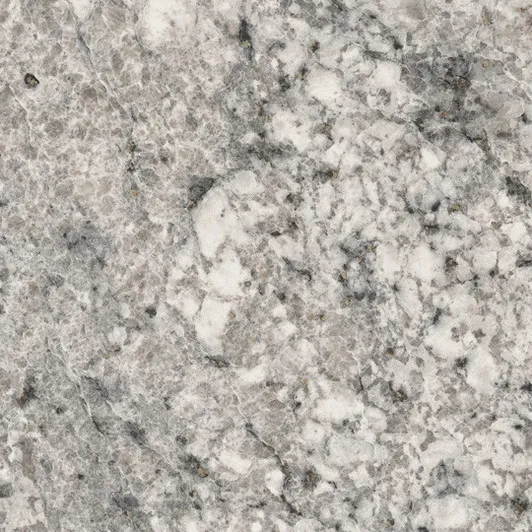

Two-tone cabinets can give a kitchen more depth and personality, but they also create an extra design decision: what countertop works with both finishes? The surface has to connect the cabinet colors without making the room look overly coordinated or visually busy.
Choosing the right cabinet counter tops is often easier when you treat the countertop as the bridge between the two cabinet finishes rather than as a separate statement piece. Color matters, but undertones, pattern scale, lighting, flooring, backsplash, and everyday maintenance can be just as important.

Why the Countertop Matters More in a Two-Tone Kitchen
In a single-color kitchen, the countertop only needs to establish a comfortable relationship with one dominant cabinet finish. With mixed cabinet colors, it has a more complicated job.
Imagine white perimeter cabinets paired with a walnut-toned island. A countertop chosen strictly to match the white cabinetry could make the island feel disconnected. A heavily brown surface selected for the wood cabinetry might make the perimeter look unrelated.
A successful countertop creates a visual link between both.
That does not mean every cabinet color must appear literally in the countertop. Often, a neutral background with subtle veining or movement is enough to connect warm and cool elements throughout the room.
The goal is cohesion, not perfect matching.
Decide Which Cabinet Finish Is Visually Dominant
Before comparing kitchen countertop materials, determine which cabinet finish occupies more visual space.
Many two-tone kitchens follow one of these arrangements:
- Light perimeter cabinets with a darker island
- Dark lower cabinets with lighter upper cabinets
- Wood cabinets combined with painted cabinetry
- A contrasting pantry or tall cabinet wall
- One accent cabinet section in a different finish
The dominant finish usually deserves slightly more influence over the countertop selection.
For example, if most cabinets are warm white and only the island is navy, a light countertop may maintain an open appearance while still complementing the island. If dark cabinetry dominates the room, a lighter surface can introduce contrast and prevent the overall design from becoming too heavy.
The secondary cabinet color should still feel intentional, but it does not need equal representation in every other finish.
Pay Close Attention to Undertones
Two colors can look compatible in isolation and clash once they are installed beside the same countertop. Undertones are often responsible.
White is a common example. Some whites lean warm and creamy, while others have cooler gray or blue undertones. Wood finishes can similarly lean golden, reddish, neutral, or gray.
Before choosing two tone kitchen countertops, compare actual samples together whenever possible:
cabinet finish + countertop + flooring + backsplash.
Looking at the complete material group is more useful than evaluating each sample independently.
Suppose the kitchen combines creamy cabinets with natural oak. A stark blue-white countertop may create an uncomfortable contrast even though "white goes with everything" in theory. A warmer off-white or softly veined surface may connect the finishes more naturally.
The same principle applies to gray cabinets. Warm greige cabinetry behaves very differently from a cool charcoal finish.
Use Countertop Movement to Connect Mixed Cabinet Colors
Pattern can help unify a kitchen, but more pattern is not automatically better.
A countertop with restrained movement can reference different colors without looking like it was selected specifically to match them. For example, a light surface containing soft gray, taupe, or beige movement may work across painted cabinets and natural wood.
This approach is especially useful when the two cabinet finishes have noticeably different characteristics.
Consider white perimeter cabinetry and a medium walnut island. A light countertop with warm gray or taupe veining can sit comfortably against both. The light background relates to the perimeter, while warmer movement helps establish a connection with the wood.
The countertop becomes a transition between finishes instead of another competing design feature.
Know When to Keep the Countertop Quiet
A highly patterned countertop can look impressive as a sample. In a finished two-tone kitchen, however, it may have to compete with cabinet contrast, flooring grain, backsplash pattern, hardware, appliances, and decorative lighting.
That can quickly become too much.
If the cabinets already create a strong visual statement, consider keeping the countertop relatively restrained. This is particularly useful with combinations such as:
- Black and white cabinets
- Strong navy and bright white
- Dramatic natural wood and painted cabinetry
- Deep green and warm cream
- Highly figured wood paired with a bold painted finish
Simpler kitchen countertops allow the cabinet contrast to remain the main feature.
A dramatic countertop can still work, but other finishes may need to become quieter. Visual hierarchy matters. Decide what should attract attention first rather than asking every material to become the focal point.
Consider Whether One Countertop or Two Makes More Sense
Using the same countertop throughout is usually the simplest way to create unifying kitchen finishes. Repetition gives the eye a consistent element as it moves between contrasting cabinet sections.
But it is not the only option.
Some kitchens use one material on perimeter cabinets and another on the island. This can work particularly well when the island is intended to look like a distinct furniture-style feature.
The trade-off is complexity. You now have four major surfaces interacting with each other: two cabinet finishes and two countertop finishes.
If you choose different surfaces, create a deliberate relationship between them. One might be lightly patterned while the other is solid, or both might share a similar undertone.
For kitchens that already contain multiple colors and textures, using one countertop throughout is often the safer and more cohesive choice.
Coordinate the Countertop With the Flooring
Flooring occupies a large visual area, so it should not be treated as an afterthought during countertop selection.
This becomes particularly important with wood-look floors and wood cabinets. If the floor, cabinetry, and countertop all contain strong warm tones or prominent patterns, the kitchen may become visually crowded.
Look for balance rather than exact coordination.
If the flooring has pronounced grain, consider a quieter countertop. If the floor is relatively uniform, the countertop has more freedom to introduce movement.
For countertops for kitchen remodeling, existing floors can also narrow the available choices. Unless the flooring is being replaced, countertop and cabinet selections need to work with what is already there.
Ignoring that fixed element can produce a kitchen where every new finish looks attractive individually but the complete room feels inconsistent.
Check Samples in the Actual Kitchen Lighting
Showroom lighting cannot tell you exactly how a surface will behave inside your kitchen.
Natural daylight, warm LED lighting, cool artificial light, window direction, and even nearby wall colors can affect how countertops and cabinet finishes appear.
Place samples together in the kitchen and observe them at different times of day. Check them near a window and in darker areas of the room.
Pay particular attention to whites, creams, grays, and greiges. Subtle undertone differences can become much more noticeable when materials are installed across large surfaces.
This simple comparison can prevent an expensive mismatch that was difficult to notice from small samples under retail lighting.
Do Not Let Appearance Override Practical Needs
The countertop still has to function as a work surface.
When comparing kitchen countertop materials, consider how the household actually uses the kitchen. Maintenance expectations, resistance to stains and scratches, heat considerations, cleaning habits, edge options, and budget should influence the final choice.
A beautiful material that requires more maintenance than the household wants may become frustrating over time.
Express Kitchen offers countertop options for different remodeling requirements, but the right choice should ultimately reflect both the design and daily use of the room.
A countertop is easier to live with when practical requirements are established before colors and patterns narrow the shortlist.
Build the Palette Around One Connecting Surface
The most effective countertop for two-tone kitchen cabinets usually does not try to match every element exactly. Instead, it creates enough visual connection that the contrasting cabinet finishes feel like parts of the same design.
Start with the dominant cabinet color, compare undertones carefully, and decide how much pattern the room can comfortably handle. Then evaluate flooring, backsplash plans, lighting, and maintenance requirements alongside the countertop sample.
Using one countertop throughout often provides the strongest unifying effect, particularly in kitchens with noticeable cabinet contrast. The result should feel coordinated without looking overly matched, allowing both cabinet finishes to retain their individual character.























Sign in to leave a comment.