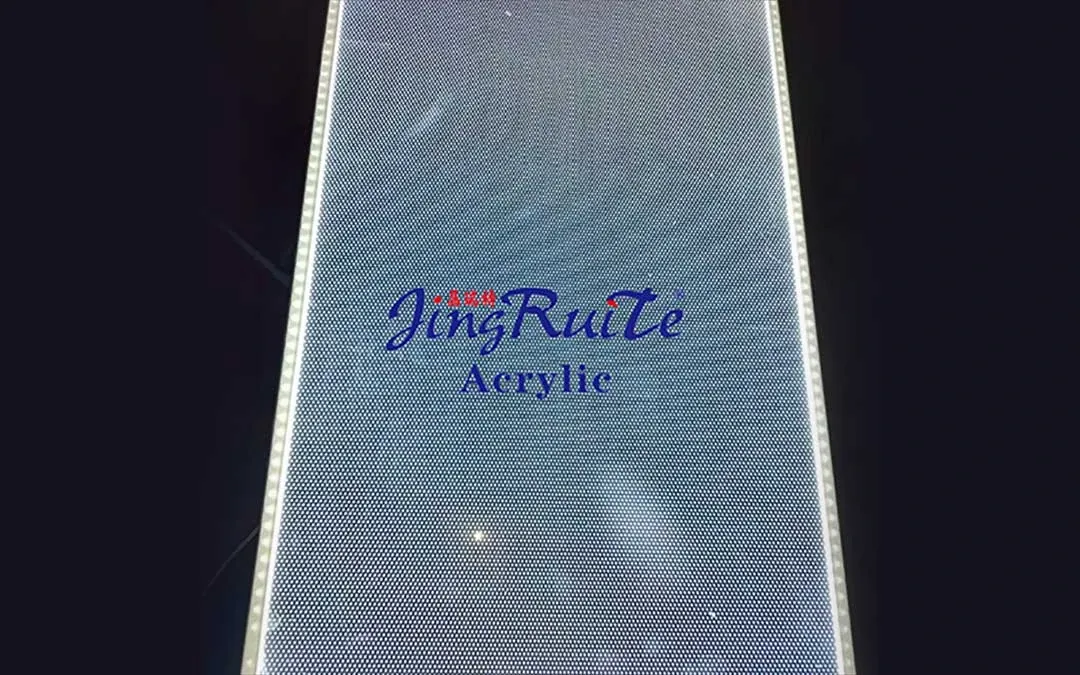

Introduction: Solving Your LED Lighting Material Pain Points
For lighting manufacturers, architects and procurement professionals, it is a key decision to find suitable optical material for LED lamps, which directly affects the lighting quality, durability and cost-effectiveness. Traditional materials, such as glass (fragile and heavy) or standard acrylic resin (poor light diffusion and easy yellowing), usually can not meet the needs of modern LED lighting systems. If you’re searching for a reliable acrylic sheet for lighting that balances performance, versatility, and longevity, LED Light Acrylic Sheet is the solution you need.
LED Light acrylic sheet is a kind of functional optical panel specially designed for LED light sources, which is made by adding nano-scale light diffusion particles on high-purity PMMA substrate. It achieves a perfect balance of high transmittance (85-92%) and high haze (90-98%), making it the core material for LED panel lights, light boxes and decorative lights. Below, we will introduce everything you need to know in detail, from its definition and unique advantages to specifications, applications and installation guide, and provide verified data and clear source notes to ensure credibility.
What Is LED Light Acrylic Sheet? (Definition and Core Functions)
LED light acrylic sheet is a specialized PMMA (polymethyl methacrylate) panel designed exclusively for LED lighting systems, distinct from general-purpose acrylic sheets. Unlike standard acrylic resin (which lacks optical additives and leads to visible LED hot spots), this material integrates uniformly dispersed nano-scale light diffusion particles to manipulate LED light-eliminating hot spots, softening glare and evenly distributing light on the whole surface.
Its core function is twofold: it is not only a high-performance acrylic board (the basic optical substrate of LED lamps) for lighting, but also a special diffusion layer, which transforms concentrated LED point light into a soft and uniform light. Light diffuser acrylic sheet is available in three core series—diffusion plates, light guide plates, and uniform light plates—with thickness ranging from 1.5 mm to 10 mm and a standard size of 1220 × 2440 mm. Custom dot pattern designs are also available, making it adaptable to a wide range of lighting applications, whether you need a reliable substrate for commercial spaces or a top-quality diffuser for residential decorative lighting.
Unique Advantages of LED Light Acrylic Sheet
1. Excellent optical performance
The defining feature of LED light acrylic sheet is its ability to balance high light transmittance and high haze—two metrics that are often mutually exclusive in standard materials. This balance is very important for creating high quality LED lighting without hot spots and glare.
● Light transmittance: 85–92%. This ensures minimal light loss, maximizing energy efficiency for LED fixtures. High-transmission variants reach 92%, ideal for applications where brightness is a priority.
● Haze: 90–98%. This scatters LED point light source into a soft diffuse light, eliminating harsh glare and visible LED chips. Anti-glare models can achieve 98% haze, which is very suitable for offices, hospitals and schools where comfort is crucial.
● Speckle shielding Rate: ≥ 99%, completely shielding a single LED chips, and creating a seamless and uniform smooth surface-a must for high-end LED panel lamps and light boxes.
This optical balance makes it the gold standard for light diffuser acrylic sheet, which is superior to standard acrylic board (low haze, visible hot spots) and glass board (limited diffusion). When selecting a lighting substrate, this optical performance is a key factor to consider, as it directly affects the quality of light your LED Light Acrylic Sheet produces.
2. Exceptional Mechanical Strength for Large-Scale Applications
LED lighting equipment (e.g., large office panel lights and subway light boxes need large-format materials that are resistant to breakage and warping). LED light acrylic sheet delivers.
●Impact strength: 16 kJ/m² (source: ASTM D 256 test method for impact strength of plastic cantilever beam), which is 10-15 times higher than the impact resistance of glass, thus eliminating the risks of damage in transportation, installation and daily use.
●Flexural Strength: ≥ 90 MPa, providing rigidity to support large-size panels (up to 1220 × 2440 mm) without sagging or bending—critical for maintaining optical uniformity.
●Dimensional Stability: Minimal warping or shrinkage under long-term use (source: Industrial Acrylic Material Quality Standards), ensuring consistent light distribution over the fixture’s lifespan.
3. Outstanding Weather & UV Resistance (Long-Term Durability)
LED lighting fixtures are usually installed outdoors, in high temperature or exposed to ultraviolet rays (e.g.,shopping mall signs and landscape lights). LED light acrylic sheet is engineered for longevity.
● Operating Temperature Range: -40℃ to 90℃, in extremely cold and high heat (for example, the heat dissipation of LED lamps).
● Anti-Yellowing Performance: Formulated with UV stabilizers, with a color difference (ΔE) < 3 after 5000 hours of UV exposure (source: UV Resistance Test for Acrylic Materials) —far superior to uncoated acrylic or polycarbonate, which yellow rapidly under UV light.
● Service Life: ≥ 50,000 hours for diffuser plates, ≥ 60,000 hours for light guide plates, matching or exceeding the lifespan of most LED light sources.
4. Excellent heat stability
LED lamps will generate continuous heat in the working process, which can lead to material warping or optical distortion. Light diffuser acrylic sheet addresses this with.
● Thermal deformation Temperature: ≥ 85℃ (diffusion plates) ≥ 90℃ (light guide plates) (source: ASTM D 648 Test method for thermal deformation temperature of plastics), which can keep its shape and optical characteristics even after being heated for a long time.
● Thermal Conductivity: 0.2–0.22 W/ (m · k) (source: ASTM C 177 Test Method for Steady-State Heat Flux Measurements), supporting efficient heat dissipation from LED chips to prevent overheating.
5. Unprecedented processing flexibility
Unlike glass (limited cutting, no thermoforming) or polycarbonate (difficult to engrave), LED Light Acrylic Sheet supports a wide range of precision processing methods—ideal for custom lighting designs.
●Cutting: laser cutting (recommended) to obtain burr-free edges; Diamond saw blade cutting (with water cooling) for large-format panels.
●Engraving: CNC engraving and laser engraving for custom dot patterns (critical for light guide plates).
●Thermoforming: Heated to 140–160℃, with a holding time of 3–5 minutes per mm thickness, enabling curved or shaped lighting fixtures.
6. Eco-Friendly & Compliant with Global Standards
For manufacturers aiming at the international markets, it is very important to comply with environmental laws and regulations. Light diffuser acrylic sheet meets global standards, ensuring it can be used in markets worldwide.
●Environmental Certifications: it conforms to RoHS and REACH standards (source: EU environmental standards) and does not contain harmful substances such as lead, mercury and cadmium.
●Halogen-Free & Low VOC: Non-toxic, with low volatile organic compound emissions (source: Green Material Certification), safe for indoor use in hospitals, schools, and offices.
●Flammability grade: UL 94 V-2 (source: UL flammability standard), meeting fire safety requirements for commercial and industrial lighting applications.






















Sign in to leave a comment.