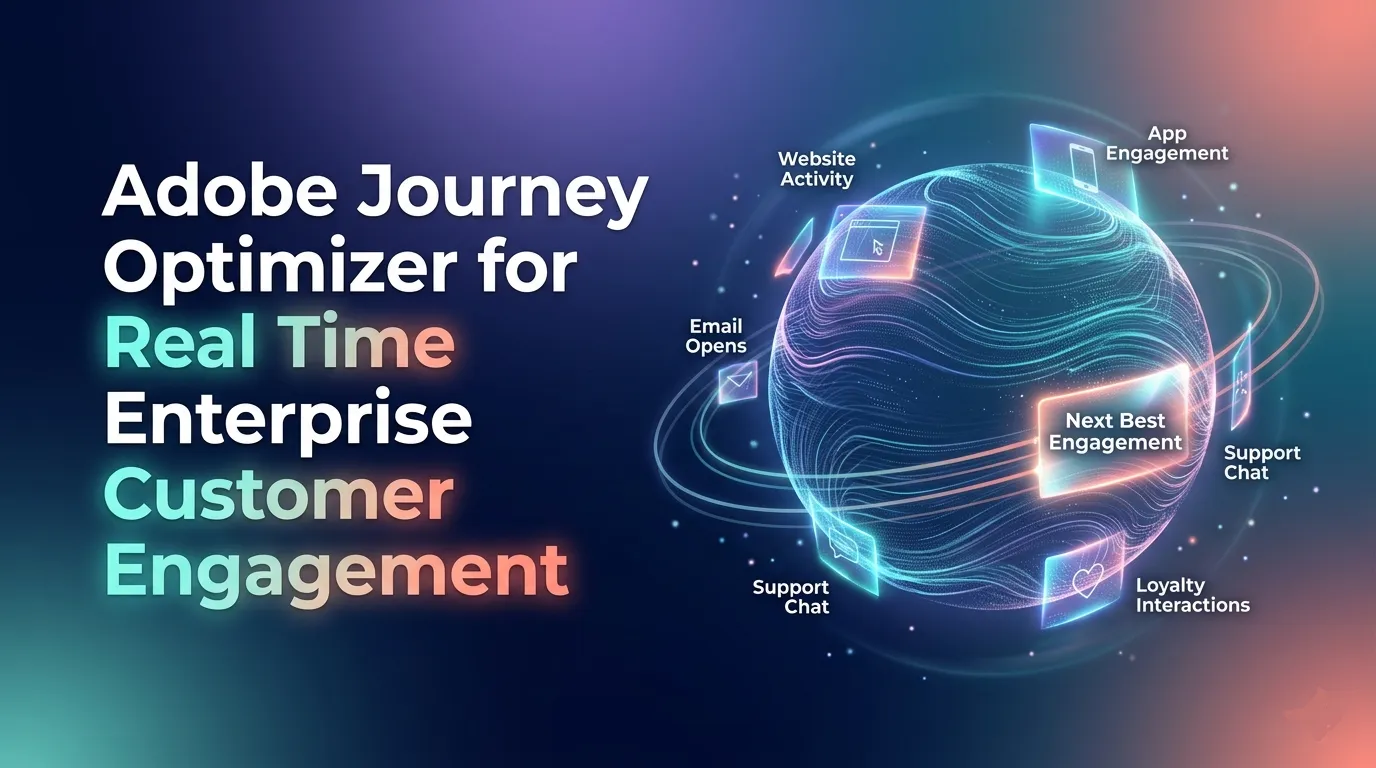

Adobe Journey Optimizer services give enterprise marketing teams the architecture to act on customer behavior instantly, not the next morning. AJO replaces slow, disconnected email service providers with a single platform that combines real-time journey orchestration, unified customer profiles, and AI-driven offer decisioning. Brands that deploy it stop losing conversions to timing gaps and start engaging customers at the exact moment intent peaks.
The Real Cost of Sticking With Legacy ESPs
Most enterprise marketing teams already know their ESP is holding them back. They see it in declining open rates, abandoned carts that go unaddressed, and campaigns that reach customers hours after the moment has passed. The tool is not the only problem, but it is the bottleneck.
How Overnight Batch Processing Loses Customers
Legacy ESPs follow a predictable and costly cycle:
- Pull audience lists from CRM each night
- Run batch segmentation and message assembly
- Deliver email the following morning
- Reach a customer who has already moved on
A cart abandoned at 2:00 PM does not need an email at 8:00 AM. It needs a response within minutes. Every hour of delay narrows the conversion window and widens the gap competitors fill.
Why Context-Aware Engagement Changes Everything
Omnichannel marketing automation treats customer behavior as a live signal, not a data point to process overnight. When a customer escalates a support issue, the system suppresses promotional messaging automatically. When a high-value user browses a premium category repeatedly, the system acts before the session ends. Intent drives timing, not the campaign calendar.
What Adobe Journey Optimizer Actually Does Differently
It Reads Live Customer Profiles, Not Stale Exports
AJO runs natively on Adobe Experience Platform, which means it never imports or syncs data from an external source. It queries the Real-Time Customer Profile directly. When a trigger fires, AJO instantly accesses:
- Full purchase and interaction history
- Current loyalty tier and segment membership
- Active browsing session and product interest signals
Every decision uses the most current version of the customer record, not last night's export.
It Runs Campaigns and Journeys From One Place
Enterprise teams typically maintain separate platforms for bulk sends and automated journeys. AJO removes that split. A marketer runs a high-volume promotional newsletter and a precision geofencing trigger from the same canvas simultaneously. Neither workflow interrupts or overrides the other, and both draw from the same unified customer data.
It Selects the Best Offer at the Moment of Send
Manual offer management breaks down when personalization operates at enterprise scale. AJO's AI decisioning engine eliminates that problem by evaluating every available offer in real time and selecting the highest-ranked option based on:
- Live customer eligibility rules
- Current inventory availability
- Individual predicted conversion propensity
The system injects the winning offer into the outgoing message automatically, before it sends.
Enterprise Results That Justify the Investment
Behavioral Triggers That Recover Lost Revenue
Henkel increased campaign efficiency by 30% after switching to real-time event-based triggers through AJO. The logic runs continuously in the background. When a known customer views a premium product category three times within 48 hours without purchasing, AJO skips the email queue and fires a personalized push notification with a dynamic, time-limited offer — immediately.
For a deeper look at how enterprise teams structure these programs, explore Adobe Journey Optimizer enterprise customer engagement approaches that scale across industries and channels.
Seamless Transitions Between Digital and Physical Channels
Most ESPs drop the thread the moment a customer steps into a store. AJO maintains it. When a customer browses online and then buys in person, AJO immediately:
- Receives in-store point-of-sale data through AEP
- Suppresses all active digital retargeting for that product
- Triggers a post-purchase loyalty and upsell sequence
The customer receives relevant follow-up rather than ads for something they already bought.
Comparing AJO Against Other Enterprise Platforms
Adobe Journey Optimizer
AJO suits enterprises that need real-time responsiveness built on a centralized data foundation. It handles massive B2C scale with millisecond latency, and the Adobe Journey Optimizer B2B Edition brings that same precision to account-based marketing programs targeting complex buying committees.
Salesforce Marketing Cloud
SFMC fits organizations where Salesforce CRM drives all marketing data decisions. It offers deep customization and proven cross-channel automation, but its relational data architecture makes millisecond real-time event streaming difficult to achieve at the level AJO delivers natively.
Braze
Braze serves fast-moving, app-first businesses that prioritize mobile push, SMS, and in-app engagement. It deploys quickly but requires substantial integration work to match the historical enterprise data modeling that AJO provides through its CDP foundation from day one.
What Can Go Wrong and How to Prevent It
AJO amplifies whatever data infrastructure sits beneath it. Two issues consistently determine whether enterprise deployments succeed or stall before they generate value.
Fragmented data produces fragmented journeys. If customer records scatter across disconnected systems without a shared identifier, AJO will orchestrate that confusion at speed. Enterprises must resolve identity and unify data architecture before deployment begins — not after the platform goes live.
Compliance runs at the infrastructure level, not the campaign level. AJO enforces GDPR and CCPA rules through AEP's Data Usage Labeling and Enforcement framework. The moment a customer withdraws personalization consent, the system automatically blocks that profile from every active journey. Marketers do not need to intervene, the platform handles it structurally.
A Realistic Timeline for Enterprise AJO Deployment
Enterprises that rush AJO deployments create logic and data errors that cascade across every journey built on top. A structured four-phase rollout across 12 to 16 weeks prevents that outcome:
- Weeks 1–4 — Data Foundations: Build AEP schemas, establish identity resolution rules, and validate all incoming data streams for completeness and accuracy
- Weeks 5–8 — Event Configuration: Define and map the core business behaviors that will fire journey triggers across channels
- Weeks 9–12 — Journey Migration: Rebuild existing high-value campaigns inside AJO, validate decision logic thoroughly, and train marketing and operations teams
- Weeks 13–16 — Optimization: Switch on AI decisioning models and launch the first net-new real-time use cases that legacy tools could never support
Teams building measurement frameworks alongside the deployment should review Adobe Analytics vs Adobe Customer Journey Analytics early to choose the right reporting layer before going live.
The Shift Toward Agentic AI Orchestration
Manual journey building is approaching its ceiling. The next phase of enterprise orchestration hands decision-making to AI agents that autonomously select the right channel, message, and timing for every individual customer, continuously updating based on live propensity signals. Marketers set strategic parameters and objectives. The system executes and self-optimizes without waiting for human review cycles.
Enterprises that deploy Adobe Journey Optimizer services on a clean, unified data foundation today build the exact infrastructure those agentic capabilities require. When that technology reaches maturity, they activate it, rather than scramble to catch up.

























Sign in to leave a comment.