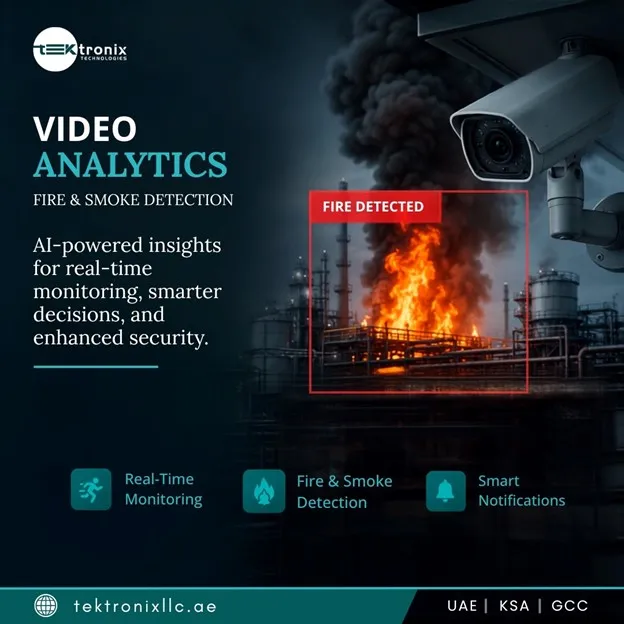

As the UAE continues its rapid expansion of commercial towers, mixed-use developments, and smart infrastructure, fire safety has become one of the most pressing operational priorities for building owners, facility managers, and civil defence authorities alike. Traditional detection systems — smoke alarms, heat sensors, and manual patrol processes — were designed for a different era of building complexity. They react to fire after it has already taken hold, and in a region where high-rise architecture dominates the skyline, that delay can be catastrophic.
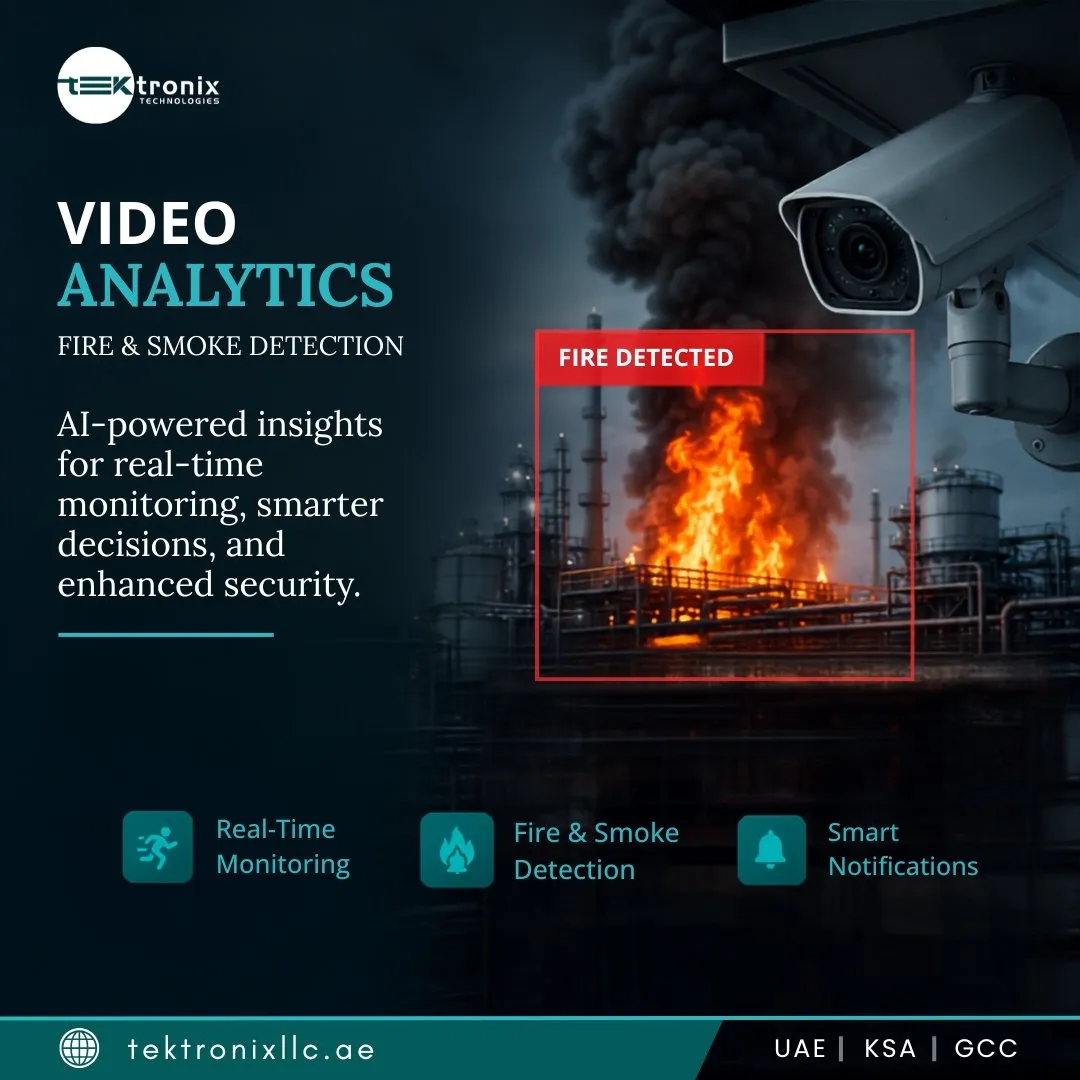
The answer lies in a technology that has fundamentally changed the fire safety equation: Video Analytics. By embedding artificial intelligence directly into the surveillance infrastructure already present in modern buildings, organisations across Dubai, Abu Dhabi, and Sharjah are now detecting smoke and flames within seconds — not minutes — of ignition.
Why Traditional Fire Detection Systems Are No Longer Sufficient
Conventional fire safety relies on threshold-based sensors. A detector trips when smoke density or temperature crosses a preset value. In a compact, enclosed room, this approach is adequate. But in the open-plan offices, atriums, logistics warehouses, and multi-storey retail environments that define modern UAE real estate, the limitations become acute.
The core problems with legacy systems include:
- Delayed detection in large, open, or high-ceiling spaces where smoke disperses before reaching a sensor
- No visual confirmation — security teams cannot distinguish a genuine fire from steam, dust, or cooking fumes without going to the scene
- High rates of false alarms, which erode staff trust and lead to slower responses over time
- Single-point coverage — a sensor covers a fixed radius and cannot adapt to changing floor layouts or occupancy patterns
- No integration with wider building intelligence systems
These gaps are not simply inconvenient — they represent a genuine risk to life and property. The UAE's Civil Defence regulations demand increasingly proactive fire safety postures, and the technology sector has responded with solutions that meet this standard. Chief among them is AI-Powered Video Analytics.
What Is AI-Powered Video Analytics and How Does It Work?
AI-Powered Video Analytics is the application of machine learning and computer vision algorithms to live CCTV video streams. Rather than passively recording footage for later review, the system analyses each video frame in real time, identifying visual patterns associated with smoke, fire, unusual crowd movement, or other hazards.
In a fire detection context, the AI model has been trained on thousands of smoke and flame behaviours across diverse environments — different lighting conditions, camera angles, smoke densities, and fire intensities. When the live feed matches a pattern in its training data, the system flags it immediately and triggers an alert, all without human monitoring.
Key capabilities of AI-powered detection include:
- Early-stage smoke identification — detecting thin wisps of smoke before visible flames appear
- Flame shape and flicker pattern recognition, distinguishing fire from reflected light or glare
- Simultaneous monitoring of dozens or hundreds of camera feeds from a single platform
- Continuous 24/7 operation with no fatigue, distraction, or shift handover gaps
- Mask-aware detection that functions across varying environmental conditions
The result is a detection system that is both faster and more reliable than any sensor-only alternative — a critical advantage in environments where seconds determine outcomes.
Video Analytics Software: The Engine Behind Accurate Detection
The intelligence behind these detection systems is delivered through specialised Video Analytics Software — the platform layer that processes incoming video data, runs AI inference models, manages alert workflows, and presents actionable information to security and operations teams.
This software layer is what differentiates a basic CCTV installation from a fully intelligent safety infrastructure. Core capabilities include:
- Real-time video processing: Frames are analysed at full resolution as they are captured, with zero meaningful delay between detection and alert.
- AI-based pattern recognition: Deep learning models identify fire-related visual signatures with high accuracy, dramatically reducing false positive rates compared to sensor-only systems.
- Customisable detection zones: Operators define specific camera regions where smoke or fire detection is active, concentrating analytical resources on high-risk areas.
- Audit trail and evidence capture: Every detection event is logged with a timestamped video clip, providing the evidentiary record required by insurers and regulatory bodies.
- Integration APIs: The software connects to fire alarm panels, building management systems, access control platforms, and emergency notification services.
When evaluating Video Analytics Software for fire detection, enterprise buyers should assess not only the accuracy of the AI models but also the platform's scalability — its ability to grow from a single building to a multi-site estate without architectural changes.
Video Analytics Solutions: A Complete Fire Safety Ecosystem
An enterprise fire safety programme built on AI does not consist of software alone. Complete Video Analytics Solutions encompass the hardware, software, integration, and managed services components that together create a coherent, end-to-end safety infrastructure.
A fully deployed solution typically includes:
- High-definition IP cameras positioned for optimal coverage of high-risk zones, corridors, and open areas
- Edge or server-based AI analytics engines that process video locally for low-latency detection
- A centralised monitoring dashboard giving security operations teams a real-time picture of all active camera feeds and alert statuses
- Automated alert routing — sending notifications to the correct response teams via app, SMS, email, or integrated fire panel
- Integration with suppression systems, evacuation protocols, and emergency lighting
- Ongoing model updates to maintain detection accuracy as environments and use patterns evolve
Tektronix LLC designs and deploys these end-to-end Video Analytics Solutions across the UAE, tailoring each installation to the specific risk profile, layout, and regulatory requirements of the facility. Whether the environment is a corporate headquarters, a hospital, a logistics hub, or a government building, the solution architecture is configured for the specific demands of that space.
Real-Time Hazard Detection: Acting Before the Incident Escalates
The defining advantage of AI-driven fire safety is captured in two words: Real-Time Hazard Detection. The shift from reactive to proactive safety posture is not merely incremental — it is a fundamental change in what building security can achieve.
Traditional fire detection is forensic: it tells you fire has occurred once the conditions have already reached a triggering threshold. Real-Time Hazard Detection tells you fire is developing — identifying the earliest visual indicators of smoke or flame before a conventional sensor would register anything.
The operational impact of this shift includes:
- Emergency response teams are dispatched during the ignition phase rather than after fire has spread
- Suppression systems can be activated earlier, containing damage to a fraction of what it would otherwise be
- Evacuation procedures begin sooner, reducing the risk of occupant exposure to smoke
- Insurance claims are supported by precise, timestamped visual evidence of the incident origin and progression
- Post-incident analysis enables facility managers to identify and remediate contributing risk factors
In the context of the UAE's densely occupied high-rise environment, where a fire event in one zone can have cascading implications for the entire building, the value of early detection cannot be overstated. Real-Time Hazard Detection is not a premium feature — it is the baseline that responsible building management demands.
Video Analytics UAE: Deployment Across All Building Types
Video Analytics UAE deployments are as varied as the country's built environment. From the financial towers of the DIFC to the industrial logistics corridors of Jebel Ali, from government campuses in Abu Dhabi to hospitality complexes along the Sharjah waterfront, the application of AI fire detection crosses every sector.
- Commercial and Corporate Environments
High-occupancy office buildings present particular challenges for fire safety: large floor plates, partitioned open-plan areas, server rooms, and continuous movement of employees and visitors. Video Analytics allows continuous monitoring of all zones simultaneously, with detection that operates independently of occupancy levels.
- Healthcare and Pharmaceutical Facilities
Hospitals, clinics, and pharmaceutical manufacturing environments combine high occupancy with sensitive equipment and vulnerable occupants. Early fire detection is not only a safety requirement but a regulatory mandate. AI-powered systems provide the accuracy needed to avoid the false alarms that cause unnecessary patient disruption.
- Industrial and Logistics Parks
Warehouses, manufacturing plants, and port-adjacent logistics facilities operate with high concentrations of flammable materials and machinery. Large, open spaces make sensor-based detection unreliable, but video analytics excels precisely here — cameras positioned at height can monitor vast floor areas with a single feed.
- Hospitality and Retail
Hotels, shopping malls, and mixed-use retail developments must meet stringent civil defence requirements while managing the guest and customer experience. Video analytics provides the detection accuracy needed to respond decisively to real incidents while dramatically reducing costly false alarm disruptions.
- Government and Institutional Buildings
Government facilities, educational campuses, and cultural institutions require fire safety systems that meet the highest audit and compliance standards. AI detection provides the detailed access logs and evidentiary video records that institutional environments require.
Video Analytics Dubai: Meeting the Standards of the World's Most Dynamic City
Dubai's building stock is among the most architecturally ambitious on the planet. Super-tall towers, complex mixed-use developments, and free zone campuses with thousands of daily users represent a fire safety challenge of extraordinary scale. Video Analytics Dubai deployments by Tektronix LLC address this complexity directly.
Dubai Civil Defence mandates increasingly sophisticated fire safety systems as part of building approvals and operational licences. AI-powered video detection supports compliance with these requirements while providing operators with a level of situational awareness that exceeds the baseline standard. For businesses in the DIFC, Business Bay, JLT, and the major free zones, investing in Video Analytics Dubai infrastructure is both a regulatory necessity and a business continuity imperative.
Video Analytics Abu Dhabi: Protecting the Capital's Institutional and Commercial Infrastructure
Abu Dhabi's built environment spans government ministries, financial institutions, healthcare campuses, and the rapidly expanding urban districts of Al Reem Island and Saadiyat. Each of these environments carries specific fire safety obligations and operational risk profiles. Video Analytics Abu Dhabi deployments are designed to meet the capital's distinct regulatory landscape, including ADDC requirements and the heightened data security expectations of government-linked facilities.
Tektronix LLC's Video Analytics Abu Dhabi installations prioritise on-premise data processing, ensuring that video streams and alert records remain within the client's own infrastructure — a critical requirement for many institutional clients in the emirate.
Video Analytics Sharjah: Industrial-Grade Detection for the Northern Emirates
Sharjah's industrial zones, manufacturing corridors, and logistics parks create some of the highest fire risk environments in the UAE. Large facilities with combustible inventories, shift-based workforces, and complex machinery require detection systems that can cover extensive areas continuously and accurately. Video Analytics Sharjah deployments leverage the specific capabilities of AI-powered systems to address the challenges of industrial environments — where smoke can travel across vast open spaces before reaching a conventional sensor.
Tektronix LLC's Video Analytics Sharjah projects are engineered for industrial-grade reliability, with hardware specified for the temperature ranges, humidity levels, and particulate conditions typical of heavy industrial and logistics environments.
Integration with Smart Building Ecosystems
One of the most strategically valuable aspects of modern Video Analytics Solutions is their capacity to integrate with the broader intelligent building infrastructure. Fire detection does not operate in isolation — its effectiveness is multiplied when it works in concert with the other systems managing the building environment.
Integration capabilities include:
- Fire alarm panels and suppression systems — automatic activation based on AI detection events
- Building Management Systems (BMS) — coordinated response including HVAC shutdown to prevent smoke spread
- Access control — automatic door release for evacuation routes and lockdown of affected zones
- CCTV and video management platforms — unified interface for security operations teams
- Emergency notification systems — simultaneous alerts to facility managers, security teams, and civil defence
- HR and occupancy platforms — live headcount data to support evacuation mustering
This integration capability transforms video analytics from a standalone detection tool into the sensory layer of a fully intelligent building safety ecosystem — the foundation on which proactive, coordinated emergency response is built.
The Future of Fire Detection Technology in the UAE
The UAE's commitment to smart city infrastructure and the Vision 2031 agenda ensures that the technology curve for building safety will continue to steepen. Several emerging developments will shape the next generation of Video Analytics Solutions in the region:
- Edge AI processing: Moving inference computation onto the camera device itself, reducing latency to near-zero and maintaining detection capability during network disruptions.
- Predictive risk analytics: Machine learning models that identify environmental conditions associated with elevated fire risk before any smoke or flame appears, enabling truly preventive safety management.
- IoT sensor fusion: Combining video analytics data with air quality sensors, temperature monitors, and gas detectors to create multi-modal hazard detection with near-zero false positive rates.
- Cloud-native management platforms: Centralised administration of fire detection policies and alert data across geographically distributed building estates through secure cloud infrastructure.
- Digital twin integration: Linking video analytics data to 3D building models to give emergency responders precise visual context during incident response.
Organisations that invest in AI-powered Video Analytics infrastructure today are not only addressing their current fire safety obligations — they are building the foundation for these next-generation capabilities as they mature.
Conclusion
Fire safety in modern UAE buildings can no longer rely solely on threshold-triggered sensors and reactive detection. The speed, scale, and complexity of the country’s-built environment demand intelligent, proactive systems that identify hazards at the earliest possible moment and trigger coordinated responses before situations escalate.
Video Analytics — and specifically the application of AI-Powered Video Analytics to fire detection — represents the most significant advance in building safety technology of the past decade. Delivered through sophisticated Video Analytics Software and deployed as complete end-to-end Video Analytics Solutions, these systems bring Real-Time Hazard Detection capability to every building type and occupancy profile.
Across Video Analytics UAE deployments — from Video Analytics Dubai commercial tower installations to Video Analytics Abu Dhabi institutional facilities and Video Analytics Sharjah industrial environments — Tektronix LLC brings the regional expertise, certified engineering capability, and ongoing support infrastructure to ensure every project delivers its full safety potential.
FAQs
1. What is the difference between Video Analytics and a standard CCTV system for fire detection?
A standard CCTV system records video footage for review after an event. Video Analytics applies AI algorithms to the live video feed, analysing every frame in real time to detect visual indicators of smoke or fire as they develop. The result is a system that actively identifies hazards and triggers alerts without any human monitoring — rather than simply recording an incident for post-event review.
2. How does AI-Powered Video Analytics reduce false fire alarms?
AI-Powered Video Analytics uses deep learning models trained to recognise the specific visual signatures of smoke and fire — distinguishing them from steam, dust, reflections, and other visual phenomena that commonly trigger false alarms in sensor-based systems. The AI analyses shape, movement, colour, and pattern characteristics simultaneously, producing a detection decision that is far more nuanced than a simple threshold comparison. The result is dramatically higher accuracy and fewer disruptive false alerts.
3. Can Video Analytics Software integrate with our existing fire alarm and building management systems?
Yes. Leading Video Analytics Software platforms are designed with open integration architecture, supporting standard communication protocols used by fire alarm panels, building management systems, access control platforms, and emergency notification services. Tektronix LLC's implementation process includes a full integration scoping phase to ensure the analytics platform connects seamlessly with your existing safety and building infrastructure.
4. Are Video Analytics Solutions suitable for outdoor and semi-outdoor environments in the UAE's climate?
Video Analytics Solutions deployed in the UAE are specified with hardware rated for the Gulf region's extreme heat, humidity, and dust conditions. Camera enclosures carry appropriate IP and IK ratings for outdoor and semi-outdoor environments, and AI detection models are trained to operate accurately across the full range of lighting conditions encountered in the UAE — from intense direct sunlight to low-light night-time environments.
5. What is the typical deployment process for Video Analytics UAE fire detection projects?
A standard Video Analytics UAE deployment by Tektronix LLC follows a structured five-phase process: (1) fire risk assessment and site survey; (2) system design covering camera placement, analytics configuration, and integration architecture; (3) hardware installation and software deployment; (4) AI model calibration and detection zone configuration; and (5) staff training, system testing, and formal handover. Post-deployment support includes preventive maintenance, firmware updates, and a 24/7 technical helpdesk with on-site response capability across Dubai, Abu Dhabi, and Sharjah.
For more information contact us on:
Tektronix Technology Systems Dubai-Head Office
+971 50 814 4086
AI-Powered Video Analytics
Video Analytics Software
Video Analytics Abu Dhabi






















Sign in to leave a comment.