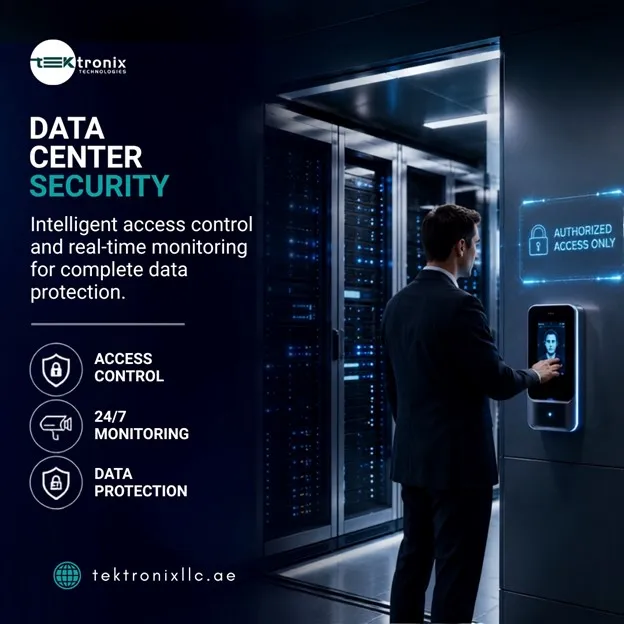

Government data centers hold the systems that keep ministries, courts, and municipal services running, which makes them a very different kind of building to secure than a typical office. Data Center Security for these facilities has to account for someone walking through a server hall, a network intrusion attempt, and everything in between — a scope far wider than a locked door and a camera in the lobby.
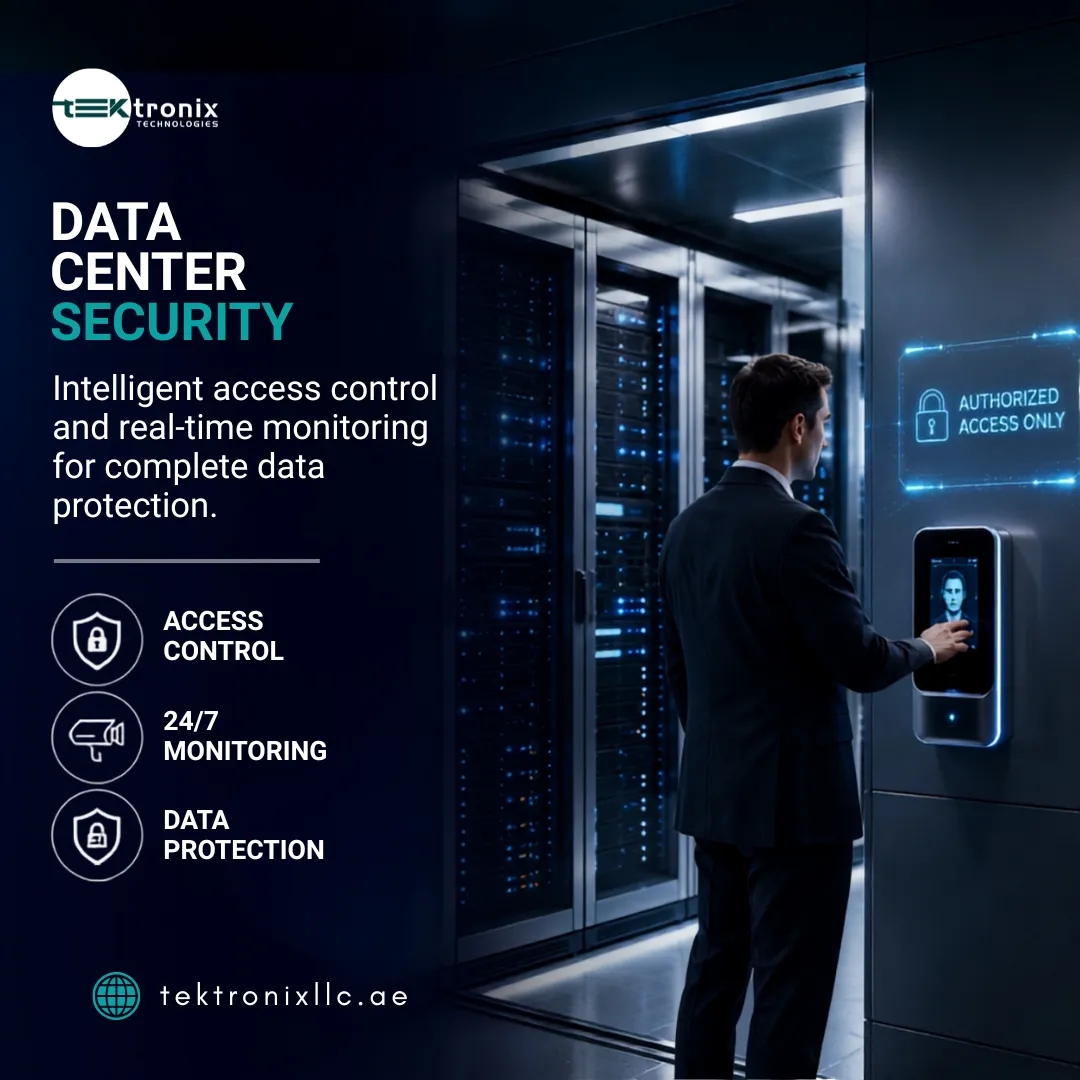
Why UAE Public Sector Data Centers Need a Layered Security Strategy
A government data center is rarely just a room full of servers — it's the physical location where citizen records, judicial case files, and inter-agency communications actually live. Losing physical control of that room, even briefly, can matter as much as a network breach, since a person with hands-on access to a rack can bypass digital protections entirely. Facilities operating under SIRA licensing requirements and NCEMA's guidance on critical infrastructure protection are expected to demonstrate that physical and digital safeguards are planned together, rather than treated as two separate projects run by two separate teams that rarely compare notes.
What Comprehensive Data Center Security Involves
A complete security posture for a government facility spans several distinct but connected layers: controlling who can physically reach the server floor, watching that floor continuously, detecting a physical breach attempt the moment it happens, and coordinating all of this with the network-level protections the IT team already runs. None of these layers works well in isolation — a locked door means little if there's no camera confirming who used the badge, and a firewall alert means less if there's no way to check whether someone was physically in the server room at the same moment.
Data Center Access Control: Restricting Who Reaches the Server Floor
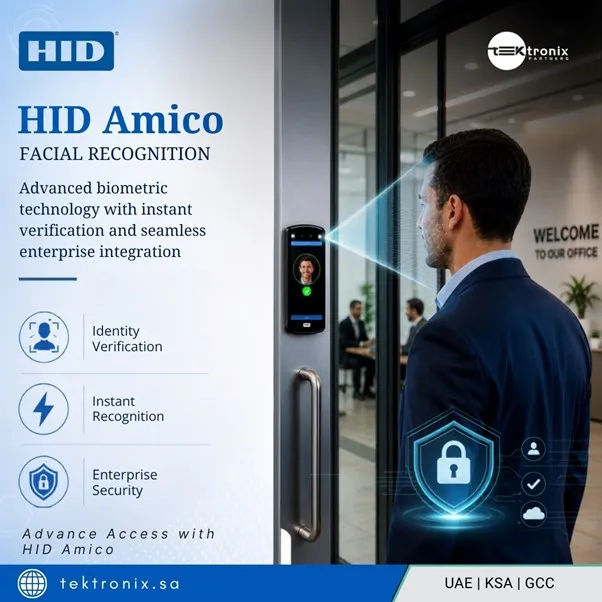
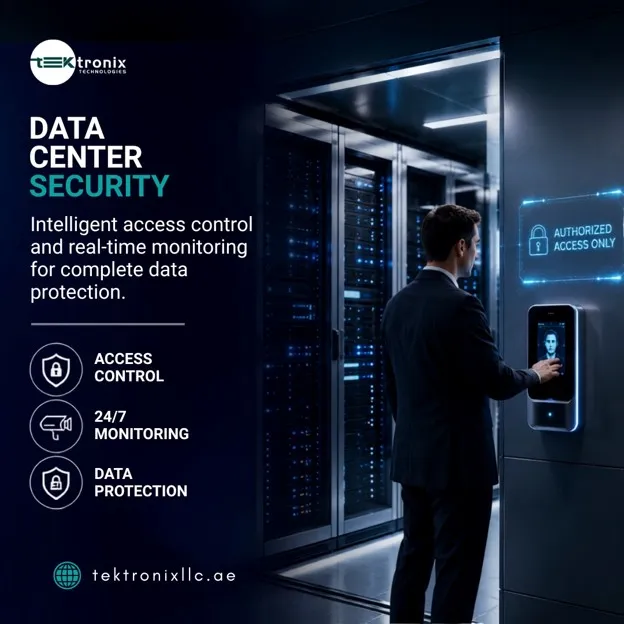
The first layer, and often the most visible one, is Data Center Access Control — governing every door between the building's main entrance and the racks themselves, not just the front door. Government data centers typically apply progressively stronger verification at each layer: a badge at the building entrance, a badge plus PIN at the data hall corridor, and biometric or two-person verification at the cabinet level for the most sensitive equipment. This tiered approach means a single stolen credential doesn't grant someone a straight walk to the servers.
Data Center Surveillance: Continuous Visual Oversight of Critical Zones
Access logs tell you which credential opened a door; cameras confirm who was actually holding it. Data Center Surveillance deployed across entry points, corridors, and the data hall itself gives security teams a visual record that access logs alone can't provide, and modern video analytics can flag loitering near a rack, an unusually long door-open duration, or a person entering without an accompanying badge event — surfacing anomalies for review rather than relying on someone watching every camera feed in real time.
Data Center Intrusion Detection: Catching Physical Breaches in Real Time
Beyond routine access monitoring, a dedicated Data Center Intrusion Detection layer watches for the specific signs of a forced or unauthorized entry — a door held open past its allowed duration, a forced door contact sensor triggering without a valid badge event, or motion detected in a supposedly empty data hall after hours. These events are configured to escalate immediately to security staff rather than sit in a log reviewed the next morning, since the minutes immediately following a physical breach attempt are usually when a response matters most.
Cybersecurity for Data Center: Where Physical and Digital Security Meet
Physical safeguards and network defenses ultimately protect the same asset, which is why Cybersecurity for Data Center operations increasingly overlaps with the physical security plan rather than running as a completely separate workstream. Correlating a physical access event with a corresponding network login attempt — confirming that whoever authenticated remotely was also, or wasn't, physically present — gives IT and security teams a joint picture that neither system produces on its own. Tektronix LLC's role in this coordination is on the physical security side, working alongside a client's existing IT and cybersecurity teams so both layers are designed with the other in mind rather than as an afterthought.
Data Center Encryption: Protecting Data at Rest and in Transit
Even with strong physical barriers in place, government data centers still need to assume a device could eventually be removed or a connection intercepted, which is where Data Center Encryption comes in. Encrypting data at rest on storage media and in transit across network links means that even in a worst-case physical compromise, the information on a stolen drive or intercepted transmission remains unreadable without the corresponding keys — a safeguard that operates independently of whether a door was ever actually breached.
Data Center Firewalls: Controlling Network Perimeter Traffic
On the network side, Data Center Firewalls filter and inspect traffic entering and leaving the facility's systems, blocking connections that don't match approved rules and logging attempts that do get flagged. For government data centers handling inter-agency traffic, firewall policies typically need to account for multiple departments with different access requirements, making rule management and regular review a continuous responsibility rather than a one-time configuration exercise handled at commissioning and left alone.
Data Center Threat Detection: Correlating Physical and Digital Signals
Bringing the physical and digital layers together is the role of coordinated Data Center Threat Detection, which looks for patterns across both domains rather than treating a badge log and a network alert as unrelated data streams. A repeated failed badge attempt at the data hall door occurring alongside an unusual login attempt on the same account, for instance, is a much stronger signal than either event reviewed in isolation — and surfacing that correlation quickly is what separates a mature security operation from two departments each watching their own dashboard.
Auditing and Incident Response Readiness
A security system's real test isn't day-to-day operation — it's how quickly a facility can reconstruct events after something goes wrong. Government data centers benefit from running periodic tabletop exercises where security and IT teams simulate a physical breach or an unusual access pattern and practice pulling the combined access log, video, and network record within a defined time window. Facilities that rehearse this process ahead of time consistently produce faster, more complete incident reports than those attempting it for the first time during an actual event, when time pressure and missing familiarity with the tools both work against a thorough response.
Vendor and Third-Party Access Management
Data centers regularly need to admit outside parties — hardware vendors performing maintenance, auditors reviewing compliance, or contractors servicing cooling and power systems — none of whom should carry the same standing access as permanent staff. A well-configured deployment issues these visitors time-boxed, escorted, or zone-restricted credentials tied to a specific work order, so a vendor's access automatically expires once the maintenance window closes rather than lingering as an unused but still-active credential months later.
Environmental and Fire Risk Considerations Alongside Security
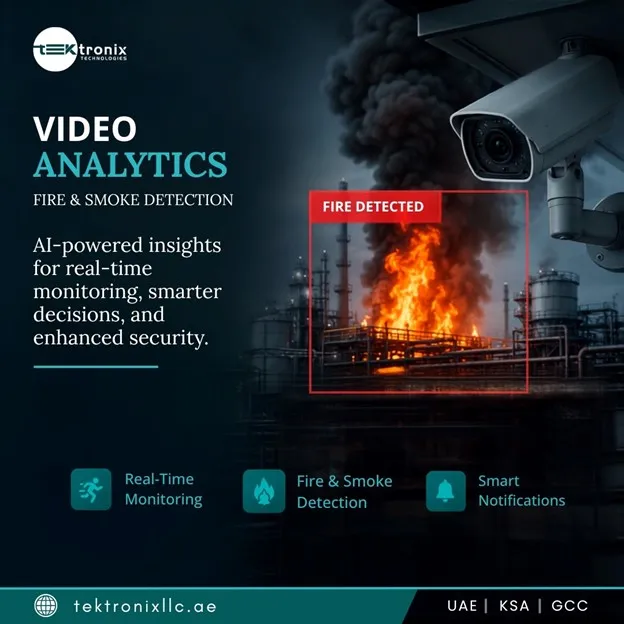
Physical security for a data center rarely stops at intruders — environmental risk sits right alongside it, since a fire, flood, or cooling failure can take a facility offline just as effectively as a breach. Integrating environmental monitoring with the same access control and surveillance platform means a temperature or smoke alert can trigger the same escalation workflow as a forced-door event, giving security staff one unified system to watch rather than a separate building-management console that nobody checks until something has already gone wrong.
Two-Person Rule and Insider Threat Mitigation
Not every risk to a data center comes from outside the organization. A two-person access rule — requiring two authorized badges within a short window before a cabinet or data hall door unlocks — reduces the chance that a single compromised or disgruntled employee can act alone at the most sensitive points in the facility. Combined with access logs that clearly show which two credentials were used together for any given entry, this creates accountability that a single-badge system can't provide, and is increasingly standard practice at government facilities handling classified or highly sensitive records.
Business Continuity and Disaster Recovery Alignment
Security planning for a government data center needs to account for what happens if the primary facility becomes unavailable, not just how well it's protected day to day. Coordinating physical security policy between a primary site and its disaster recovery facility — matching access tiers, surveillance coverage, and intrusion detection configuration across both — avoids a scenario where a failover site ends up less protected than the facility it's meant to replace during an actual emergency.
Deploying Data Center Security UAE-Wide
Rollout priorities differ across the country, but the underlying approach stays consistent: tier access by sensitivity, monitor continuously, and keep physical and digital teams coordinated. A Data Center Security UAE deployment for a federal or municipal facility typically begins with an assessment of the data hall's current risk exposure — door count, existing camera coverage, and integration gaps with the network security team — before hardware selection and installation begin. Tektronix LLC has carried out this assessment-first approach across several UAE government facilities, avoiding the common mistake of installing hardware before understanding which doors and zones actually carry the greatest risk.
Data Center Security Dubai: Considerations for High-Density Facilities
Dubai's data center footprint tends to combine dense, multi-tenant facilities with high-value government workloads sharing infrastructure alongside private sector tenants. Data Center Security Dubai deployments in this environment often need to demonstrate strict segregation between a government tenant's racks and neighbouring commercial tenants, with access control and surveillance configured so that a government agency's zone remains fully isolated even within a shared facility.
Data Center Security Abu Dhabi: Federal and Critical Infrastructure Sites
Abu Dhabi hosts a concentration of federal data infrastructure supporting ministries and critical national services, where security requirements are frequently set at a national policy level rather than left to individual facility managers. Data Center Security Abu Dhabi projects commonly require closer coordination with federal digital-identity and infrastructure protection frameworks from the earliest planning stages, making early alignment between the integrator, the client's IT team, and the relevant regulatory body a bigger factor in timeline than the physical installation itself.
Regulatory Alignment and Compliance
Government data centers sit at the intersection of several regulatory expectations at once — UAE PDPL principles for the personal data many of these systems store, SIRA requirements for the physical security equipment protecting the building, and sector-specific standards depending on which ministries or agencies the facility serves. A properly documented deployment keeps access logs, video retention, and incident records in a format that can be produced quickly during an audit, rather than assembled after the fact from systems that were never designed to talk to each other.
Why Tektronix LLC Is Trusted for Data Center Perimeter Security
Tektronix LLC is a SIRA-licensed systems integrator with direct experience securing government and semi-government data center facilities across the UAE, building perimeter and interior security around manufacturer-certified hardware from Hikvision, Dahua, Axis, HID Global, Suprema, and video management platforms including Genetec and Milestone. Every deployment is scoped to work alongside a client's existing network security team rather than in isolation, so physical and digital protections are designed as one coordinated plan. Facility managers evaluating an integrator for a new or upgraded deployment can review the data center perimeter security solutions for government facilities page for the hardware options, compliance documentation, and support model used on completed UAE projects.
Implementation Best Practices for Government Data Center Security
- Tier access progressively from the building entrance to the cabinet level rather than applying one uniform badge policy everywhere.
- Pair every access-controlled door with a camera covering it, so badge logs and video can always be cross-referenced.
- Configure intrusion alerts to escalate immediately to on-duty security staff rather than sitting in a log for next-day review.
- Schedule joint reviews between physical security and network security teams so access and login anomalies are checked together.
- Align video, access log, and incident retention periods with the facility's regulatory obligations rather than a generic default.
Conclusion
Protecting a UAE public sector data center now means treating physical and digital defenses as one coordinated plan rather than two separate projects. Comprehensive Data Center Security starts with tiered Data Center Access Control and continuous Data Center Surveillance, backed by Data Center Intrusion Detection that flags a physical breach the moment it happens. Layered alongside Cybersecurity for Data Center operations, Data Center Encryption, Data Center Firewalls, and correlated Data Center Threat Detection, it gives ministries, municipalities, and federal agencies a defensible answer to both who can reach a server room and what happens on the network around it. Organizations planning a Data Center Security UAE, Data Center Security Dubai, or Data Center Security Abu Dhabi project can review Tektronix LLC's data center perimeter security for the hardware, compliance framework, and support model behind completed public sector deployments.
Frequently Asked Questions
1. How is data center security different from standard office building security?
Data centers require tiered, progressively stricter access from the entrance to the cabinet level, continuous surveillance of the data hall itself, and coordination with the network security team — layers a typical office deployment usually doesn't need.
2. Does physical security integration replace our existing cybersecurity setup?
No. Physical security and cybersecurity operate as complementary layers protecting the same facility; a well-planned deployment coordinates the two rather than replacing either one.
3. Can surveillance and access control systems flag suspicious activity automatically?
Yes. Modern platforms can flag anomalies such as doors held open too long, unaccompanied entries, or after-hours motion in restricted zones, escalating them to security staff rather than requiring manual review of every log.
4. How are access logs and video footage retained for compliance purposes?
Retention periods are typically set according to the facility's regulatory obligations and internal records policy, with logs and footage stored in an exportable format for audit or investigation purposes.
5. Is this approach suitable for shared or multi-tenant data center facilities?
Yes. Deployments in shared facilities are commonly configured to fully segregate a government tenant's racks, access rights, and surveillance coverage from neighbouring commercial tenants within the same building.
For more information contact us on:
Tektronix Technology Systems Dubai-Head Office
+971 50 814 4086
Data Center Security
Data Center Access Control
Data Center Surveillance
























Sign in to leave a comment.