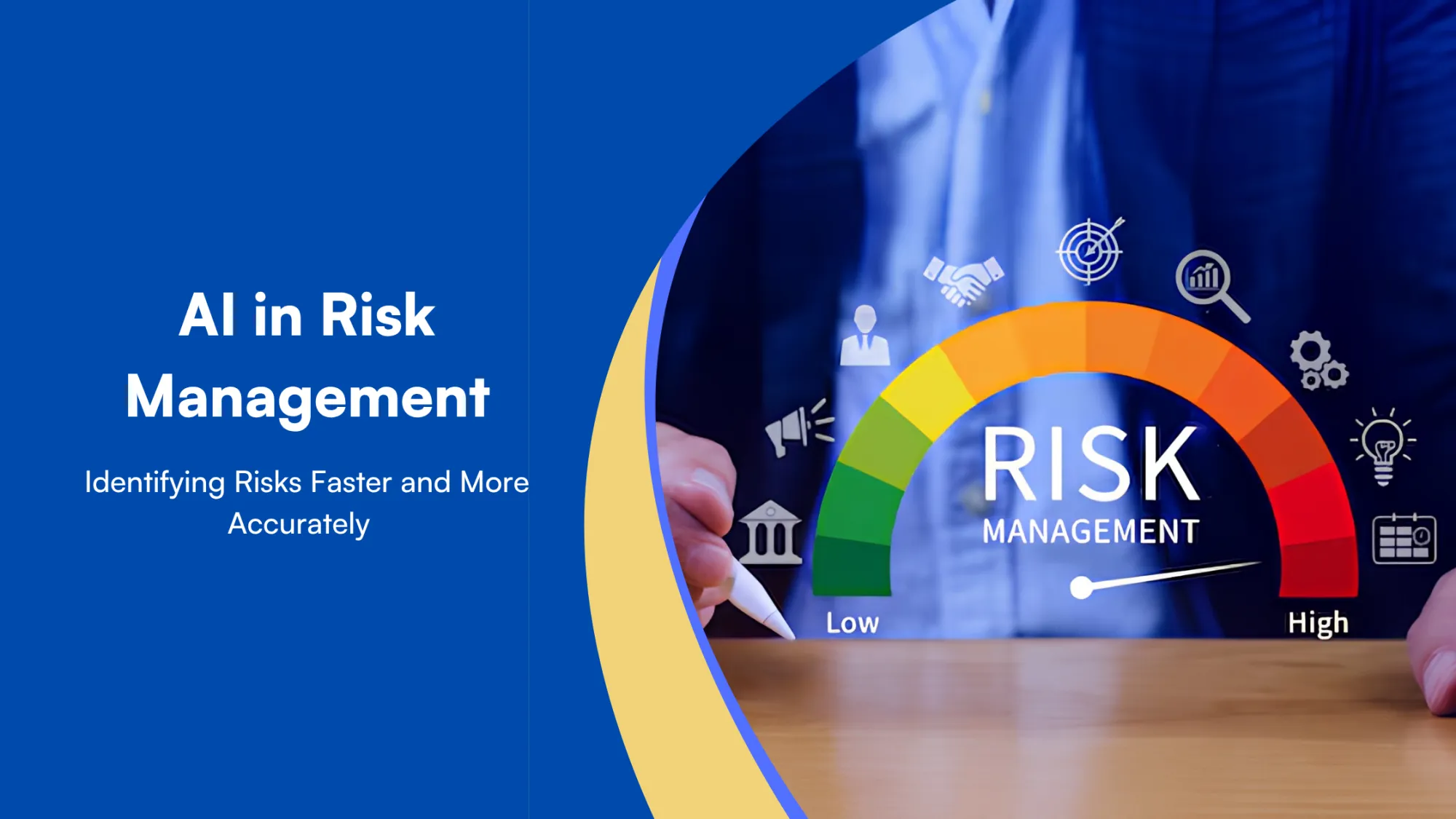

Risk management used to be like checking the weather by looking out the window once a week. You saw the storm only when the clouds were already gray and the wind was picking up. By then, your only choice was to run for cover. In the modern business environment, that approach is a recipe for disaster. You need a 24/7 radar that spots the storm while it is still a tiny dot on the horizon.
This is where AI in Risk Management changes the equation. It shifts the entire focus of a business from reacting to what happened yesterday to predicting what might happen tomorrow. Instead of looking at old spreadsheets, you are using an intelligent layer of software that scans your data in real-time to find the glitches, the fraudsters, and the holes in your defense before they cost you a dime.
Role of AI in Risk Management: The Proactive Shift
The role of AI in risk management is to act as a bridge between massive, messy datasets and actual decisions. Human teams have a natural limit. They can only read so many transaction logs or news reports in a day. Artificial intelligence solutions do not have that limit. They process structured data, like numbers in a database, and unstructured data like news sentiment or legal text at speeds that make human effort look like it is standing still.
By using AI/ML solutions, a company moves away from "gut feeling" and toward empirical evidence. These systems identify patterns and correlations that are invisible to the naked eye, such as a tiny shift in how a vendor behaves or a subtle change in market volatility.
Spotting the Ghost: Identifying Risks Faster and More Accurately
This is the core of why businesses are moving to these systems. Accuracy in risk detection comes from the ability of machine learning to learn what normal looks like so it can instantly flag anything that is abnormal.
1. Pattern Recognition and Behavioral Anomalies
In financial services, identifying fraud used to take days of manual review. Now, systems analyze transactions in less than 50 milliseconds. By building multi-dimensional pathways including looking at location, device type, and even how a user moves their mouse, these artificial intelligence solutions can improve fraud detection rates by up to 300%. They don't just see a credit card number; they see a behavior.
2. Predictive Maintenance and Operational Stability
For manufacturers or utility plants, a broken machine means a broken budget. Machine learning models ingest sensor data to forecast when a part will fail. This allows for repairs during scheduled downtime rather than a sudden emergency stop. Research shows this lead to 30% fewer incidents and a massive drop in repair costs.
3. Real-Time Compliance and News Scanning
Natural Language Processing (NLP) allows a system to scan thousands of pages of new regulations or global news for potential threats. If a new trade law passes in another country that affects your supply chain, the AI flags it before your legal team has even had their morning coffee.
| Capability | Impact on Detection | Result |
|---|---|---|
| Pattern Recognition | Detects subtle shifts in data | 300% better fraud detection |
| Predictive Analytics | Forecasts failures before they happen | 30% fewer disruptions |
| NLP Scanning | Automates regulatory mapping | Real-time compliance updates |
The Toolkit: AI Risk Management Tools
When you start looking for AI risk management tools, you will find the market is split into a few main camps.
- Governance and Ethics: Tools like Credo AI or IBM Watson help you keep your models honest. They map your internal controls to frameworks like the NIST AI Risk Management Framework to ensure your AI isn't building in its own biases.
- Security Posture: Platforms like AccuKnox focus on the "Zero Trust" side of things. They block threats in the AI pipeline itself, protecting your data from prompt injection or model theft.
- Integrated Risk Management (IRM): Platforms like OneTrust or MetricStream aggregate everything, from audit logs to vendor risks, into a single dashboard for the board to see.
AI Software Testing: The Reliability Anchor
You cannot trust a risk system if you haven't tested the system itself. This is where AI software testing comes in. Unlike old software, these models are "probabilistic," meaning they can change over time.
A specialized AI/ML Development Company uses a specific matrix to prioritize testing. They look at the likelihood of a failure versus the business impact. For example, a failure in your payment gateway is a "Critical" risk, while a glitch in a profile picture uploader is "Low."
| Likelihood / Impact | Low Impact | Medium Impact | High Impact |
| High Likelihood | Medium Priority | High Priority | Critical Priority |
| Medium Likelihood | Low Priority | Medium Priority | High Priority |
| Low Likelihood | Low Priority | Low Priority | Medium Priority |
By using automated testing, teams can run "judge" models that verify the accuracy of the primary AI. This ensures that as the world changes, your risk detection remains steady.
Moving to a Proactive Future
Transitioning to these technologies is not something you do overnight. It usually starts with a 4-to-6-week assessment to see if your data is ready. From there, you build a pilot to prove the value in one specific area, like sales or supply chain, before scaling across the whole company.
If you want to see how a modern framework looks in practice, you can explore this guide on AI risk management frameworks.
Final Thoughts
The goal of AI in Risk Management is to give you back your time. When the software handles the tedious job of watching every single transaction and sensor, your team can focus on strategy and growth. Success belongs to the owners who stop treating risk like a "box to check" and start treating it like a data problem that can be solved.
Building these systems takes a mix of data science and security expertise. Partnering with a dedicated AI/ML Development Company provides the technical backbone needed to set up these pipelines without the trial-and-error that slows most companies down. It is time to stop looking out the window and start building your radar.


















Sign in to leave a comment.