
Sandra owns a property management company in Austin. She has 340 units across six properties and a front office that fields calls about maintenance requests, lease inquiries, move-in scheduling, and after-hours emergencies. She has been using a live answering service for three years. Last month, she got her renewal quote: $1,240 per month, reflecting rate increases for after-hours coverage, a new holiday surcharge, and an overage charge from December when call volume spiked.
She sat down to calculate what she had actually paid in the prior twelve months. The base rate was $640 per month, but the true average - including after-hours premiums, two months of overages, a script update fee, and the holiday surcharge - was $967 per month. Nearly $11,600 for the year. She had been budgeting $7,680 and absorbing the overages as surprises.
The comparison she ran that afternoon was not complicated. An AI phone answering service that handled the same call types - maintenance request intake, leasing questions, after-hours emergency routing - was available for $199 per month, flat, with no per-minute charges, no after-hours premium, no holiday surcharge, and no overage fees.
The performance data she found showed AI answering services resolving 90 to 95 percent of calls without escalation, answering in under five seconds, and operating at 99 percent uptime. She switched the following week. The monthly savings covered the cost of Dialora for four years.
This guide is the comparison Sandra needed three years earlier - an honest, numbers-first analysis of AI phone answering services versus live answering services, including the hidden fees that inflate live service costs beyond the advertised rate, the performance data that determines where each option genuinely excels, and the decision framework for choosing the right model for your specific business type.
The Real Numbers Behind the AI vs. Live Answering Decision
The headline cost comparison between AI and live answering services is not subtle - but the details behind it reveal where the real decisions lie.
- 60-85% less cost for AI answering services versus live services for equivalent call handling (2026 industry analysis)
- $200-$1,000 typical monthly cost for live answering services - before after-hours premiums, holiday surcharges, and overage fees
- $29-$349 typical monthly cost for AI answering services, most with unlimited calls, 24/7 coverage, and no hidden charges
- 90-95% call resolution rate without escalation for modern AI answering services, across 347,000+ real business calls analyzed
- 30-90 seconds typical live service answer time - versus under 5 seconds for AI, with no hold queue and no variation by time of day
- $126,000 average annual revenue lost by small businesses from missed calls - the primary ROI driver for any answering service investment
The 60 to 85 percent cost advantage of AI is real but incomplete as a decision metric. The actual cost differential is often larger when live service hidden fees are properly accounted for. The actual performance comparison is more nuanced than a single resolution rate - there are call types where live agents genuinely outperform AI, and understanding those types determines whether a pure AI solution, a hybrid model, or a live service is the right fit. The remainder of this post unpacks both dimensions with the specificity that Sandra's spreadsheet required.
The True Cost of a Live Answering Service: What the Advertised Rate Does Not Include
The Base Rate Is the Starting Point, Not the Total
Live answering service pricing is structured in ways that make direct comparison to AI pricing systematically difficult. The advertised monthly rate represents the base cost for a defined package of minutes during standard business hours. Everything beyond those parameters generates additional charges that are often not prominently disclosed in the initial quote. Understanding the full cost structure of a live service requires reading the contract details, not the homepage pricing.
The base rate covers a specified number of minutes per month - typically 50 to 500 minutes depending on the plan tier. Minutes are counted from when the agent picks up to when they hang up, including hold time, message-taking, and transfer. A three-minute call at a base rate of $1.25 per minute costs $3.75. Fifty calls averaging three minutes each: $187.50 in a 100-minute plan, which includes the first 33 minutes at no additional charge and then 100 minutes of overages at the per-minute rate. The math compounds quickly and unpredictably.
After-Hours and Holiday Premiums: Where the Real Inflation Lives
The most significant hidden cost in live answering service contracts is the after-hours and holiday premium. The standard business hours rate applies roughly 9 AM to 5 PM on weekdays. Coverage during evenings, weekends, and holidays - the hours when many small businesses have their highest need for answering service coverage - is charged at a premium rate that typically ranges from 25 to 100 percent above the base rate.
For a service business where after-hours emergency calls are the highest-priority use case - the HVAC company with a midnight furnace failure call, the property manager with a burst pipe on a Sunday, the dental practice with a weekend pain emergency - the value of the answering service is concentrated precisely in the hours that cost the most. A base rate of $0.90 per minute becomes $1.35 to $1.80 during the hours the service is needed most. This premium does not appear in the advertised rate and is frequently underestimated in initial budget projections.
⚠ BUDGET REALITY: Live answering services that advertise $300/month commonly cost $500-$800/month when after-hours premiums, holiday surcharges, and overages are included. Always request 12 months of actual billing history from current customers before signing a contract.
-> How Dialora's AI answering service eliminates every premium with flat-rate 24/7 pricing
Overage Fees and Per-Call Surprises
Every minute-based live answering service has a threshold beyond which the per-minute rate applies at overage pricing - typically 1.5 to 2 times the base per-minute rate. Businesses with seasonal call volume spikes (Q4 retail rush, spring home services season, post-holiday healthcare scheduling) reliably exceed their monthly minute allotment during peak periods. The overage cost arrives on a subsequent invoice after the month has closed, making it genuinely difficult to budget for in advance.
Per-call pricing models - used by services like Smith.ai at $9.75 per call - create a different version of the same problem. At $9.75 per call with 100 monthly calls, the service costs $975 per month. Scale to 200 calls, and the cost doubles to $1,950. The per-call model is logical for very low-volume businesses but punishing at scale. AI services that charge flat monthly rates eliminate both the overage problem and the per-call scaling problem simultaneously - the cost of handling 100 calls and 1,000 calls is identical.
Script Fees, Setup Charges, and Agent Training Costs
Live answering services frequently charge for changes to call scripts, greetings, or routing instructions. A business that updates its service hours, adds a new department, or changes its intake questions pays $25 to $75 per script modification. Over a 12-month period, a business that makes routine updates to its call handling protocol may pay several hundred dollars in script fees that were not anticipated in the original budget.
Setup and onboarding fees of $50 to $200 are common at contract initiation. Agent training - the time required for live agents to become familiar with the business's specific protocols, terminology, and routing requirements - is absorbed into early overage charges as agents handle calls less efficiently during the ramp period. For businesses with specialized terminology (medical, legal, technical) or complex routing requirements, this ramp period can extend weeks and generate meaningful additional cost.
AI vs. Live: An Honest Performance Comparison
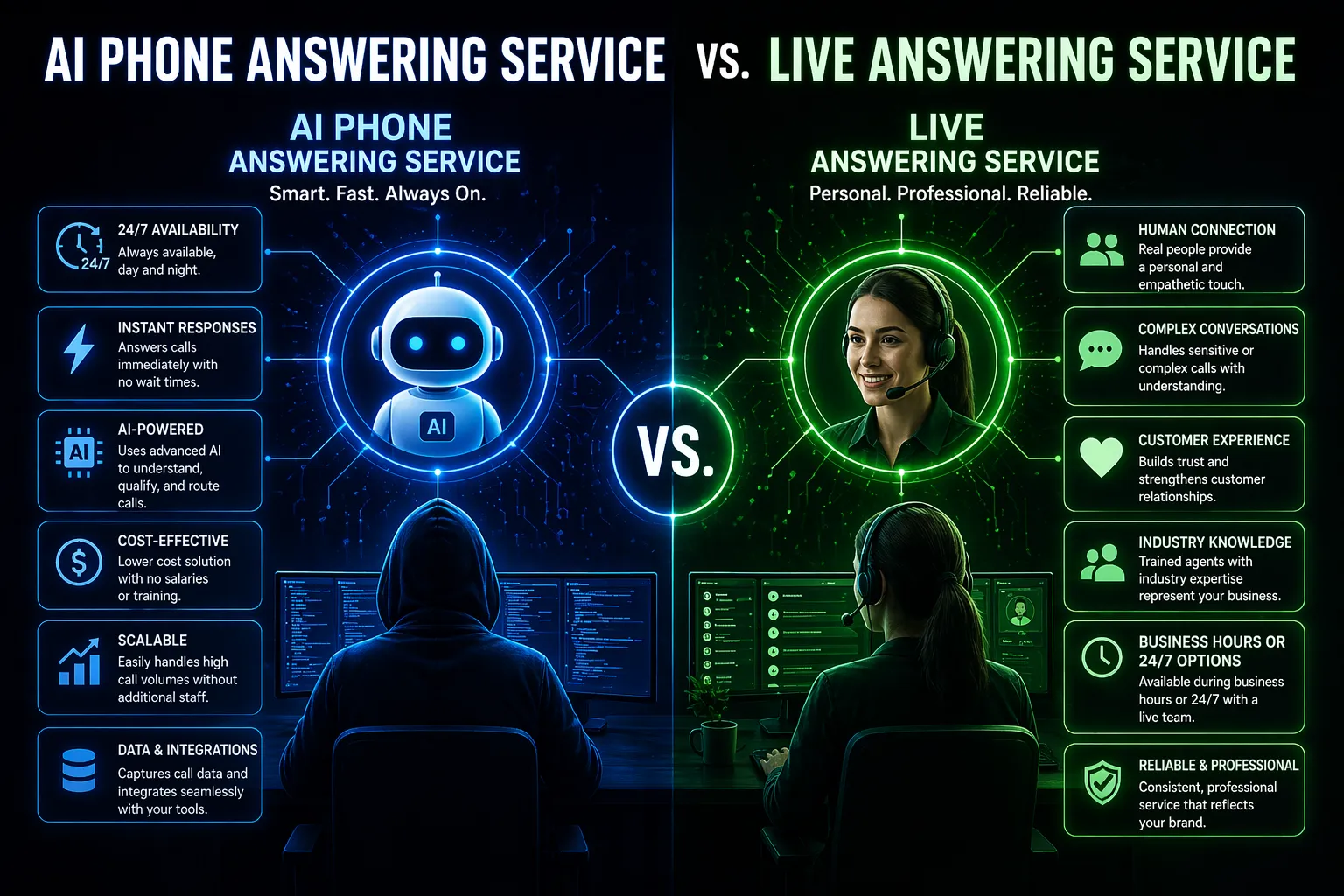
Where AI Answering Services Genuinely Excel
Modern AI phone answering services are not limited chatbots or IVR systems. The performance data from production deployments in 2025 and 2026 reflects systems that use natural language processing to understand caller intent, retrieve real-time information from connected scheduling and CRM systems, handle common call types end-to-end, and route to human staff when conversations exceed their designed scope. The performance advantages over live services are real and consistent in specific contexts.
Speed is the most reliable AI advantage. AI answering services answer in under five seconds, at every hour, regardless of call volume. Live services answer in 30 to 90 seconds on average, with waits extending during peak volume. For callers with urgent needs - the person calling about a same-day appointment, the homeowner with an urgent maintenance request - the 60-second difference between an immediate answer and a 90-second hold is the difference between a captured lead and a caller who moved on.
Volume handling is the second unambiguous AI advantage. A single AI service handles unlimited simultaneous calls - the Monday morning rush that sends three callers to hold queues is three answered calls. Live services handle one call per agent, with hold queues during peak volume and dropped calls when queue capacity is exceeded. For businesses with predictable volume spikes, AI eliminates the call loss that occurs at the busiest moments of the business week.
After-hours consistency is the third AI advantage. AI answering performs identically at 9 AM and 11 PM. Live services operate consistently during business hours and with variable quality - and higher cost - during after-hours coverage. For businesses where after-hours calls represent significant revenue or urgent service needs, AI's flat-rate after-hours performance is a material operational advantage.
Where Live Answering Services Genuinely Excel
An honest comparison requires acknowledging where live agents consistently outperform AI - and it is not the categories that the comparison usually frames. The performance gap is not about scripted vs. conversational interactions, or simple vs. complex routing. Modern AI handles both at high accuracy. The genuine live agent advantage is in a specific category of interaction: emotionally charged, high-stakes, and highly novel conversations where human empathy, judgment, and real-time creative problem-solving are the primary value drivers.
A personal injury attorney's intake call, where the caller is in distress immediately after an accident, benefits from a human agent who can adapt tone, provide appropriate reassurance, and build the rapport that converts the call into a case. A mental health crisis line call, where the caller's emotional state requires moment-by-moment response calibration, requires human emotional intelligence that current AI cannot reliably provide. A high-value B2B sales call, where objection handling and relationship-building during the call determine whether a proposal is invited, requires human conversational improvisation.
These interaction types share a common characteristic: the value of the interaction is not in the information exchanged but in the human connection made. They are also a minority of total call volume for most businesses. A legal firm that receives 50 new intake calls per month and 200 existing client scheduling and FAQ calls benefits from AI handling the 200 and live agents handling the 50 - a hybrid model that captures the cost advantage of AI for high-volume routine calls while preserving the human advantage for the interactions where it matters most.
The Quality Question: Does AI Sound Good Enough?
The concern most frequently raised by businesses evaluating AI answering services is voice quality - whether callers perceive they are speaking with a machine and whether that perception damages the brand experience. The performance data on this question has changed substantially in 2025 and 2026. Modern AI voice synthesis using platforms like ElevenLabs produces natural-sounding speech with sub-400ms response latency. Production data from deployments across multiple industries shows that callers who receive accurate, helpful responses from an AI agent that sounds natural are satisfied with the interaction - the perceived humanity of the voice becomes a secondary concern when the interaction resolves the caller's need efficiently.
The quality threshold that matters is not perfect indistinguishability from a human. It is a natural-sounding voice that responds quickly, understands what the caller is saying, and handles the call competently. Business owners who have tested modern AI answering services in live conditions - not demo scenarios but actual calls from their customer base - consistently report that caller satisfaction is comparable to live answering services for routine call types. The calls where callers notice and care about AI versus human distinction are the emotionally complex interactions discussed above, which are precisely the calls that a well-designed AI system routes to human staff.
-> Listen to Dialora's AI phone answering service demo - real call flow, not a script
Making the Switch: What the First 30 Days Look Like
Setup That Takes Hours, Not Weeks
The operational concern that most frequently delays businesses from switching from live to AI answering is implementation complexity - the assumption that deploying an AI answering service requires a technical project, a lengthy onboarding period, and significant configuration work. The operational reality of modern AI answering service platforms like Dialora is significantly more straightforward. The setup process involves configuring the agent's voice and tone, defining the call flows for the most common inbound call types, connecting the scheduling or CRM system the agent will write to, and forwarding the business phone number to the AI agent. In practice, most businesses are live within a day of signing up - not because the configuration is superficial, but because the platform is designed for non-technical business owners rather than IT teams.
The comparison to a live answering service onboarding is instructive. A live service onboarding typically involves a two to four week period of script development, agent training, and quality review before the service is operating at full performance. An AI service onboarding is immediate - the call flow is configured, tested, and live within hours. The ongoing optimization that improves AI performance - reviewing call transcripts, refining call flows based on real call patterns, adjusting escalation triggers - is done by the business owner reviewing a dashboard rather than by submitting change requests to a service account manager.
What to Measure in Month One
The metrics that confirm an AI answering service is working - and that justify the switch decision - are straightforward: total calls handled by AI versus total calls received (the answer rate); the percentage of calls resolved without human escalation (the containment or resolution rate); the number of appointments booked or leads captured that would previously have required a call-back from the business; and the number of after-hours calls handled that previously went to voicemail or the live service at premium rates.
For most businesses making the switch, the first metrics that move are answer rate and after-hours captures. Businesses that were answering 60 to 70 percent of calls with a live service (during business hours only) see answer rates approaching 100 percent immediately, across all hours. The after-hours call captures - leads and service requests that previously hit voicemail and were lost at an 85 percent non-callback rate - represent the clearest, most immediate revenue impact of the switch.
-> Start your Dialora AI phone answering service trial - 3 days, real calls, no credit card
The Honest Conclusion Sandra Needed Three Years Earlier
Sandra's math was clear. The live answering service she had used for three years had cost her $11,600 in her most recent year - $4,000 more than she had budgeted - because after-hours premiums, overages, and surcharges consistently inflated the actual bill beyond the advertised rate. An AI answering service that handled the same call types was available at $199 per month flat, with better answer rate consistency, unlimited simultaneous call handling, and no premium for the after-hours calls that were among her most important.
The switch she made took one afternoon. The savings in year one exceeded $9,000. The calls she had been missing during peak volume - the maintenance request that went to hold and then to voicemail, the leasing inquiry on Sunday evening that went to the answering service queue and back to voicemail - are now answered instantly, at any hour, at no additional cost.
This comparison is not theoretical. It is the math that every business currently paying for a live answering service should run before their next renewal. The advertised rate is not the total cost. The performance gap between AI and live answering for routine call types has closed substantially. The cost gap has not. The businesses that switch in 2026 are the ones whose owners took an afternoon to do the arithmetic.



























Sign in to leave a comment.