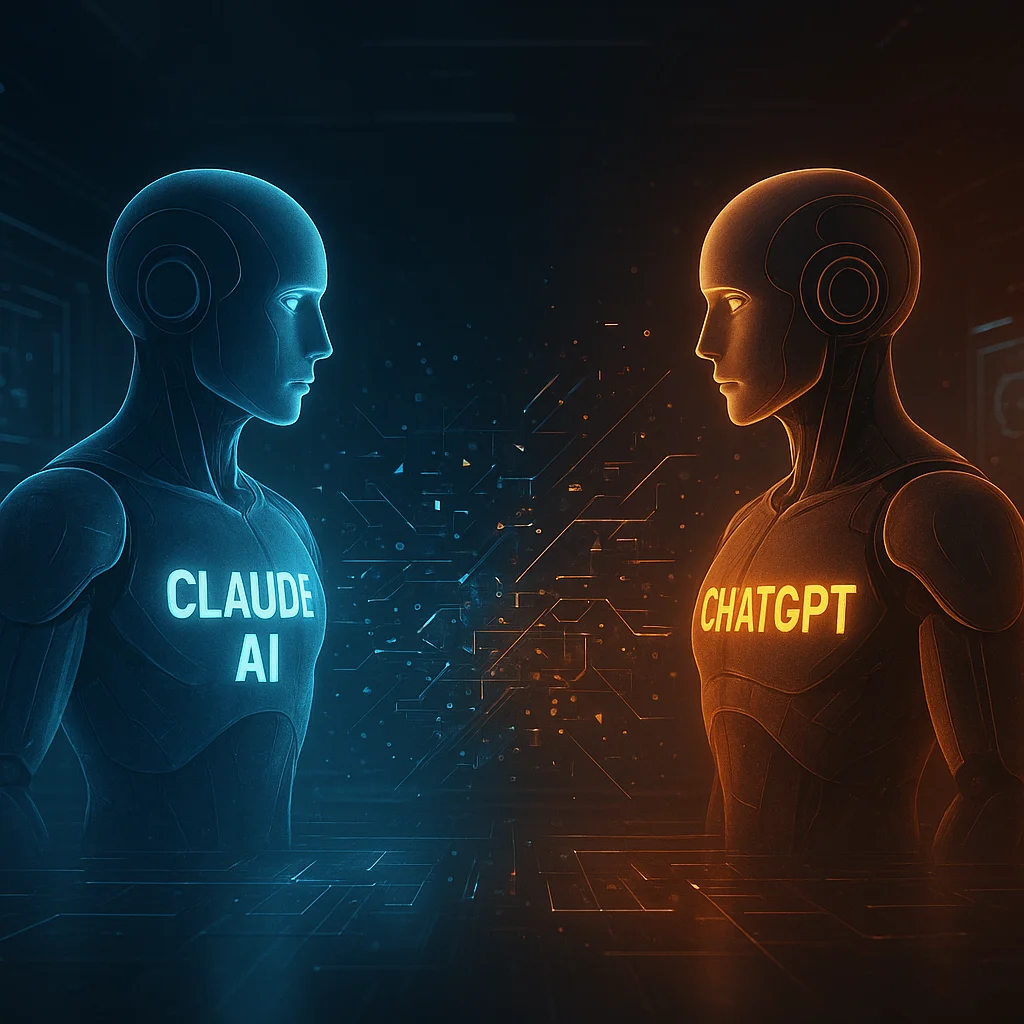

Opening the Curtain: A Tale of Two AI Titans
In the rapidly evolving domain of AI-driven conversational agents, two names have emerged as defining pillars: Claude AI, developed by Anthropic, and ChatGPT, OpenAI's flagship model. Their rivalry encapsulates a broader narrative of AI innovation, ethics, and enterprise adoption. Imagine a dynamic Seoul-based AI development lab evaluating these platforms for integration into a smart city infrastructure project. The stakes are high: nuanced natural language understanding, ethical safety nets, and adaptability to multilingual contexts weigh heavily on the decision-making. This scenario typifies the real-world tension between Claude AI and ChatGPT: a choice not merely of technology, but of philosophy and strategic direction.
Claude AI and ChatGPT stand as archetypes of contemporary large language models (LLMs), each with distinct approaches to alignment, safety, and user interaction. Their competition has intensified as both have reached new milestones in 2026, building on years of foundational research. This article provides a comprehensive analysis of their architectures, performance metrics, ethical frameworks, and market impacts, drawing from recent sources including ZDNet and Mint on MSN.
"The competition between Claude AI and ChatGPT reflects deeper challenges in balancing AI capability with ethical guardrails and user trust." — Industry analyst, ZDNet
Genesis of the Giants: How Claude AI and ChatGPT Evolved
The origins of Claude AI and ChatGPT trace back to the early 2020s, a period marked by breakthroughs in transformer architectures and reinforcement learning techniques. ChatGPT emerged from OpenAI’s GPT lineage, inheriting extensive pretraining on diverse internet data and pioneering instruction tuning to make interactions more natural and goal-oriented. Its 2025 iteration, ChatGPT 5.5, introduced multimodal inputs and expanded coding capabilities—a nod to software developers demanding AI assistance beyond text generation.
Conversely, Claude AI, named after Claude Shannon, originates from Anthropic, a company rooted in research on AI safety and interpretability. Its philosophy centers on constitutional AI, where the model’s behavior is guided by a set of ethical principles encoded during training and refinement. Claude Opus 4.7, the latest release, emphasizes transparency, reduced hallucination, and conversational safety, targeting enterprise users needing stringent compliance and risk mitigation.
Both systems have been shaped by the broader AI ecosystem’s push toward responsible AI, but their trajectories diverge notably in ecosystem strategies. OpenAI integrates ChatGPT within Microsoft’s expansive cloud and productivity platforms, leveraging the Azure infrastructure, while Anthropic positions Claude as a modular API-first tool, enabling customizability across verticals.
"Claude’s constitutional AI approach redefines how language models internalize ethics, contrasting with ChatGPT’s instruction-tuning paradigm." — AI ethics researcher, WriteUpCafe
Technical Anatomy and Performance Metrics
Delving into the architecture and benchmarks reveals nuanced distinctions. ChatGPT 5.5 operates on a transformer model with upwards of 300 billion parameters, fine-tuned via supervised learning and reinforcement learning from human feedback (RLHF). Its multimodal capabilities now extend to image and voice inputs, facilitating richer human-AI dialogues. Claude Opus 4.7, while slightly smaller in parameter count (~220 billion), leverages a layered constitutional training regimen, which constrains unsafe outputs and enforces factual consistency.
Comparative studies by Trak.in and Geeky Gadgets highlight key performance differences:
- Natural Language Understanding: ChatGPT excels in creative writing and context retention over extended conversations, sustaining coherence across multi-turn dialogues.
- Safety and Alignment: Claude’s constitutional AI reduces hallucinations by approximately 30% in fact-based queries, a significant improvement for high-stakes industries.
- Coding Proficiency: ChatGPT's integration with GitHub Copilot and expanded code generation supports multiple programming languages, with superior debugging assistance.
- Customization: Claude provides more granular control via API parameters, enabling enterprises to tailor response style and restrict sensitive content.
- Multimodal Capabilities: ChatGPT’s multimodal input surpasses Claude’s primarily text-focused interface, offering advantage in use cases requiring image recognition or voice commands.
These technical differences reflect divergent priorities: ChatGPT’s breadth and multimodal versatility versus Claude’s safety-centric design and customization. For example, in Seoul’s smart city AI deployments, where data privacy and ethical compliance are paramount, Claude’s model is often preferred, while ChatGPT dominates creative content generation and developer tooling.
2026 Updates: Recent Innovations and Market Shifts
This year has been pivotal for both platforms. ChatGPT 5.5 rolled out enhanced integration with Samsung’s AI ecosystem, enabling seamless interaction with IoT devices and Bixby voice assistance. This synergy aligns with South Korea’s government-backed AI innovation programs, advancing smart urban environments and personalized digital assistants.
Meanwhile, Anthropic launched Claude Sonnet 4.5, an iteration focusing on advanced coding capabilities and improved interpretability for complex queries. This release targeted financial services and healthcare sectors, where explainability and auditability are critical. Claude’s new rank tracking tools, detailed in WriteUpCafe’s analysis, enhance model performance monitoring, a feature gaining traction in enterprise AI governance.
The market landscape simultaneously reflects intensifying competition with emergent models like Gemini and Perplexity, but Claude and ChatGPT remain dominant forces in AI adoption. Their rivalry drives continuous innovation, compelling users and developers to weigh trade-offs between performance, safety, and integration ease.
Industry Perspectives and Real-World Applications
Leading AI practitioners emphasize that the Claude-ChatGPT comparison transcends raw capabilities, touching on trustworthiness and ecosystem fit. Korean tech conglomerates, including Samsung and Naver, have experimented extensively with both models. Samsung’s AI labs report that ChatGPT’s multimodal skillset accelerates consumer-facing applications, such as automated customer support and content generation, whereas Claude’s alignment-first approach underpins internal tools requiring sensitive data handling.
Case studies reveal diverging use cases:
- ChatGPT in Creative Industries: Media companies leverage ChatGPT’s narrative generation for scripts, marketing slogans, and interactive entertainment, capitalizing on its expansive knowledge and linguistic creativity.
- Claude in Regulated Sectors: Financial institutions deploy Claude for compliance monitoring and risk assessment chatbots, benefiting from its reduced hallucination rates and ethical guardrails.
These distinctions underscore a broader industry insight: no one-size-fits-all AI exists. Instead, organizations often adopt hybrid approaches, combining Claude’s rigorous alignment with ChatGPT’s generative power. This trend is corroborated by insights from Free Press Journal, which documents real AI workflows blending these platforms for optimized outcomes.
Looking Forward: What the Future Holds for Claude AI and ChatGPT
As AI models scale and diversify, the next frontier lies in harmonizing capability with responsibility. Both Claude and ChatGPT are investing heavily in self-monitoring features, adaptive learning, and multilingual proficiency to meet global demands. Especially in South Korea, where AI policy emphasizes transparency and data sovereignty, Claude’s ethical AI foundations resonate with regulatory frameworks.
Moreover, ongoing research into causal reasoning and multimodal fusion promises to blur the distinctions between these models. The future will likely see convergence: Claude adopting more multimodal features, and ChatGPT refining safety protocols through constitutional principles. For enterprises and developers, this evolution demands vigilant assessment of emerging features and strategic alignment with organizational values.
Key takeaways for stakeholders include:
- Evaluate AI models not just on raw performance but on ethical alignment and adaptability to domain-specific challenges.
- Leverage hybrid deployments to exploit complementary strengths of Claude and ChatGPT.
- Monitor regulatory developments closely, particularly in markets with stringent AI governance like South Korea and the EU.
- Invest in continuous training and interpretability tools to maintain trust and compliance.
Ultimately, the Claude AI versus ChatGPT contest exemplifies the broader quest for AI that is powerful, reliable, and aligned with human values. The trajectory of both platforms will shape the contours of AI integration across industries for years to come.
For further detailed technical comparisons, refer to our previous article Claude AI vs ChatGPT: A 2026 Analysis of AI Rivals and explore how Anthropic’s coding advances are expanding Claude’s utility in Claude Sonnet 4.5: How Anthropic is Pushing the Coding Frontier.



























Sign in to leave a comment.