

Customer service training is evolving as organizations look for more effective ways to prepare agents for increasingly complex customer interactions. Traditional training methods continue to play an important role, but businesses are also exploring technologies that can make learning more adaptive, scalable, and aligned with real-world service environments.
This shift has accelerated interest in AI in Customer Service Training, where intelligent systems support learning, skill development, and performance improvement. By combining automation, simulations, analytics, and personalized learning experiences, AI-powered training solutions are helping organizations build stronger and more capable customer service teams.
AI-Powered Customer Service Training
AI in Customer Service Training refers to the use of artificial intelligence technologies to support how customer service professionals learn, practice, and develop their skills. These systems help create training experiences that are more responsive to individual learning needs while providing organizations with greater visibility into workforce development.
Unlike traditional learning approaches that often follow fixed training paths, AI-powered systems can continuously adapt based on performance data, learning progress, and business requirements. This allows training programs to remain relevant as customer expectations and service environments evolve.
- Personalized learning experiences
- Intelligent training recommendations
- Realistic customer interaction simulations
- Automated performance evaluations
By combining these capabilities, AI in Customer Service Training helps organizations create more engaging and effective learning environments. It supports continuous development while helping agents build the skills needed to deliver high-quality customer experiences.
Core Capabilities of AI-Powered Customer Service Training
AI-powered training platforms combine multiple technologies to create learning environments that are more adaptive, interactive, and performance-driven. These capabilities help organizations strengthen workforce readiness while improving the effectiveness of customer service training programs.
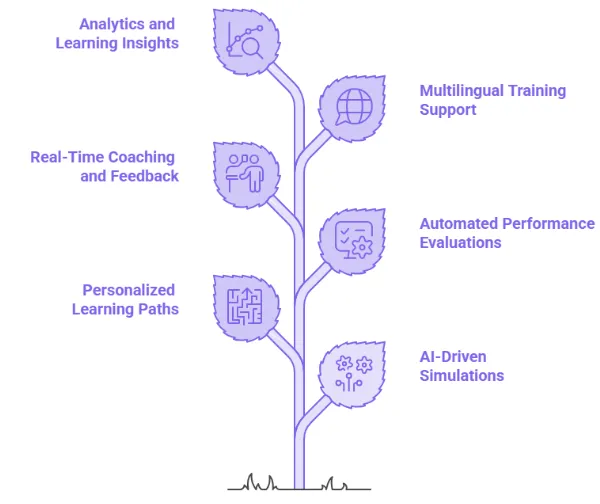
🟣 AI-Driven Simulations
AI-powered simulations recreate realistic customer interactions with different communication styles, emotions, and levels of complexity. Agents can practice handling situations they are likely to encounter in real customer conversations.
These simulations provide hands-on experience in a safe environment, helping employees build confidence and improve decision-making before interacting with actual customers.
🟣 Personalized Learning Paths
AI can analyze individual learning progress, performance metrics, and skill gaps to recommend tailored training content. This allows agents to focus on areas that need improvement rather than following a generic learning path.
Personalized learning helps improve engagement while making training more relevant to each employee's development needs.
🟣 Automated Performance Evaluations
AI-powered systems can assess training activities and simulated interactions using predefined performance criteria. Evaluations can include communication effectiveness, compliance adherence, accuracy, and customer handling skills.
Automated assessments provide objective feedback and help organizations identify coaching opportunities more efficiently.
🟣 Real-Time Coaching and Feedback
Modern AI learning platforms can provide immediate guidance during training exercises and simulations. Agents receive feedback while they are actively learning, allowing them to correct mistakes and reinforce best practices quickly.
This continuous feedback approach supports faster skill development and stronger learning outcomes.
🟣 Multilingual Training Support
Many AI-powered training systems support learning in multiple languages while accounting for communication styles and cultural nuances. This enables organizations to prepare customer service teams for diverse customer populations.
Multilingual capabilities are particularly valuable for global organizations serving customers across different regions and markets.
🟣 Analytics and Learning Insights
AI platforms generate detailed insights into learning outcomes, performance trends, skill gaps, and training effectiveness. These analytics help organizations make informed decisions about workforce development and training strategies.
By turning learning data into actionable insights, organizations can continuously improve both training programs and employee performance.
Together, these capabilities demonstrate why AI in Customer Service Training is becoming an important part of modern workforce development strategies. They help organizations create learning environments that are scalable, measurable, and closely aligned with real customer service challenges.
Common Use Cases of AI in Customer Service Training
Organizations are using AI in Customer Service Training across a wide range of learning and workforce development initiatives. These use cases help customer service teams build skills, improve readiness, and maintain consistent service standards across different business environments.
As customer interactions become more complex, AI-powered training systems provide practical ways to support both new and experienced customer service professionals.
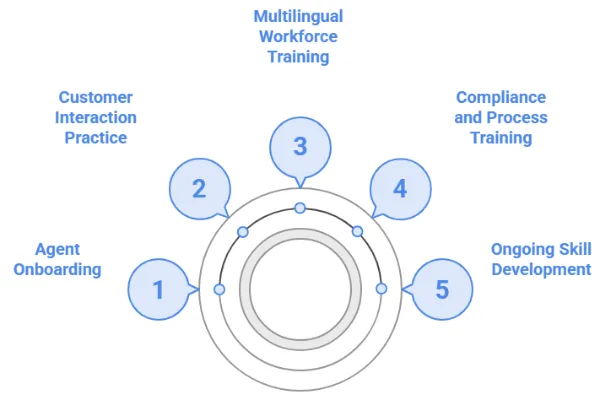
🔵 Agent Onboarding
AI-powered training platforms help new hires learn customer service processes, communication standards, and product knowledge more efficiently. Personalized learning paths and simulations allow agents to gain practical experience during onboarding.
This helps reduce ramp-up time while improving confidence and preparedness before agents begin handling live customer interactions.
🔵 Customer Interaction Practice
Organizations use AI simulations to help agents practice responding to different customer personalities, concerns, and service situations. These simulations provide realistic learning opportunities without affecting actual customer experiences.
Repeated exposure to real-world scenarios helps improve communication skills, decision-making, and problem-solving abilities.
🔵 Multilingual Workforce Training
Global organizations use AI-powered learning systems to train customer service teams across multiple languages and communication styles. These platforms can support language-specific learning experiences while accounting for cultural nuances.
This helps organizations deliver more consistent customer experiences across diverse customer populations and international markets.
🔵 Compliance and Process Training
AI training systems can help employees learn regulatory requirements, internal procedures, and service protocols through interactive learning experiences. Automated evaluations help verify knowledge retention and understanding.
This use case is particularly valuable in industries where adherence to policies and procedures is essential for customer service operations.
🔵 Ongoing Skill Development
Many organizations use AI in Customer Service Training to provide continuous learning opportunities long after onboarding is complete. AI can identify skill gaps and recommend targeted learning experiences based on performance trends.
This supports long-term workforce development while helping agents adapt to evolving customer expectations and business requirements.
These use cases demonstrate how AI-powered training extends beyond basic learning programs. Organizations can apply these systems across multiple stages of employee development to create more capable and adaptable customer service teams.
Business Benefits of AI-Powered Customer Service Training
Organizations adopting AI in Customer Service Training are seeing benefits that extend beyond learning outcomes alone. These improvements often contribute to stronger workforce performance and better customer experiences.
✅ Faster onboarding processes for new customer service agents.
✅ Improved training scalability across teams, locations, and business units.
✅ More consistent service delivery through standardized learning experiences.
✅ Enhanced agent confidence and readiness before live customer interactions.
✅ Better visibility into workforce development through analytics and reporting.
✅ Stronger support for continuous learning initiatives across customer service teams.
These benefits help explain why AI-powered learning systems are becoming an important part of modern customer service operations. They support both employee development goals and broader business objectives.
Conclusion
AI-powered customer service training is transforming how organizations develop customer-facing teams by making learning more adaptive, measurable, and aligned with real-world service demands. Through capabilities such as simulations, personalized learning, automated evaluations, and analytics, businesses can create more effective training experiences that support long-term workforce development.
The growing adoption of AI in Customer Service Training reflects the need for learning systems that can evolve alongside customer expectations and business requirements. Organizations are increasingly using these technologies to strengthen agent performance, improve service consistency, and accelerate employee development across customer service operations.
As customer experience continues to be a key business differentiator, AI-powered training solutions are becoming an important investment for organizations seeking to build skilled, confident, and future-ready support teams. These systems provide the flexibility and scalability needed to support continuous learning in rapidly changing service environments.
FAQs
1. What is AI-powered customer service training?
AI-powered customer service training uses artificial intelligence technologies to support learning, practice, evaluations, coaching, and workforce development across customer service teams.
2. How does AI improve customer service training programs?
AI helps personalize learning experiences, automate evaluations, provide realistic simulations, and generate insights that improve training effectiveness and employee development.
3. What are the most common use cases of AI in Customer Service Training?
Common use cases include agent onboarding, customer interaction practice, multilingual training, compliance education, and continuous skill development programs.
4. Can AI-powered training support large customer service teams?
Yes. AI-powered learning platforms are designed to scale across teams, locations, and regions while maintaining consistent training quality and learning experiences.
5. Why are organizations investing in AI in Customer Service Training?
Organizations use AI-powered training to improve workforce readiness, accelerate onboarding, strengthen service quality, support continuous learning, and enhance customer experience outcomes.






















Sign in to leave a comment.