
HR operations have consistently evolved as organizations adopt technologies that improve how workforce processes are managed, delivered, and governed.
Early HR systems focused on digitization. Automation tools improved efficiency by standardizing workflows. Today, AI agent platforms are introducing a new operational model that combines intelligence, execution, and adaptability within HR systems.
According to enterprise leaders such as IBM and Microsoft, the next phase of enterprise AI is defined by systems that can reason, plan, and act across business workflows, moving beyond static automation into autonomous execution layers. Accenture similarly highlights that AI is shifting from experimentation to enterprise-wide orchestration of work.
For HR teams, this means moving beyond automation toward intelligent, governed execution of work.
In this blog, we examine the best AI agent platforms for HR, focusing on capabilities, real-world use cases, and how organizations can evaluate the right practical fit.
The Shift from HR Automation to AI Agent Platforms
Early HR AI systems were primarily conversational interfaces. They could answer FAQs or route tickets, but they lacked execution capability.
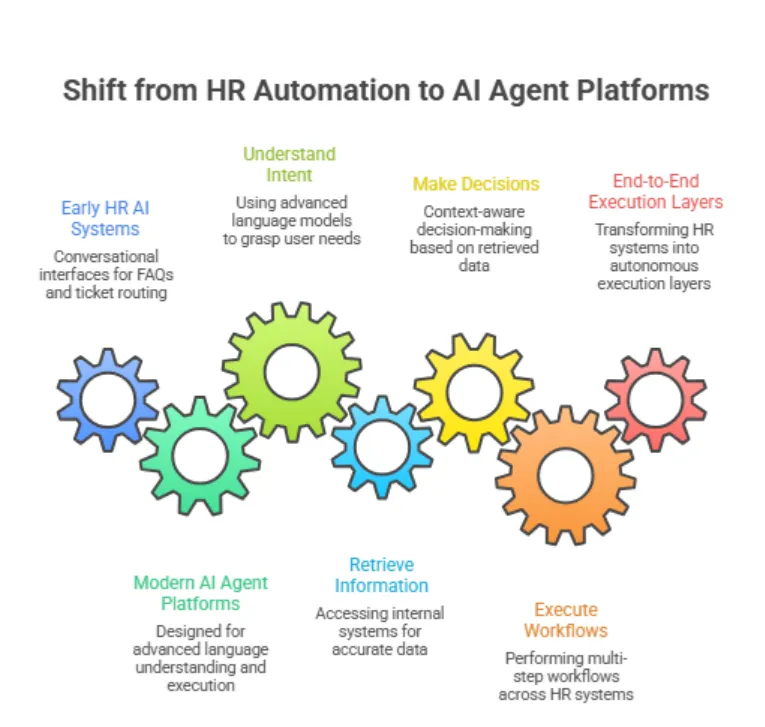
Modern AI agent platforms operate differently. They are designed to
- Understand intent using advanced language models
- Retrieve accurate information from internal systems (using RAG architectures)
- Make context-aware decisions
- Execute multi-step workflows across HR systems
This shift transforms HR systems into end-to-end execution layers.
Instead of answering “How many leave days do I have?”, an AI agent can now
- Check HRIS records
- Validate policy eligibility
- Update leave balances
- Notify managers
Trigger payroll adjustments
All within a single workflow.
Top AI Agent Platforms for HR in 2026
Based on current market direction and enterprise adoption patterns, the following platforms represent the leading options for HR teams.
1. DTskill AI
DTskill AI is emerging as a unified AI agent platform designed to orchestrate HR workflows across systems while maintaining governance and operational control.
Key strengths
- End-to-end workflow orchestration across HR, IT, and operations
- Built-in governance, auditability, and compliance alignment
- Context-aware AI agents grounded in enterprise data
- Scalable architecture for complex organizations
Best fit
Enterprises looking to move beyond fragmented tools toward a centralized, agent-driven HR operating model
2. Juicebox.ai
A leader in multi-agent HR orchestration, particularly across the hiring lifecycle.
Strengths
- Strong ATS/HRIS integrations
- Multi-agent collaboration (e.g., recruiting + onboarding agents)
Policy-aware automation
3. Eightfold AI
Focused on talent intelligence powered by deep skills data.
Strengths
- Skills graph-driven matching
- Internal mobility recommendations
Workforce planning insights
4. Paradox (Olivia)
Specialized in high-volume recruiting automation.
Strengths
- Candidate screening and scheduling
- Conversational recruiting
High-speed hiring workflows
5. Leena AI
A widely adopted AI assistant for employee support.
Strengths
- 24/7 employee query resolution
- Policy navigation
HR service desk automation
6. Workday AI
Best suited for organizations deeply integrated into the Workday ecosystem.
Strengths
- Native integration with HCM data
- Policy-aligned decision-making
Embedded AI workflows
7. Espressive (Barista AI)
Focused on HR and IT service desk automation.
Strengths
- Case deflection
- Employee self-service
High ticket resolution rates
8. Lindy
A no-code platform for building custom AI agents.
Strengths
- Flexibility
- Rapid deployment
Custom workflow automation
9. HR Acuity (olivER)
Purpose-built for employee relations.
Strengths
- Investigation consistency
- Risk analysis
Compliance tracking
Core Capabilities of AI Agent Platforms for HR
The best AI agent platforms for HR combine reasoning, system integration, and operational control to enable scalable HR operations.
Autonomous Workflow Execution
Modern AI agents are designed to independently execute end-to-end processes. They can update HR systems, process employee requests, and trigger workflows across multiple departments without manual intervention.
This significantly reduces dependency on human coordination while improving speed and consistency across HR operations.
Context-Aware Reasoning
AI agents operate with a high level of contextual awareness.
According to Microsoft, enterprise AI systems must incorporate organizational context, permissions, and real-time data signals to deliver meaningful outcomes.
By evaluating factors such as employee location, role, tenure, and organizational policies, they can make accurate and relevant decisions. This capability is critical for handling complex scenarios where static, rule-based systems fall short.
Multi-Agent Collaboration
Advanced platforms deploy multiple specialized agents, such as
- Recruiting agents
- Onboarding agents
- Benefits agents
These agents work together to complete workflows.
Secure Data Retrieval (RAG)
Retrieval-Augmented Generation (RAG) ensures that AI agents are grounded in internal enterprise data.
Google Cloud emphasizes that grounding AI outputs in enterprise data is critical for accuracy, trust, and compliance in production systems.
By accessing company policies, knowledge bases, and documentation, agents deliver accurate, policy-compliant responses while minimizing the risk of incorrect or generalized outputs.
Proactive Engagement
AI agents are increasingly capable of identifying patterns that indicate disengagement, communication gaps, or potential attrition risks.
Based on these insights, they can proactively trigger alerts, recommend actions, or initiate workflows, shifting HR from reactive support to proactive management.
High-Impact Use Cases Across HR
AI agent platforms are delivering measurable value by transforming how core HR functions operate.
Talent Acquisition at Scale
AI agents streamline hiring processes by managing resume screening, candidate communication, and interview scheduling. This not only accelerates hiring timelines but also enhances the overall candidate experience.
Autonomous Onboarding
Onboarding becomes more efficient as AI agents coordinate tasks such as IT provisioning, documentation workflows, and training schedules. This ensures a consistent and seamless experience for new hires without requiring manual follow-ups.
This aligns with SAP's perspectives on creating integrated, experience-driven onboarding journeys.
24/7 Employee Support
AI-powered assistants provide continuous support by resolving common queries related to leave, payroll, and benefits. This significantly reduces the workload on HR service teams while improving response times for employees.
Internal Mobility and Skill Development
AI systems analyze employee skills and organizational needs to recommend career paths, learning opportunities, and internal job matches. This supports workforce development and improves retention.
Performance Management Automation
AI agents assist in performance processes by drafting reviews, collecting feedback, and managing goal-setting activities. This enables more structured and continuous performance management across teams.
Choosing the Right Platform for HR
Selecting the right AI agent platform depends on organizational structure, technology maturity, and operational priorities.
Enterprises with Established HCM Systems
Organizations using platforms like Workday or SAP benefit from AI solutions that integrate natively within these ecosystems. This enables seamless data access, policy alignment, and consistent workflow execution.
SMB and Mid-Market Organizations
Smaller organizations typically require solutions that offer rapid deployment, minimal IT dependency, and pre-configured workflows. Platforms such as Lindy are well-suited for these environments due to their flexibility and ease of use.
High-Volume Industries
Industries such as retail and healthcare, which experience high employee turnover, require platforms that support real-time engagement and scalable automation.
Enterprises Seeking End-to-End Orchestration
Organizations aiming for a more comprehensive transformation should consider platforms like DTskill AI. These platforms enable cross-system orchestration, integrate governance frameworks, and support scalable deployment of AI agents across HR operations.
Final Thoughts
AI agent platforms are redefining HR operations. They enable organizations to move from reactive workflows to proactive, intelligent systems that can manage complex processes at scale.
However, the value of these platforms depends on how they are implemented.
The best AI agent platforms for HR are those that
- Combine intelligence with execution
- Integrate across enterprise systems
- Operate within governance frameworks
- Maintain transparency and accountability
- Scale with organizational complexity
As organizations adopt these platforms, HR will evolve from a support function into a strategic, autonomous, and intelligence-driven system.
FAQs
What governance and compliance controls are required for HR AI agents?
Organizations need role-based access controls, audit logs, policy grounding (via RAG), and human-in-the-loop oversight. Governance ensures that AI actions remain compliant with labor laws, internal policies, and data privacy standards.
How do AI agent platforms integrate with existing HR tech stacks?
Most enterprise-grade platforms integrate with systems like HRIS, ATS, payroll, and ITSM through APIs and data connectors. Leading platforms emphasize interoperability, allowing agents to operate across systems without replacing existing infrastructure.
What is RAG in HR AI systems?
Retrieval-Augmented Generation ensures AI responses are based on company policies and internal data.
What types of HR workflows are best suited for AI agent adoption first?
High-volume, repeatable workflows such as employee query resolution, interview scheduling, onboarding coordination, and leave management are ideal starting points due to their structured nature and measurable ROI.
How should organizations measure ROI from AI agent platforms in HR?
ROI can be evaluated through metrics such as reduction in manual workload, faster resolution times, improved employee experience scores, decreased hiring cycle time, and increased HR team productivity.




















Sign in to leave a comment.