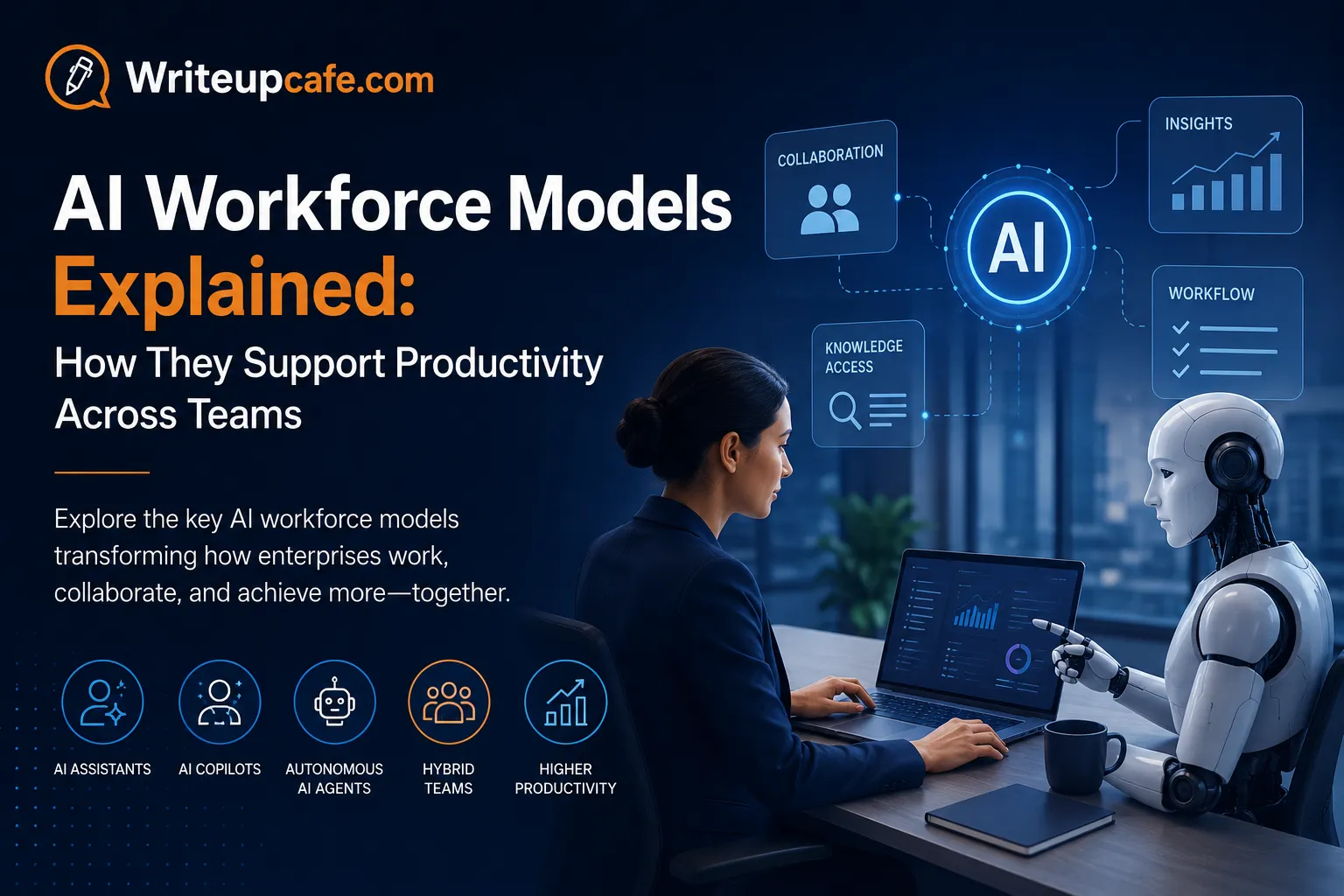

Every enterprise has the same number of working hours available in a day. What separates industry leaders from the rest is how effectively those hours are converted into decisions, actions, and business outcomes. Increasingly, that difference is being shaped by how organizations integrate AI into the flow of work.
This shift is elevating workforce productivity from an operational metric to a strategic growth lever. According to McKinsey, generative AI could unlock between $2.6 trillion and $4.4 trillion in annual economic value globally, with a substantial portion tied to improving how knowledge work is performed. As a result, enterprises are exploring how intelligent systems can become embedded participants in everyday work.
However, AI alone does not create productivity. Value is realized when organizations establish the right workforce model, that determines how humans and AI collaborate, make decisions, and execute work together. From AI assistants and copilots to autonomous agents and hybrid human-AI teams, these models are redefining the architecture of enterprise productivity.
This blog explores the key AI workforce models shaping the future of work, how they enhance productivity across teams, and the strategic considerations enterprises should evaluate to maximize business impact from their AI investments.
Understanding AI Workforce Models
An AI workforce model refers to the structured way artificial intelligence interacts with employees, processes, and business systems to improve performance and productivity.
Unlike traditional automation, which focuses on replacing repetitive tasks, modern AI workforce models are designed to
- Augment human decision-making
- Accelerate knowledge access
- Improve operational efficiency
- Enable cross-functional collaboration
- Increase employee effectiveness
- Support enterprise-scale workflows
Think of AI workforce models as digital workforce architectures that define how humans and AI collaborate to achieve business goals.
The 5 AI Workforce Models Driving Enterprise Productivity
Organizations typically adopt one or a combination of the following AI workforce models depending on their maturity and business priorities.
1. The AI Assistant Model
The AI Assistant Model is often the starting point for enterprise AI adoption. In this model, AI functions as a personal productivity partner, helping employees manage routine activities such as content creation, information retrieval, analysis, and communication.
Organizations such as Microsoft have accelerated this model through Microsoft 365 Copilot, enabling employees to summarize meetings, draft documents, analyze spreadsheets, and generate presentations directly within familiar productivity applications.
Typical Use Cases
- Drafting emails and reports
- Meeting summarization
- Knowledge search
- Data analysis support
- Presentation creation
- Documentation generation
Teams Benefiting Most
- Human Resources
- Marketing
- Finance
- Sales
- Customer Service
- Operations
Productivity Impact
Employees spend a significant portion of their workday searching for information, documenting activities, and managing administrative tasks. AI assistants help reduce these low-value activities, allowing employees to focus on strategic and customer-facing responsibilities.
Organizations implementing AI assistants often report
- Faster content generation
- Reduced administrative workload
- Improved employee efficiency
- Better knowledge accessibility
This model creates immediate productivity gains with relatively low implementation complexity.
2. The AI Copilot Model
While AI assistants help employees perform tasks, AI copilots operate within business applications and workflows to provide contextual recommendations. A copilot understands the user's role, workflow, and data environment. Instead of waiting for instructions, it proactively assists during task execution.
Salesforce's Einstein Copilot is a strong example of this approach. By delivering contextual insights within CRM workflows, it helps sales and service professionals make faster and more informed decisions without leaving their working environment.
Typical Use Cases
- Sales opportunity recommendations
- Financial forecasting support
- Procurement guidance
- Service desk assistance
- Risk analysis
- Project management optimization
Teams Benefiting Most
- Sales Operations
- Finance
- Supply Chain
- IT Service Management
- Project Management Offices
Productivity Impact
The value of the copilot model comes from reducing decision latency. Employees need not to switch between multiple systems, search for information manually, or interpret large volumes of data independently.
Benefits include
- Faster decisions
- Improved accuracy
- Reduced cognitive load
- Higher operational consistency
This model is especially effective for knowledge-intensive roles where information complexity slows execution.
3. The AI Agent Model
The AI Agent Model represents the next evolution in workforce productivity. Unlike assistants and copilots, AI agents can independently execute predefined tasks and workflows with minimal human intervention.
Agents can
- Gather information
- Analyze data
- Trigger actions
- Coordinate systems
- Complete workflow steps
Typical Use Cases
- Employee onboarding
- Customer onboarding
- IT ticket resolution
- Vendor management
- Procurement processing
- Compliance monitoring
Teams Benefiting Most
- Human Resources
- IT Operations
- Procurement
- Shared Services
- Customer Operations
Productivity Impact
AI agents eliminate workflow bottlenecks caused by repetitive coordination activities. Instead of employees manually managing every step, agents handle routine operational execution while humans focus on oversight and exception management.
Organizations adopting agentic AI models often achieve
- Reduced cycle times
- Increased process throughput
- Lower operational costs
- Improved service delivery
This model transforms productivity at the workflow level rather than the individual level.
4. The AI Knowledge Workforce Model
One of the largest productivity barriers in enterprises is fragmented knowledge.
Critical information often exists across
- Emails
- Documents
- ERP systems
- CRM platforms
- Internal portals
- Knowledge repositories
Employees waste substantial time locating information before they can take action. The AI Knowledge Workforce Model addresses this challenge by creating an intelligent enterprise knowledge layer.
Leading organizations such as IBM have demonstrated how AI-powered knowledge systems can help employees retrieve contextual information from multiple sources, reducing search time and improving decision quality.
Typical Use Cases
- Enterprise search
- Policy guidance
- Technical support
- Learning and development
- Compliance assistance
- Customer support knowledge access
Teams Benefiting Most
- Customer Service
- Human Resources
- IT Support
- Legal
- Compliance
- Engineering
Productivity Impact
When employees can instantly access contextual knowledge, productivity accelerates significantly.
Benefits include
- Faster issue resolution
- Reduced knowledge silos
- Improved employee onboarding
- Better decision quality
- Enhanced collaboration
5. The Hybrid Human-AI Workforce Model
The most advanced organizations are moving toward hybrid workforce models where humans and AI operate as collaborative teams.
In this model
- Humans provide judgment
- AI provides speed
- Humans provide creativity
- AI provides scalability
- Humans manage strategy
- AI manages execution support
Rather than treating AI as a tool, organizations treat it as a workforce participant.
Typical Use Cases
- Strategic planning
- Innovation programs
- Customer experience optimization
- Digital operations
- Business process management
Teams Benefiting Most
- Enterprise Leadership
- Digital Transformation Teams
- Operations
- Strategy Offices
- Innovation Centers
Productivity Impact
The hybrid model creates exponential productivity gains because it combines human strengths and machine capabilities.
- Faster innovation cycles
- Improved operational agility
- Better workforce utilization
- Increased organizational resilience
This model is emerging as the future-state architecture for AI-enabled enterprises.
How Different Teams Leverage AI for Workforce Productivity
The value of AI workforce models is not limited to a single department. While the underlying technologies may be similar, the productivity gains vary based on how different teams apply AI within their workflows and operational priorities.
Human Resources
HR teams are using AI to streamline recruitment, automate onboarding processes, enhance employee support, and generate workforce insights. By reducing administrative burdens and accelerating talent-related activities, AI enables HR professionals to spend more time on strategic workforce planning and employee engagement initiatives.
The outcome is faster hiring cycles, improved employee experiences, and greater operational efficiency across the talent lifecycle.
Sales
For sales teams, AI serves as a productivity multiplier by assisting with prospect research, opportunity prioritization, proposal generation, and revenue forecasting. Rather than spending hours gathering information, sales professionals can focus on customer interactions and relationship building.
This translates into increased selling time, improved pipeline visibility, and stronger revenue performance.
Customer Service
Customer service functions leverage AI to retrieve knowledge, manage customer interactions, and support faster ticket resolution. AI-powered assistants and knowledge engines help agents access relevant information instantly, reducing the time spent searching for answers.
As a result, organizations experience faster response times, higher agent productivity, and improved customer satisfaction.
Finance
Finance teams are increasingly using AI to accelerate reporting, forecasting, reconciliation, and compliance-related activities. By automating repetitive analytical tasks, AI allows finance professionals to focus on strategic planning and business decision support.
The benefits include improved accuracy, shorter financial close cycles, and more data-driven decision-making.
IT Operations
Within IT, AI is helping teams proactively manage incidents, monitor systems, and improve service desk operations. AI-driven insights enable faster issue identification and resolution while reducing the operational burden on support teams.
The outcome is reduced downtime, enhanced operational efficiency, and a more resilient technology environment.
Across every function, AI is amplifying the expertise. The organizations realizing the greatest productivity gains are those that embed AI into everyday workflows, enabling employees to focus on work that creates the highest business value.
The Future of AI Workforce Productivity
The next phase of enterprise AI adoption will focus on creating intelligent workforce ecosystems where humans, copilots, agents, and enterprise knowledge systems work together seamlessly.
Microsoft envisions AI agents evolving into digital teammates capable of executing tasks on behalf of employees. Salesforce refers to this transformation as the emergence of a digital labor workforce, where autonomous AI systems work alongside humans to scale business operations.
Industry leaders are already moving toward environments where
- AI agents execute workflows
- AI copilots guide decisions
- AI assistants support employees
- Knowledge systems provide contextual intelligence
Together, these capabilities create a continuously learning and increasingly productive organization. The enterprises that gain the greatest competitive advantage will be those that view AI as a workforce transformation strategy.
Final Thoughts
AI workforce models provide organizations with structured approaches to augment employees, streamline operations, accelerate decision-making, and scale performance across departments. Whether through AI assistants, copilots, agents, knowledge platforms, or hybrid human-AI teams, the objective is to enable people to spend less time on routine work and more time creating business value.
Organizations that strategically align AI workforce models with business goals, workforce needs, and operational processes will be best positioned to unlock sustainable productivity gains in the AI enterprise era.
As enterprises continue their transformation journeys, the future of productivity will not be defined by humans or AI working independently, but by how effectively they work together.
Frequently Asked Questions (FAQs)
1. What is an AI workforce model?
An AI workforce model is a structured approach that defines how artificial intelligence supports employees, processes, and business operations. These models determine how humans and AI collaborate to improve productivity, automate tasks, enhance decision-making, and streamline workflows across the organization.
2. How does AI improve workforce productivity?
AI improves workforce productivity by reducing manual effort, automating repetitive tasks, accelerating information access, supporting decision-making, and optimizing business processes. This enables employees to focus on strategic, creative, and customer-facing activities that generate greater business value.
3. What are the different types of AI workforce models?
The most common AI workforce models include AI Assistants, AI Copilots, AI Agents, AI Knowledge Layers, and Hybrid Human-AI Workforce Models. Each model serves a distinct purpose, ranging from individual productivity enhancement to autonomous workflow execution and enterprise-wide collaboration.
4. Which business functions benefit most from AI workforce models?
AI workforce models deliver value across multiple functions, including Human Resources, Sales, Customer Service, Finance, IT Operations, Procurement, and Supply Chain Management. The productivity impact depends on the complexity of workflows and the volume of repetitive or knowledge-intensive tasks within each function.
5. Can AI workforce models replace employees?
The primary purpose of AI workforce models is augmentation rather than replacement. AI handles routine, repetitive, and data-intensive activities, while employees focus on judgment, creativity, relationship management, and strategic decision-making. The most successful organizations use AI to enhance human capabilities rather than eliminate them.
6. How can organizations choose the right AI workforce model?
Organizations should evaluate their business objectives, process maturity, workforce challenges, and desired outcomes before selecting an AI workforce model. For example, AI assistants are often suitable for improving individual productivity, while AI agents are better suited for automating complex workflows at scale.
7. What are the key benefits of AI for workforce productivity?
Key benefits include improved employee efficiency, faster decision-making, reduced operational costs, enhanced customer experiences, accelerated workflow execution, better knowledge accessibility, and increased organizational agility.

























Sign in to leave a comment.