
Every IT service organization today is navigating a familiar but intensifying reality, growing user bases, expanding technology ecosystems, and an exponential rise in support demand. What once functioned effectively as a structured, ticket-driven model is now reaching its limits under this scale and complexity.
AI for IT Ticketing System repositions the helpdesk from a reactive support function into an intelligent, execution-driven service layer, capable of interpreting context, making decisions, and resolving issues with minimal friction.
Industry research from Gartner indicates that AI-enabled service desks are rapidly becoming foundational to IT operations, enabling organizations to handle increasing support volumes without proportional increases in headcount.
But to fully understand its impact, it’s important to move beyond surface-level automation and examine three core dimensions
- The capabilities AI brings into IT support operations
- The practical use cases where these capabilities create value
The measurable outcomes organizations are achieving at scale
This blog breaks down AI helpdesk solutions through that lens, capabilities, use cases, and outcomes to provide a clear, expert perspective on how IT services are evolving.
Core Capabilities Powering AI for IT Ticketing System
AI-powered helpdesk solutions are built on a set of interconnected capabilities that operate across the entire support lifecycle. Together, these capabilities transform how IT teams interpret requests, make decisions, and execute outcomes at scale.
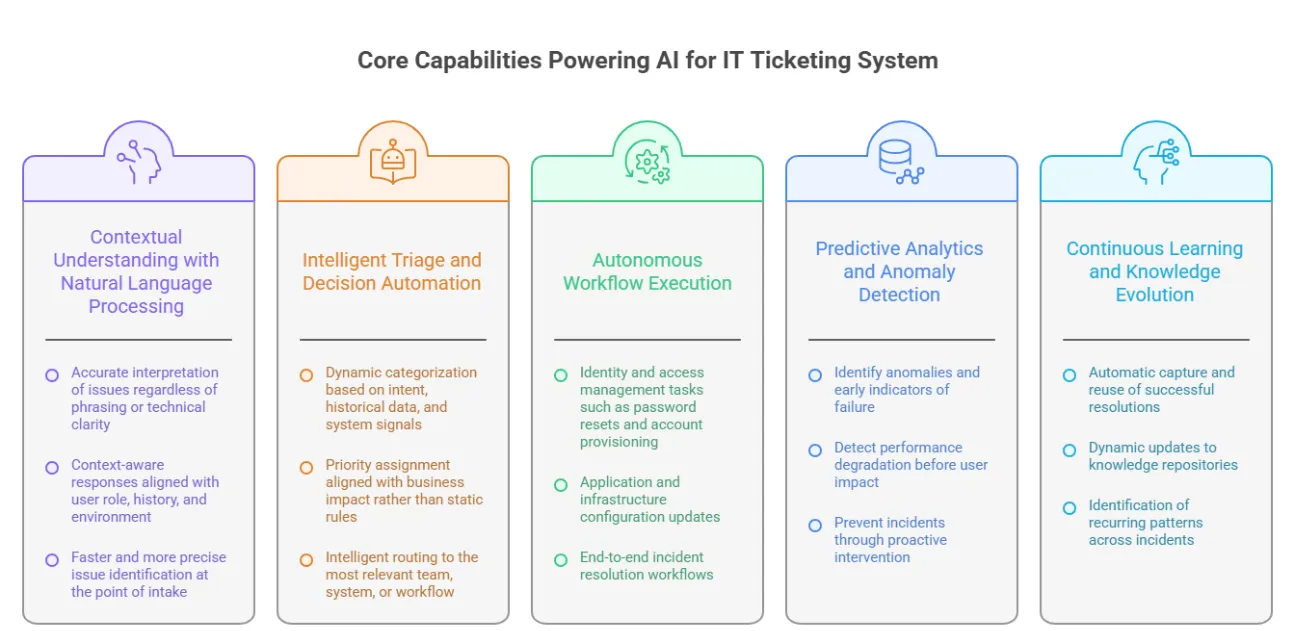
Contextual Understanding with Natural Language Processing
At the foundation is the ability to understand user intent in its natural form. Instead of relying on structured forms or predefined inputs, modern AI systems interpret requests expressed in everyday language.
This enables
- Accurate interpretation of issues regardless of phrasing or technical clarity
- Context-aware responses aligned with user role, history, and environment
Faster and more precise issue identification at the point of intake
The outcome is a more intuitive and frictionless interaction model for end users, while ensuring IT teams receive well-contextualized requests from the outset.
According to Microsoft, the rise of natural language interfaces and AI copilots is fundamentally changing how users interact with enterprise systems, making conversational IT support the new standard.
Intelligent Triage and Decision Automation
AI fundamentally redefines triage by replacing manual classification with real-time, context-driven decision-making.
It enables
- Dynamic categorization based on intent, historical data, and system signals
- Priority assignment aligned with business impact rather than static rules
- Intelligent routing to the most relevant team, system, or workflow
This reduces delays, minimizes misrouting, and ensures that every request is handled with the right level of urgency and expertise from the start.
Autonomous Workflow Execution
Beyond decision-making, AI introduces the ability to execute actions independently across enterprise systems.
This includes
- Identity and access management tasks such as password resets and account provisioning
- Application and infrastructure configuration updates
- End-to-end incident resolution workflows
In this model, AI does not stop at recommending the next steps; it carries them out. This significantly reduces manual intervention and accelerates resolution cycles.
Predictive Analytics and Anomaly Detection
AI extends its value by continuously analyzing system-level data, including logs, performance metrics, and user behavior.
This allows IT teams to
- Identify anomalies and early indicators of failure
- Detect performance degradation before user impact
- Prevent incidents through proactive intervention
Support shifts from reactive response to predictive operations, improving system stability, and reducing overall ticket volume.
Continuous Learning and Knowledge Evolution
A defining capability of AI-powered helpdesks is their ability to learn and improve over time. Every interaction contributes to a feedback loop that enhances system intelligence.
This enables
- Automatic capture and reuse of successful resolutions
- Dynamic updates to knowledge repositories
- Identification of recurring patterns across incidents
Over time, the system becomes more accurate, more efficient, and increasingly capable of handling complex scenarios independently turning knowledge into a continuously evolving asset rather than a static resource.
McKinsey & Company notes that organizations that embed continuous learning into AI systems see compounding gains in efficiency and accuracy over time, turning knowledge into a scalable enterprise asset.
Where AI Creates Tangible Value: High-Impact Use Cases in IT Services
The true value of AI for IT Ticketing System becomes evident when applied to real-world IT service scenarios. Rather than acting as a generic automation layer, AI delivers targeted impact across high-volume, high-friction areas of support operations.
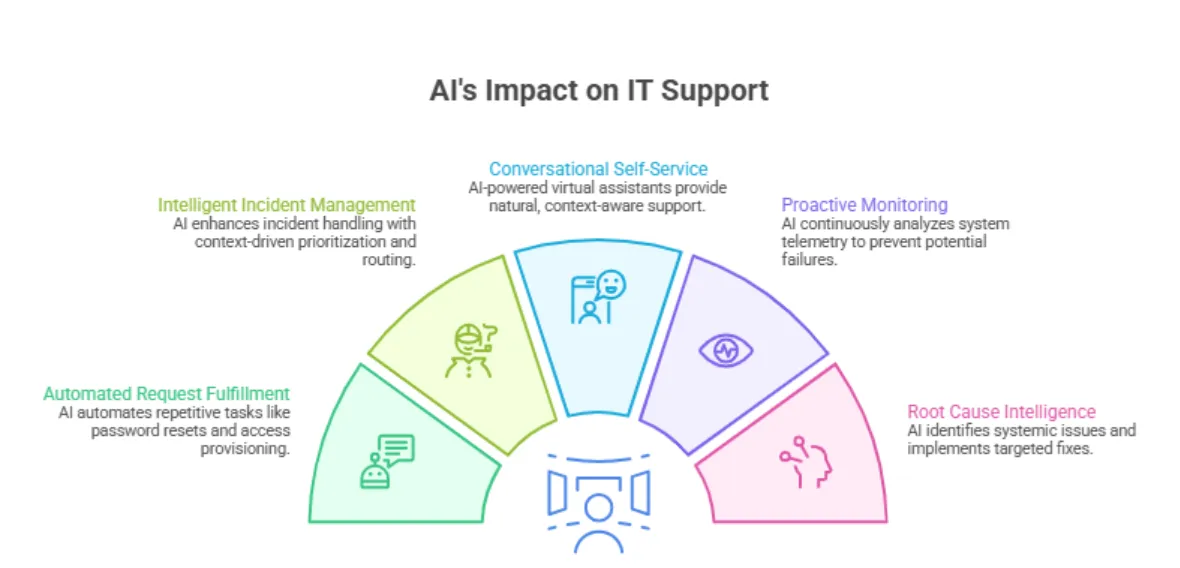
Automated Request Fulfillment
A significant portion of the helpdesk workload is driven by repetitive, rule-based requests, password resets, access provisioning, and account updates. These are essential but time-consuming tasks.
AI enables end-to-end automation of these requests by
- Validating user identity and access policies
- Executing predefined actions across integrated systems
- Confirming completion and closing requests autonomously
This reduces response times from hours to seconds while freeing IT teams from routine operational load.
Intelligent Incident Management
Incident management is where delays and inefficiencies often compound. AI introduces precision and speed into this process by embedding intelligence at every stage.
It enhances incident handling through
- Context-driven classification and prioritization
- Real-time routing aligned with expertise and availability
- Resolution recommendations based on historical patterns
This results in faster response cycles, fewer escalations, and more consistent handling of critical issues.
Conversational Self-Service and Virtual Support
AI-powered virtual assistants to redefine how users interact with IT support. Instead of navigating portals or submitting tickets, users engage in natural, conversational interactions.
These systems enable users to
- Describe issues in plain language
- Receive immediate, context-aware responses
Follow the guided steps to resolve issues independently
By resolving a large percentage of queries at the point of interaction, organizations significantly reduce ticket volume while improving user satisfaction.
Proactive Monitoring and Incident Prevention
AI shifts IT operations from reactive support to proactive management by continuously analyzing system telemetry.
This includes
- Monitoring infrastructure performance and usage patterns
- Detecting anomalies across networks, applications, and systems
Predicting potential failures before user impact
By addressing issues before they surface, IT teams reduce downtime, stabilize operations, and minimize disruption across the enterprise. IBM emphasizes that predictive IT operations can significantly reduce incident volumes by identifying risks before they materialize into disruptions.
Root Cause Intelligence and Problem Management
Beyond resolving individual incidents, AI brings the ability to identify systemic issues across environments.
By correlating data across multiple tickets and systems, AI enables teams to
- Detect recurring patterns and failure points
- Trace incidents back to the underlying root causes
Implement targeted fixes that eliminate repeated disruptions
This shifts IT from symptom resolution to long-term problem elimination, improving reliability, and reducing operational overhead over time.
Business Outcomes of AI for IT Ticketing Systems
The value of AI for IT Ticketing System is reflected in measurable improvements across operational efficiency, service quality, and user experience. Organizations that have integrated AI into their helpdesk ecosystems are seeing tangible gains that extend beyond incremental optimization.
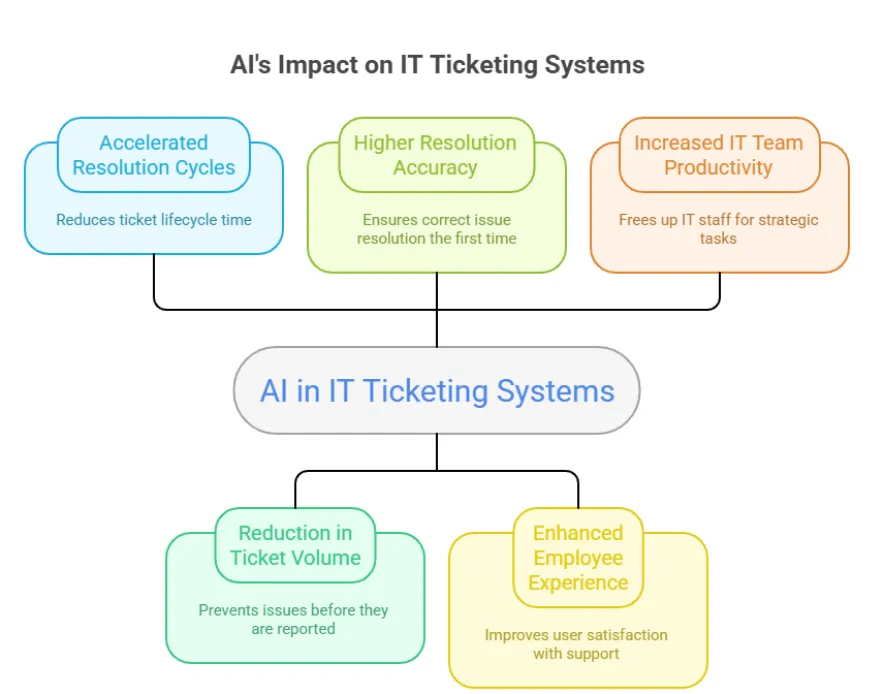
Accelerated Resolution Cycles
AI compresses the entire ticket lifecycle from intake and triage to execution and closure. By eliminating manual dependencies and enabling real-time decision-making, organizations achieve significantly lower mean time to resolution (MTTR). Faster resolutions directly translate into reduced downtime and improved business continuity.
Reduction in Ticket Volume
With predictive monitoring and intelligent self-service, many issues are resolved before they are ever reported. AI assistants handle routine queries at the point of interaction, while proactive detection prevents incidents altogether. The outcome is a noticeable decline in incoming ticket volumes and a more manageable support environment.
Gartner suggests that AI-powered automation and virtual agents can deflect a substantial portion of incoming service requests, reducing overall ticket volumes.
Higher Resolution Accuracy
Context-aware analysis ensures that issues are understood and addressed correctly the first time. By leveraging historical patterns, user context, and system dependencies, AI minimizes misclassification, reduces rework, and improves first-contact resolution rates.
Enhanced Employee Experience
Faster responses, consistent outcomes, and intuitive support interactions contribute to a significantly improved user experience. Employees spend less time waiting for resolutions, and more time focused on productive work driving overall organizational efficiency.
Increased IT Team Productivity
By automating repetitive, high-volume tasks, AI allows IT professionals to redirect their efforts toward higher-value initiatives such as system optimization, security enhancement, and innovation. This shift not only improves operational efficiency but also elevates the strategic role of IT within the organization.
According to insights from Gartner and Forrester, AI service desks are consistently delivering measurable improvements in efficiency, cost optimization, and service quality, reinforcing AI’s role as a foundational capability in modern IT operations.
What to Look for in AI Helpdesk Solutions
Not all AI-powered solutions deliver the same value. Organizations must evaluate platforms based on their ability to support enterprise-scale operations.
Key Capabilities to Prioritize
- Conversational interfaces for intuitive interaction
- Agentic AI for autonomous task execution
- Seamless integration with enterprise systems
- Real-time analytics and performance insights
- Scalability to handle growing demand
Strong security and compliance frameworks
Time-to-Value Considerations
Modern solutions should be designed for rapid deployment, enabling organizations to achieve measurable ROI within weeks rather than months.
Flexibility and Future Readiness
The platform should adapt to evolving business needs, supporting new use cases, and integrating with emerging technologies.
Final Thoughts
AI helpdesk solutions signal more than incremental improvement; they mark a structural shift in how IT services are designed, delivered, and sustained.
By bringing together contextual understanding, predictive intelligence, and autonomous execution, AI for IT Ticketing System redefines the helpdesk as an intelligent service layer, one that responds to issues and actively orchestrates outcomes across the enterprise.
For IT service teams, the impact extends beyond efficiency gains. It introduces a new operating model, one defined by precision in decision-making and the ability to continuously adapt to changing system conditions and user needs. This allows teams to move away from reactive workload management and focus on higher-value priorities such as resilience engineering, security, and long-term optimization.
Looking ahead, the benchmark for IT support will continue to evolve. Success will be measured by how effectively systems anticipate disruptions, resolve issues autonomously, and continuously improve service performance.
FAQs
1. What is AI for IT Ticketing System?
AI for IT Ticketing System refers to the use of artificial intelligence to automate and enhance IT support processes, including ticket classification, routing, resolution, and predictive analysis.
2. What are the key capabilities of AI helpdesk solutions?
Key capabilities include natural language understanding, intelligent triage, autonomous workflow execution, predictive analytics, and continuous learning.
3. How does AI reduce ticket volume?
AI reduces ticket volume by enabling proactive issue detection, self-service resolution, and autonomous handling of routine requests.
4. What are common use cases for AI in IT services?
Common use cases include automated request fulfillment, incident management, self-service support, predictive monitoring, and root cause analysis.
5. What benefits do organizations see from AI-powered helpdesks?
Benefits include faster resolution times, reduced ticket volumes, improved accuracy, better user experience, and increased IT productivity.
6. What should organizations consider when selecting an AI helpdesk solution?
They should evaluate conversational capabilities, autonomous execution, integration options, analytics, scalability, and security.
7. Is AI replacing IT support teams?
No. AI augments IT teams by handling repetitive tasks, enabling professionals to focus on complex problem-solving and strategic initiatives.
























Sign in to leave a comment.