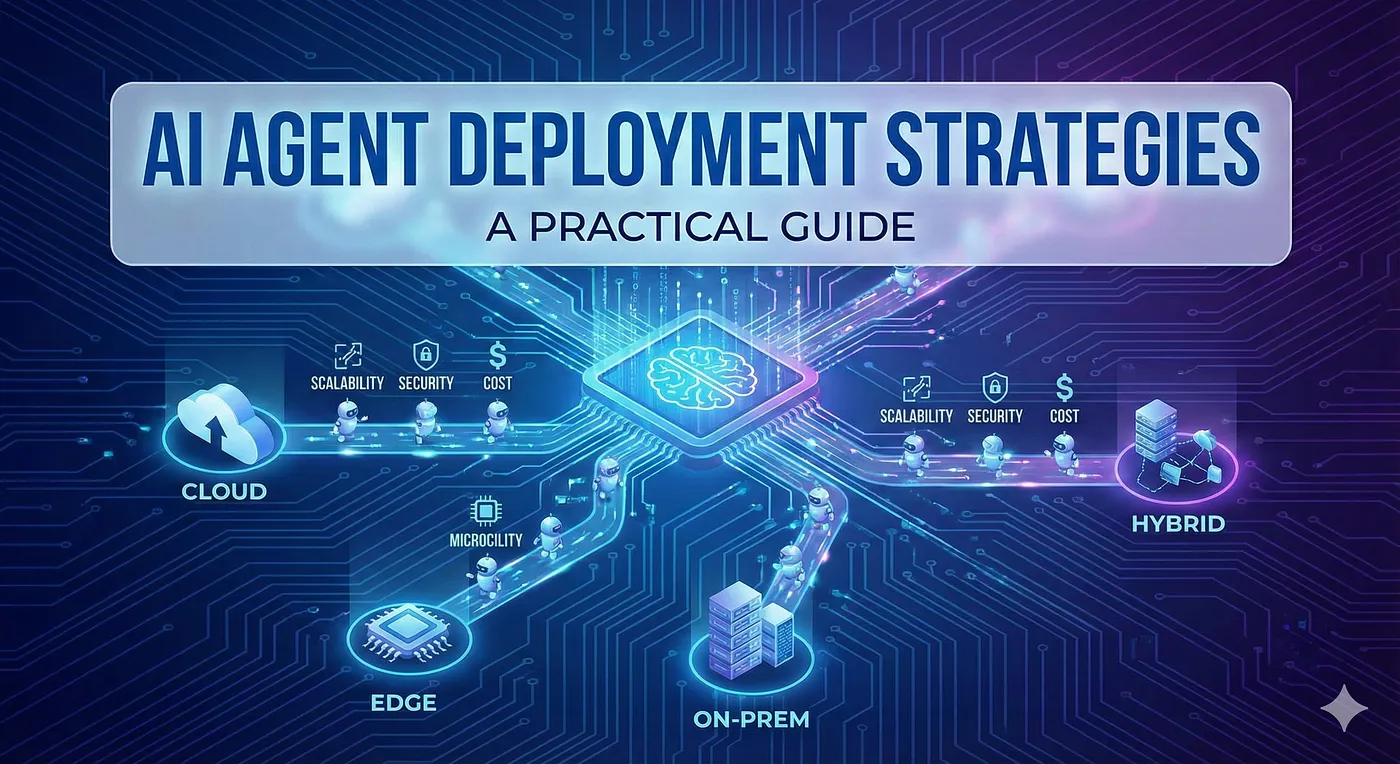

The AI Agent Implementation Timeline is often discussed in parts, individual steps, isolated challenges, or specific phases. But for most enterprises, what matters is understanding the full journey from planning to deployment, and how each stage connects to the next.
When viewed end-to-end, the timeline reveals something important. It’s not just about building an AI agent, it’s about aligning systems, data, and workflows so that the agent can function reliably in real conditions. This is what makes the implementation process structured, but also inherently iterative.
From Planning to Deployment: Understanding the Full AI Agent Implementation Timeline
In enterprise environments, the AI Agent Implementation Timeline typically moves from planning and design to deployment and early adoption. Each stage builds on the previous one, but progress is rarely linear. Teams often revisit earlier steps as new dependencies and constraints emerge.
What makes this timeline complex is not the sequence itself, but the interactions between stages. Decisions made during planning influence data preparation, which in turn shapes model behavior, validation requirements, and ultimately how smoothly deployment and adoption happen.
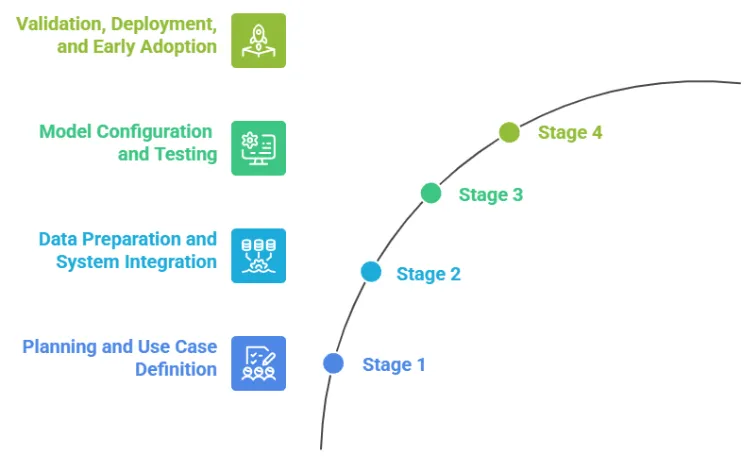
Stage 1: Planning and Use Case Definition
The implementation process begins with defining what the AI agent is expected to do and how it fits into existing workflows. This stage sets the direction for the entire AI Agent Implementation Timeline, making it critical to establish clarity early.
- Identify high-impact use cases aligned with business objectives and operational workflows
- Map current processes to understand where AI can enhance efficiency and decision-making
- Define the role of the AI agent, including inputs, outputs, and interaction points
- Align stakeholders across business, data, and technology teams on scope and expectations
This stage often involves multiple iterations, as initial ideas are refined based on system constraints, data availability, and practical feasibility.
Stage 2: Data Preparation and System Integration
Once the use case is defined, the focus shifts to preparing the data and integrating it across enterprise systems. This stage forms the backbone of enterprise AI integration and significantly influences both performance and timeline.
- Identify and connect data sources across systems such as CRM, ERP, and internal platforms
- Clean and standardize data to ensure consistency and usability
- Validate data accuracy and relevance for the defined use case
Establish secure access and governance across data pipelines
In practice, data preparation is rarely straightforward. Teams often uncover inconsistencies and gaps that require multiple cycles of refinement, making this one of the most time-intensive stages.
Stage 3: Model Configuration and Testing
With data in place, teams move to configuring models and testing how well they perform in real scenarios. This stage focuses on aligning model behavior with business expectations and operational requirements.
- Evaluate different models based on use case needs and constraints
- Design prompts and interaction logic tailored to workflows
- Fine-tune configurations to improve output quality and consistency
- Test outputs against real scenarios and refine iteratively
This phase progresses through continuous experimentation, as teams adjust models and prompts based on feedback and observed performance.
Stage 4: Validation, Deployment, and Early Adoption
As the solution matures, it moves into validation and deployment, where reliability, compliance, and usability are tested in real environments. This stage ensures that the AI agent is ready to operate within enterprise systems and workflows.
Validation involves checking accuracy, performance, and adherence to governance standards. Teams conduct pilot runs and controlled deployments to identify any gaps or issues before scaling further. These checks often introduce additional iterations, as adjustments may be needed across data, models, or workflows.
Once deployed, early adoption begins. End users interact with the system, providing feedback that highlights practical challenges and opportunities for improvement. This phase bridges the gap between technical readiness and real-world usage, shaping how the solution evolves within the broader AI Agent Implementation Timeline.
Conclusion
The AI Agent Implementation Timeline becomes much clearer when viewed as a complete journey from planning to deployment. Each stage plays a distinct role, but it is the connection between them that determines how smoothly the implementation progresses.
For enterprises, understanding this flow helps set realistic expectations and improves coordination across teams. Instead of focusing only on individual stages, organizations can approach implementation as an integrated process, enabling more consistent execution and better long-term outcomes.
FAQs
1. What does the AI Agent Implementation Timeline include?
It includes all stages from planning and use case definition to data preparation, model configuration, validation, deployment, and early adoption. Each stage contributes to how effectively the AI agent operates in real environments.
2. Why is the AI Agent Implementation Timeline not linear?
Because each stage depends on inputs from others, and new insights often require revisiting earlier steps. This creates an iterative process rather than a straight sequence.
3. Which stage is the most challenging in AI agent implementation?
Data preparation and integration are often the most challenging due to fragmented systems, data quality issues, and cross-team dependencies.
4. How does early adoption impact the implementation timeline?
Early adoption reveals real-world usage challenges, which often lead to refinements in models, workflows, or system integration, extending the timeline but improving outcomes.
5. How can enterprises manage the AI Agent Implementation Timeline more effectively?
By understanding each stage, aligning teams early, and managing dependencies across systems and workflows. A structured approach helps reduce delays and ensures smoother execution.




























Sign in to leave a comment.