

Sales organizations are entering a phase where performance improvement depends less on adding new tools and more on transforming how existing systems are used. As a result, the role of AI Tools for Sales becomes fundamental in driving meaningful improvement.
Many organizations continue to operate with fragmented sales stacks, combining CRM systems, engagement platforms, and analytics tools that function in isolation. Gartner consistently emphasizes that disconnected sales technologies are a primary cause of poor pipeline visibility and inconsistent execution.
Adopting AI in sales should not be viewed as simply adding another layer of automation. It requires a more deliberate shift toward rethinking how sales workflows are structured, how decisions are made, and how execution is carried out at scale.
This blog explores how organizations can approach AI adoption more strategically, focusing on capabilities that improve productivity, strengthen pipeline execution, and enable more consistent revenue outcomes.
Why Most Sales Tools Fail to Deliver ROI
Before evaluating the best solutions, it is essential to understand why many sales tools fail to generate meaningful returns. The issue is not the lack of features, but the gap between technology and real-world execution.
1. They Add Work Instead of Reducing It
Many sales tools are introduced with the promise of improving efficiency, yet they often add to the workload. Sales teams are required to manually update CRM records, manage data inputs, and maintain system accuracy.
Instead of reducing effort, these tools consume valuable selling time, limiting productivity and focus on revenue-generating activities. Research from Salesforce indicates that sales reps still spend a significant portion of their time on non-selling activities, reinforcing this challenge.
2. They Provide Insights Without Context
Dashboards and analytics platforms provide visibility into performance metrics, trends, and pipeline status. However, they rarely translate these insights into clear next steps.
Without actionable guidance, sales representatives are left to interpret data on their own, reducing the practical impact of these tools.
3. They Operate in Silos
Sales ecosystems typically consist of multiple disconnected tools, CRM platforms, engagement solutions, and analytics systems.
This fragmentation creates data silos, making it difficult to maintain a unified view of the customer journey and leading to inconsistent decision-making.
4. They Ignore Execution
Most tools are designed to track and report activity rather than drive it.
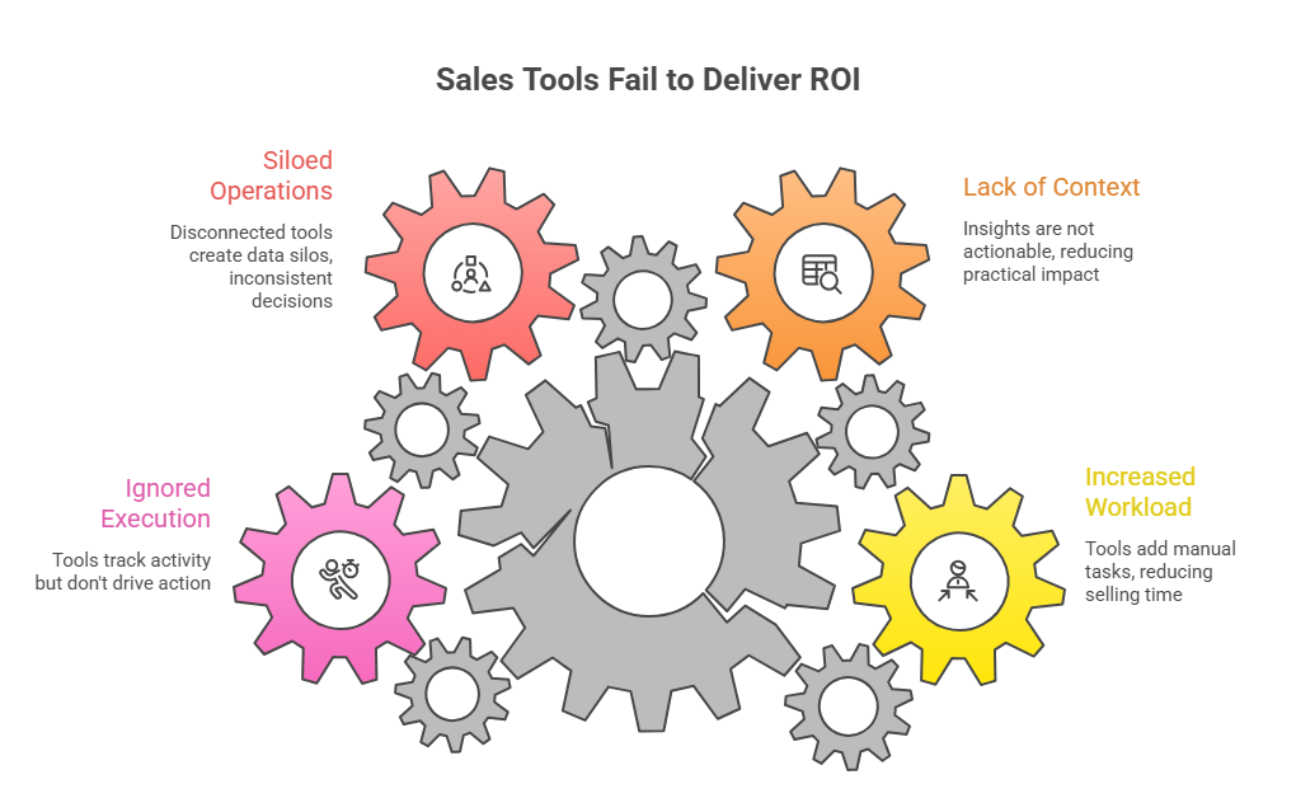 However, sales success depends on consistent execution, particularly timely follow-ups and disciplined engagement. Visibility alone does not improve outcomes unless it is directly tied to action.
The Capabilities that Actually Matter in 2026
Leading sales organizations' focus has shifted to capabilities that directly influence execution quality, decision velocity, and revenue outcomes. The following capabilities define what truly matters in AI Tools for Sales in 2026.
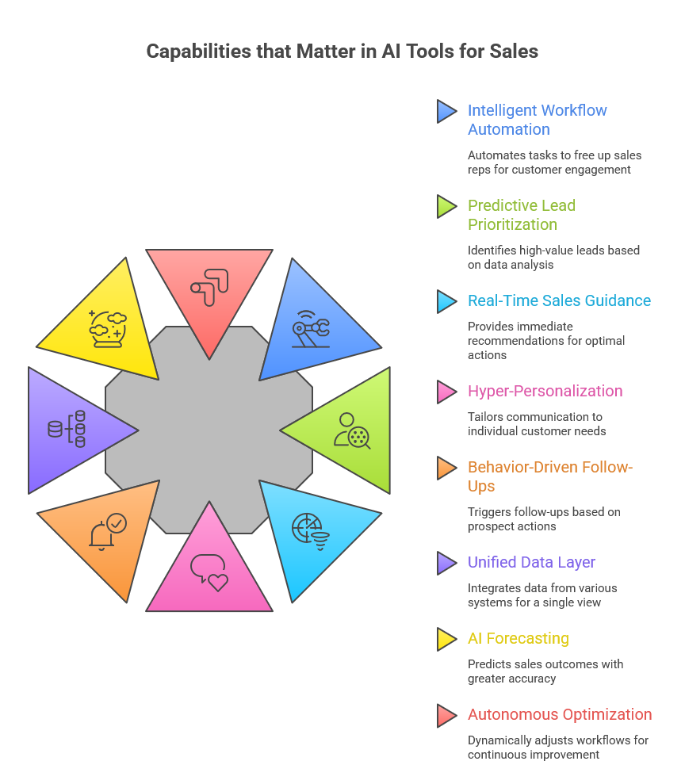
1. Intelligent Workflow Automation
Automation is about removing operational friction across the sales lifecycle. Advanced AI systems automatically capture meeting insights, update CRM records in real time, extract next steps, and trigger downstream workflows without manual intervention.
Why it matters
This shifts sales effort away from system management toward customer engagement. It also ensures data integrity at scale, reducing dependency on manual inputs and improving overall pipeline visibility.
2. Predictive Lead and Opportunity Prioritization
Not all leads are equal, but most sales processes treat them that way.
AI changes this by
- Analyzing historical deal data
- Tracking engagement signals (opens, clicks, visits)
- Identifying patterns of high-conversion opportunities
It then assigns dynamic scores that evolve in real time.
Why it matters
Sales teams gain a continuously updated view of where effort will generate the highest return. This enables precision selling, where time and attention are aligned with the most valuable opportunities. According to McKinsey & Company, predictive analytics can significantly improve conversion rates by aligning sales efforts with high-probability deals.
3. Real-Time Sales Guidance (Next-Best Actions)
Execution gaps in sales often stem from uncertainty around timing, messaging, and sequencing. AI addresses this by embedding real-time decision support directly within sales workflows.
These systems recommend next-best actions, optimal outreach timing, and contextually relevant content based on prospect behavior and deal progression.
Why it matters
It standardizes high-quality execution across the team, reduces reliance on individual intuition, and accelerates deal movement through informed, timely actions.
4. Hyper-Personalization at Scale
Personalization has become a baseline expectation, yet scaling it remains operationally complex. AI enables context-aware engagement by generating tailored communication aligned with prior interactions, intent signals, and customer profiles.
This includes dynamic email generation, personalized content recommendations, and adaptive outreach strategies.
Why it matters
Sales teams can deliver highly relevant interactions without increasing manual effort, leading to stronger engagement, improved response rates, and more meaningful customer conversations.
5. Behavior-Driven Follow-Up Systems
Traditional follow-up models rely on predefined timelines, often disconnected from actual buyer intent. AI introduces event-driven engagement, where follow-ups are triggered by real-time prospect behavior.
Signals such as email interactions, website activity, proposal engagement, or inactivity patterns drive automated yet contextual follow-ups.
Why it matters
This ensures that outreach occurs at moments of highest relevance, increasing responsiveness while eliminating missed opportunities due to inconsistent follow-up discipline.
6. Unified Data and Context Layer
Sales execution is often hindered by fragmented data across CRM, communication platforms, and marketing systems. AI tools in 2025 act as a unification layer, integrating these data sources into a single, coherent customer view.
Why it matters
Sales professionals operate with complete context during every interaction, enabling more informed decisions, reducing duplication of effort, and improving overall customer experience.
7. AI Forecasting and Deal Risk Analysis
Forecasting accuracy remains a persistent challenge due to reliance on manual inputs and subjective judgment. AI enhances this process through continuous pipeline analysis, identifying risk signals such as stalled engagement, declining activity, or inconsistent deal progression.
Why it matters
Organizations gain predictive visibility into pipeline health, enabling proactive intervention, more accurate forecasts, and stronger alignment between sales strategy and execution.
8. Autonomous Sales Workflow Optimization
The next frontier of AI in sales lies in self-optimizing systems. These platforms go beyond recommendations to dynamically adjust workflows, refining outreach sequences, re-prioritizing opportunities, and optimizing engagement strategies based on real-time performance data.
Why it matters
Sales operations transition from static, rule-based processes to adaptive systems that continuously improve, driving sustained productivity gains and long-term efficiency.
Top 5 Best AI Tools for Sales Teams in 2026
Selecting the right AI Tools for Sales is about identifying solutions that directly improve execution, decision-making, and revenue outcomes.
Below are five leading tools in 2025, each aligned with specific sales capabilities that actually matter.
1. DTskill AI
Best for: End-to-End Sales Execution and Workflow Intelligence
DTskill AI is designed to go beyond automation by embedding intelligence into the entire sales workflow. It connects systems like CRM, ERP, and engagement platforms to create a unified execution layer.
Key capabilities
- AI workflow orchestration
- Automated follow-ups and next-best-action recommendations
- Intelligent quotation and proposal automation
- Real-time decision support
Why it stands out
DTskill AI enables sales teams to move from fragmented activities to structured, data-driven execution across the sales lifecycle.
2. Salesforce Einstein
Best for : Enterprise AI-Powered CRM and Predictive Insights
Salesforce Einstein integrates AI directly into CRM workflows, helping teams prioritize leads and forecast revenue with greater accuracy.
Key capabilities
- Predictive lead and opportunity scoring
- Automated activity tracking
- AI-driven forecasting
- Personalized sales recommendations
Why it stands out
It offers deep integration and scalability, making it ideal for large organizations managing complex pipelines.
3. HubSpot
Best for : Ease of Use and Fast Adoption
HubSpot combines user-friendly design with powerful AI features, making it a strong choice for growing sales teams.
Key capabilities
- AI-generated emails and content
- Workflow automation
- Conversation intelligence
- Pipeline tracking and insights
Why it stands out
It delivers quick productivity gains without requiring heavy technical setup.
4. Outreach
Best for : Follow-Up Execution and Sales Engagement
Outreach focuses on improving consistency and effectiveness in sales outreach and follow-ups.
Key capabilities
- Multi-channel outreach automation
- Behavior-based follow-up triggers
- Engagement tracking and analytics
- AI sequence optimization
Why it stands out
It helps sales teams execute follow-ups at scale with precision and consistency, addressing a critical gap in sales performance.
5. Gong
Best for : Conversation Intelligence and Deal Visibility
Gong captures and analyzes sales conversations to provide insights into deal health and team performance.
Key capabilities
- Call and meeting analysis
- Deal risk identification
- Sales coaching insights
- Revenue forecasting support
Why it stands out
It transforms conversations into actionable insights, helping teams improve win rates and decision-making.
Final Thoughts
In 2026, the effectiveness of AI Tools for Sales will be defined by their ability to move beyond automation and actively shape how sales work gets executed. The focus is on enabling consistent, high-quality actions across the entire sales cycle.
Organizations that align AI with core sales workflows, prioritization, engagement, follow-ups, and forecasting will see measurable gains in productivity and conversion efficiency. Those who rely on fragmented tools or surface-level insights will continue to face execution gaps. As emphasized by McKinsey & Company, organizations that embed AI into core workflows outperform peers in both productivity and revenue growth.
The competitive advantage lies in building a connected, intelligence-driven sales environment where decisions are faster, actions are timely, and processes continuously improve. AI is a force multiplier that allows teams to operate with greater precision, discipline, and impact at scale.
FAQs
1. What defines the best AI Tools for Sales Teams in 2026?
The best AI Tools for Sales in 2026 are defined by their ability to improve execution and decision-making, not just automate tasks. Key capabilities include predictive lead prioritization, real-time sales guidance, behavior-driven follow-ups, and unified data integration that directly impact revenue outcomes.
2. How do AI tools improve sales productivity?
AI tools enhance productivity by automating administrative tasks such as CRM updates, capturing meeting insights, and triggering workflows. They also guide sales reps on next-best actions, enabling them to focus more on selling and less on manual processes.
3. Why is predictive lead scoring important in modern sales?
Predictive lead scoring uses AI to analyze historical data and real-time engagement signals to identify high potential opportunities. This helps sales teams prioritize effectively, ensuring that time and effort are spent on leads most likely to convert.
4. How do AI tools help improve follow-ups and engagement?
AI tools enable behavior-driven follow-ups by tracking signals like email opens, website visits, and proposal interactions. This allows sales teams to engage prospects at the right time with relevant messaging, increasing response rates and conversions.
5. What should organizations consider when selecting AI Tools for Sales?
Organizations should evaluate tools based on core capabilities such as workflow automation, real-time guidance, personalization at scale, forecasting accuracy, and system integration. The focus should be on how well the tool fits into existing workflows and drives measurable business impact.




























Sign in to leave a comment.