
If you talk to any sales leader today, you’ll hear the same frustration: we have more tools than ever, yet selling feels harder than it used to.
CRMs are full. Dashboards are busy. Automation is everywhere. And still, reps spend a shocking amount of time updating records, chasing the wrong leads, and following up too late. Buyers, meanwhile, have changed the rules. They research on their own, respond only when something feels relevant, and expect fast, thoughtful engagement every time they show intent.
This gap between how sales teams work and how buyers buy is exactly why AI Agents for Sales are getting so much attention.
AI agents for Sales can engage prospects, qualify leads, personalize outreach, manage follow-ups, and surface pipeline insights, often autonomously and across multiple channels.
Yet despite the growing hype, many organizations still struggle to answer practical questions:
Which AI agents actually deliver value? What capabilities matter in real sales environments? And how are leading teams adopting AI agents without damaging trust, accuracy, or human judgment?
Gartner predicts that by 2028, AI agents will outnumber human sellers tenfold, but without a disciplined approach to integration, fewer than 40% of sellers will actually report improved productivity.
This blog explores the best AI Agents for Sales, the capabilities that truly differentiate them, the use cases delivering measurable impact, and how organizations are successfully adopting AI agents at scale.
Core Capabilities of the Best AI Agents for Sales
At a minimum, high-performing agents demonstrate maturity across five core capabilities.
| Capability | What the Best AI Agents Actually Do |
| Intelligent Lead Engagement | Engage buyers instantly, ask natural qualification questions, detect intent and urgency, capture CRM-ready data, and route leads with full context |
| Autonomous Outbound Prospecting | Build and enrich prospect lists, personalize outreach, manage follow-ups based on engagement, and schedule meetings without manual prompts |
| Contextual Personalization | Adapt messaging using industry, role, past interactions, deal stage, and real-time intent signals |
| Sales Intelligence & Pipeline Analysis | Identify deal risk, prioritize opportunities, guide rep focus, and improve forecast accuracy using behavioral data |
| CRM-Native Execution & Trust | Update CRM automatically, log activities accurately, track deal progression, and support compliance without parallel systems |
According to enterprise practitioners and platform makers such as Salesforce, AI agents should integrate directly with CRM systems to surface insights and actions in context, thereby accelerating sales execution and decision-making.
Key Use Cases for AI Agents Across the Sales Funnel
Across industries and go-to-market models, four high-impact use cases consistently emerge.
Use Case 1: AI Agents as Scalable SDRs
The top of the funnel is where sales teams feel scale pain first. As outreach volume increases, consistency drops, follow-ups slip, and response quality becomes uneven across reps.
AI Agents for Sales operate as always-on SDRs by handling:
- High-volume outbound prospecting
- Multi-step follow-up sequences
- Qualification conversations before human handoff
- Meeting scheduling based on buyer readiness
This use case is most effective for
- B2B SaaS and digital-first businesses
- Mid-market and SMB sales teams
- Organizations scaling into new regions or segments.
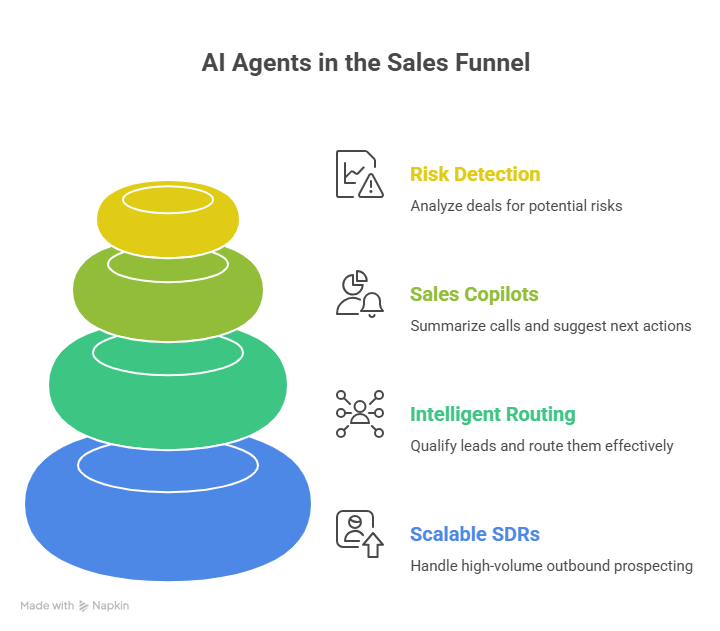
Use Case 2: Instant Qualification and Intelligent Routing
AI Agents for Sales engage inbound leads the moment intent is expressed, whether through a website visit, demo request, or inbound email. Instead of static forms and delayed callbacks, buyers experience a real-time, conversational interaction.
These agents:
- Qualify intent dynamically, not through fixed forms
- Capture context such as use case, urgency, and budget signals
- Route leads based on deal complexity, territory, and availability
The outcome is a measurable improvement in:
- Speed-to-lead
- Buyer experience
- Inbound-to-opportunity conversion rates
Use Case 3: AI Agents as Sales Copilots
As deals move into discovery and evaluation, the cost of inefficiency rises sharply. Reps juggle calls, emails, notes, CRM updates, and internal coordination, often at the expense of deal strategy.
AI Agents for Sales act as embedded copilots by:
- Summarizing calls and conversations automatically
- Extracting objections, intent, and sentiment
- Suggesting next-best actions based on deal behavior
- Drafting context-aware follow-ups aligned to buyer signals
Use Case 4: Forecasting and Deal Risk Detection
Forecasting is where intuition often overrides data and where surprises are most expensive.
AI Agents for Sales continuously analyze deal activity, engagement patterns, and historical outcomes to surface insights that humans miss, such as:
- Deals that appear active but show declining buyer engagement
- Pipeline inflation driven by stalled opportunities
- Risk signals that threaten forecast accuracy
This enables timely intervention, more realistic forecasting, and better alignment between sales, finance, and leadership teams.
Best AI Agents for Sales in 2026
| AI Agent | Primary Use Case | Where it Excels | Best Fit Teams |
| DTskill AI | End-to-End AI Agents for Sales | Autonomous execution across the funnel, CRM-native intelligence, pipeline risk detection | Enterprise & mid-market B2B teams with complex sales motions |
| Ava by Artisan | SDR Automation (Outbound) | Runs outbound prospecting autonomously, fast pipeline creation | High-volume outbound SaaS teams |
| Lindy | Custom AI Workflow Automation | No-code flexibility, agent logic customization | Ops-led teams with unique workflows |
| Cognism | Data & Intent Intelligence | High-quality B2B data, enrichment, compliance | Data-first prospecting teams |
| Apollo.io | All-in-One Sales Platform | Broad sales execution features in one place | SMB and mid-market sales teams |
| Botpress | Conversational AI Sales | Advanced conversation design, multichannel support | Product-led & chat-driven sales teams |
Real-World Adoption: Who is Using AI Agents for Sales Today?
AI Agents for Sales are being deployed across companies of all sizes, but for very different reasons.
Here’s how AI agents are showing up in the real world today.
Enterprises
Across regions, teams, and product lines, sales execution often varies widely. AI Agents for Sales help enterprises standardize how work gets done without forcing rigid processes on human sellers.
In enterprise environments, AI agents are commonly used to:
- Enforce consistent follow-up and engagement standard
- Support account executives with real-time deal intelligence
- Surface pipeline risk and forecast gaps earlier
- Reduce dependency on manual reporting and rep self-assessment
Mid-Market Companies
For mid-market organizations, growth often creates operational strain.
Pipeline demand increases faster than teams can hire, train, and manage SDRs. AI Agents for Sales provide a way to scale outbound and inbound activity without proportional increases in headcount.
Mid-market teams typically deploy AI agents to:
- Run outbound prospecting at higher volumes
- Handle inbound qualification and routing in real time
- Reduce SDR workload while maintaining pipeline quality
- Shorten ramp time for new reps
Startups and SMBs
For startups and SMBs, AI Agents for Sales often become the first dedicated sales resource.
Before hiring a full sales team, founders use AI agents to manage:
- Lead qualification from inbound interest
- Early-stage outreach and follow-up
- Meeting scheduling and CRM hygiene
This allows small teams to validate demand, learn buyer signals, and build repeatable sales motions before investing heavily in human headcount. In many cases, AI agents reduce early hiring risk while accelerating time to revenue.
Final Thoughts
The best AI sales agents aren’t the ones that send the most emails or generate the most data. They’re the ones that remove friction from the sales process, enforce execution discipline, and surface intelligence at the exact moment decisions need to be made.
What we’re seeing across enterprises, mid-market teams, and fast-growing startups is a clear pattern: AI agents are most effective when they are embedded into sales workflows, integrated with CRM systems, and aligned to real sales outcomes, not treated as standalone tools.
From a DTskill POV, the future belongs to AI Agents for Sales that operate as autonomous contributors within the revenue engine.
Sales teams that approach AI agents as a strategic capability, rather than a quick productivity fix, will be the ones best positioned to win in the next phase of B2B selling.
FAQs
How are AI Agents for Sales different from chatbots or sales automation tools?
Chatbots and automation tools follow predefined rules. AI Agents for Sales combine execution with intelligence; they make decisions based on context, learn from outcomes, and adjust actions dynamically. This allows them to handle complex sales workflows rather than just single tasks.
Can AI Agents for Sales replace SDRs or sales reps?
In most organizations, AI agents don’t replace sales reps; they replace repetitive, low-value work. AI agents often act as SDRs at the top of the funnel or as copilots during active deals, allowing human sellers to focus on strategy, relationships, and closing.
Which sales teams benefit the most from AI Agents for Sales?
AI Agents for Sales deliver value across company sizes, but the use cases differ:
- Enterprises use them to standardize execution and improve forecasting.
- Mid-market teams use them to scale the pipeline without adding headcount.
- Startups and SMBs use them as their first virtual sales hire.
Are AI Agents for Sales safe to use with customer data?
Yes, when deployed correctly. Enterprise-grade AI Agents for Sales operate inside secure systems like CRMs, follow compliance standards, and maintain audit trails. Trust and data governance depend more on implementation quality than the AI itself.
How do AI Agents for Sales improve forecast accuracy?
AI agents analyze real buyer behavior, engagement patterns, deal velocity, and historical outcomes, rather than relying on rep optimism alone. This enables earlier risk detection and more accurate revenue forecasting.
What should buyers look for when evaluating AI Agents for Sales?
Key evaluation criteria include:
- CRM-native execution
- Autonomy across the sales funnel
- Data transparency and explainability
- Proven real-world adoption
- Alignment with existing sales processes
How long does it take to see ROI from AI Agents for Sales?
Many organizations see early impact within weeks, especially in speed-to-lead and outbound efficiency. Full ROI typically emerges over a few quarters as AI agents learn from data and are applied across more stages of the sales funnel.
Are AI Agents for Sales suitable for complex B2B sales cycles?
Yes, in fact, complex sales cycles benefit the most. AI agents help manage long timelines, multiple stakeholders, and inconsistent engagement, while surfacing risks and insights that humans often miss.






























Sign in to leave a comment.