

Sales organizations today are not short on technology or ambition. Most have already invested heavily in CRMs, marketing automation platforms, engagement tools, proposal systems, and forecasting software. Yet despite this, sales execution often feels slower, more fragmented, and harder to scale. The challenge is not access to tools; it is the inability of those tools to think, adapt, and operate as a connected system across the revenue journey.
This is where AI Workflow Automation for Sales represents a fundamental shift. AI workflows bring intelligence directly into the flow of sales operations. They align data, systems, and actions in real time, understanding buyer intent, prioritizing opportunities, and continuously optimizing decisions from lead intake through deal closure.
This blog explores how AI workflow automation transforms each stage of the sales lifecycle, why many teams struggle to move beyond surface-level automation, and how organizations that get implementation right are building scalable, intelligent revenue engines that consistently outperform their peers.
How AI Workflows Operate Across the Sales Lifecycle
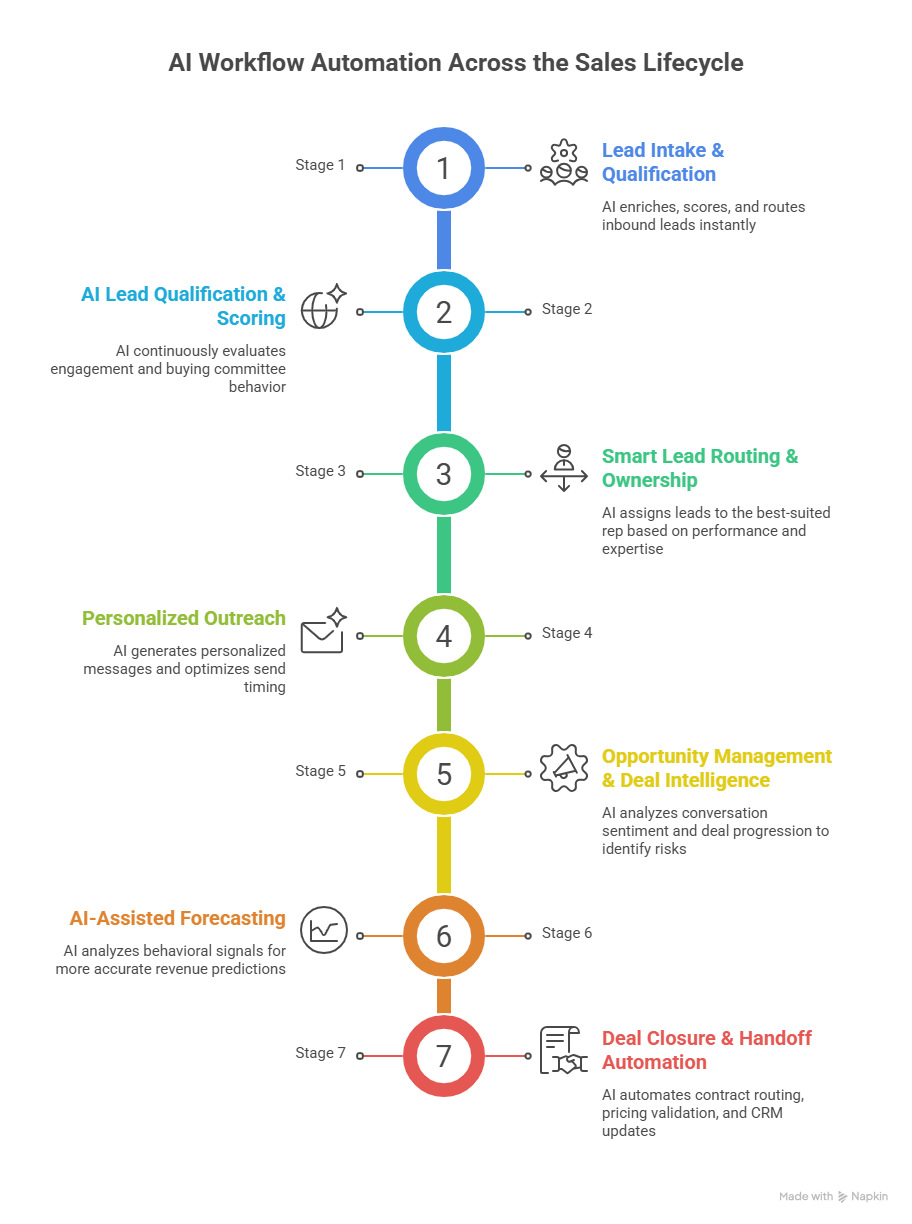
Stage 1: Lead Intake and Qualification
Lead intake is where revenue journeys are often lost before they begin. High volumes of inbound leads, inconsistent data, and delayed follow-ups reduce conversion potential.
AI workflow automation transforms this stage by
- Enriching leads instantly using third-party and first-party data
- Scoring leads based on behavioral intent, firmographics, and historical conversion patterns
- Routing leads dynamically based on deal potential, territory, and rep performance
- Triggering contextual actions in real time
Instead of static lead scoring models, AI continuously recalibrates scores as new data emerges. A prospect revisiting pricing pages, engaging with sales content, or interacting with emails immediately influences workflow decisions.
Outcome Higher lead quality, cleaner CRM data, and reduced manual research for SDRs. |
Stage 2: AI Lead Qualification and Scoring
Traditional lead scoring models are static and decay quickly.
AI-powered qualification workflows continuously evaluate
- Engagement patterns across channels
- Buying committee behavior, not just individual actions
- Historical conversion data across similar accounts
- Industry, deal size, and sales cycle benchmarks
More importantly, AI workflows explain why a lead is prioritized, giving reps confidence in where to focus.
Outcome Sales teams engage the right accounts at the right moment, without guesswork. |
Stage 3: Smart Lead Routing and Ownership Assignment
Lead routing is one of the most underestimated revenue levers. Gartner identifies intelligent routing as a critical driver of pipeline velocity and first-touch conversion.
AI workflow automation assigns leads based on:
- Rep performance with similar accounts
- Current workload and response times
- Product or industry expertise
- Time-zone and availability alignment
Instead of round-robin distribution, AI ensures each lead is routed to the best possible owner, increasing first-contact success and deal probability.
Outcome Faster response times and higher conversion from first touch. |
Stage 4: Personalized Outreach
Generic email sequences no longer work.
AI-powered outreach workflows
- Generate personalized messaging based on buyer role, industry, and intent
- Optimize send timing based on engagement patterns
- Adapt messaging dynamically based on responses or silence
- Recommend next-best actions across email, LinkedIn, calls, and meetings
Rather than replacing reps, AI acts as a copilot, ensuring every interaction is relevant, timely, and consistent.
Outcome Higher engagement rates without increasing rep workload. |
Stage 5: Opportunity Management and Deal Intelligence
Once a lead converts to an opportunity, AI workflow automation shifts from engagement to deal orchestration. McKinsey and CSO Insights show that AI deal intelligence improves win rates and reduces late-stage losses.
AI-powered workflows for sales continuously analyze:
- Conversation sentiment from calls and emails
- Deal progression compared to historical win patterns
- Stakeholder engagement gaps
- Competitive signals and pricing sensitivity
When risks emerge, such as stalled decision-makers or missing champions, the system proactively alerts reps and managers with recommended interventions.
This transforms pipeline reviews from opinion-driven discussions into evidence-based decision-making.
Outcome Improved deal velocity and reduced late-stage surprises. |
Stage 6: AI-Assisted Forecasting and Revenue Predictability
Forecasting is where most sales leaders lose sleep.
AI workflow automation improves forecasting by
- Analyzing behavioral signals instead of self-reported probabilities
- Continuously updating forecasts based on deal activity
- Highlighting forecast risk and upside scenarios
- Identifying systemic bottlenecks across the funnel
Outcome More accurate forecasts and confident executive decision-making. |
Stage 7: Deal Closure and Handoff Automation
Closing a deal is a transition point.
AI-powered closing workflows automate
- Contract and approval routing
- Pricing validation and discount governance
- CRM updates and documentation
- Seamless handoff to onboarding, finance, and customer success
By eliminating manual friction at this stage, organizations reduce deal slippage and accelerate time-to-value for customers.
Outcome Faster closures and better post-sale customer experience. |
Key Benefits of AI Sales Workflows
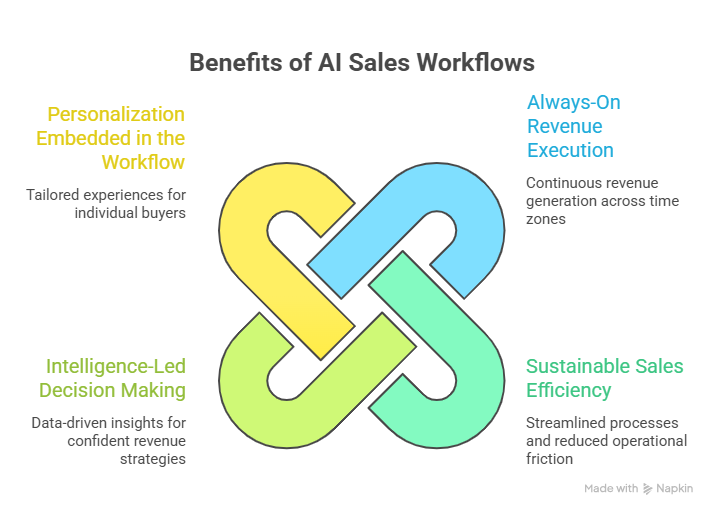
Always-On Revenue Execution
AI sales workflows operate continuously across geographies and time zones, engaging buyers the moment intent signals emerge.
Whether it’s responding to inbound interest, prioritizing high-intent accounts, or triggering contextual follow-ups, AI ensures revenue momentum never pauses outside standard business hours.
Sustainable Sales Efficiency
By automating lead enrichment, CRM updates, routing logic, and activity tracking, AI Workflow Automation for Sales removes operational friction from the sales process.
Reps spend less time managing systems and more time on consultative selling, deal strategy, and customer conversations that drive revenue impact.
Intelligence-Led Decision Making
AI workflows transform fragmented sales data into real-time intelligence. Forecasts are continuously refined based on behavioral signals, deal progression patterns, and historical outcomes, allowing leaders to identify risks early, allocate resources effectively, and make confident revenue decisions.
Personalization Embedded in the Workflow
Rather than relying on manual customization, AI enables relevance by design.
Every outreach, follow-up, and recommendation is informed by buyer context, engagement history, and role-specific insights, delivering consistent, personalized experiences at scale without increasing rep workload.
Which AI Tool is Best for Sales?
There is no single “best” AI tool for sales in isolation. The right choice depends on how well an AI platform supports end-to-end sales workflows, not just individual tasks like email generation or lead scoring.
The most effective AI tools for sales share three core capabilities
- They orchestrate actions across the entire revenue lifecycle
- They adapt dynamically to buyer behavior and deal context
- They integrate intelligence across CRM, engagement, and enterprise systems
Below are the primary categories of AI tools used in modern sales organizations—and how they compare.
1. DTskill GenE – AI Workflow Orchestration for Sales (End-to-End)
Best for
Organizations seeking full AI Workflow Automation for Sales, not point automation.
DTskill GenE functions as an AI orchestration and automation layer that sits across CRM, ERP, email, and sales engagement systems. Rather than automating isolated tasks, it designs adaptive workflows that connect lead intake, qualification, engagement, deal management, and forecasting into a continuous revenue flow.
Key strengths
- Modular AI agents for different sales stages
- Context-aware decisioning across lead, opportunity, and pipeline data
- LLM- and vector-database-agnostic architecture
- Focus on outcomes such as conversion, velocity, and forecast accuracy
GenE is best suited for enterprises that want workflow-led sales execution, where intelligence drives every handoff and action from lead to deal closure.
2. CRM-Native AI (e.g., Salesforce Einstein, HubSpot AI)
Best for
Teams optimizing within a single CRM ecosystem.
CRM-native AI tools enhance existing workflows with predictive scoring, activity insights, and basic recommendations. They are effective when sales processes are already standardized and primarily CRM-centric.
Limitations
- Intelligence is largely confined to CRM data
- Limited orchestration across external systems
- Customization often depends on rigid configurations
These tools improve efficiency but typically do not deliver full AI Workflow Automation for Sales across the revenue lifecycle.
3. Sales Engagement AI Platforms (e.g., Outreach, Salesloft)
Best for
Improving outbound productivity and rep execution.
These platforms use AI to optimize cadences, messaging, and engagement timing. They are valuable for SDR and inside sales teams focused on outreach volume and consistency.
Limitations
- Narrow focus on engagement, not dealing with intelligence
- Limited forecasting or pipeline orchestration
- Dependence on manual inputs for context
They solve engagement efficiency but not end-to-end workflow intelligence.
4. Conversation Intelligence Tools (e.g., Gong, Chorus)
Best for
Coaching, deal inspection, and risk detection.
Conversation intelligence platforms analyze calls and meetings to surface insights around sentiment, objections, and deal health.
Limitations
- Post-interaction analysis rather than real-time orchestration
- Insights require manual action by reps or managers
- Do not automate workflows across systems
They complement sales workflows but do not orchestrate them.
Final Thoughts
AI Workflow Automation for Sales is redefining how modern revenue teams operate by transforming disconnected activities into a unified, intelligent sales operating model. By embedding decision intelligence directly into sales workflows, organizations move beyond fragmented execution toward systems that continuously learn, adapt, and optimize across the entire revenue lifecycle.
From lead intake through deal closure, AI workflows increase efficiency, improve forecast accuracy, and deliver consistent, context-aware personalization at scale.
More importantly, they elevate the role of sales teams, eliminating manual overhead while enabling representatives to focus on strategic conversations, complex negotiations, and relationship-building that directly impact revenue outcomes.
Organizations that treat AI workflow automation as a core sales capability, rather than a collection of isolated tools, build predictable revenue performance, scalable growth models, and a durable competitive advantage in increasingly complex and non-linear buying environments.
Frequently Asked Questions (FAQs)
1. What is AI Workflow Automation for Sales?
AI Workflow Automation for Sales refers to the use of artificial intelligence to orchestrate and optimize sales processes from end to end. It automates lead intake, qualification, routing, engagement, deal management, and forecasting by continuously analyzing data and triggering intelligent actions in real time.
2. How is AI workflow automation different from traditional sales automation?
Traditional sales automation relies on static rules and predefined sequences. AI workflow automation uses adaptive intelligence, learning from buyer behavior, historical outcomes, and real-time signals, to dynamically adjust actions, prioritize opportunities, and improve decision-making throughout the sales cycle.
3. Does AI Workflow Automation for Sales replace sales reps?
No. AI workflow automation augments sales teams rather than replacing them. It eliminates administrative tasks, enhances insight quality, and facilitates better decisions, enabling reps to concentrate on relationship-building, deal strategy, and customer value creation.
4. What sales processes can be automated using AI workflows?
AI workflows can automate lead enrichment, scoring, routing, outreach personalization, opportunity health monitoring, forecasting, approvals, and post-deal handoffs.
5. How does AI Workflow Automation for Sales improve forecasting accuracy?
AI forecasting analyzes real-time engagement data, deal progression patterns, and historical performance rather than relying solely on manual rep inputs. This enables more accurate predictions, early risk detection, and data-backed revenue planning.
6. When should an organization invest in AI sales workflows?
Organizations should invest in AI Workflow Automation for Sales when pipeline complexity increases, forecasting becomes unreliable, or sales teams spend excessive time on manual processes. It is especially valuable for scaling revenue operations without proportionally increasing headcount.

























Sign in to leave a comment.