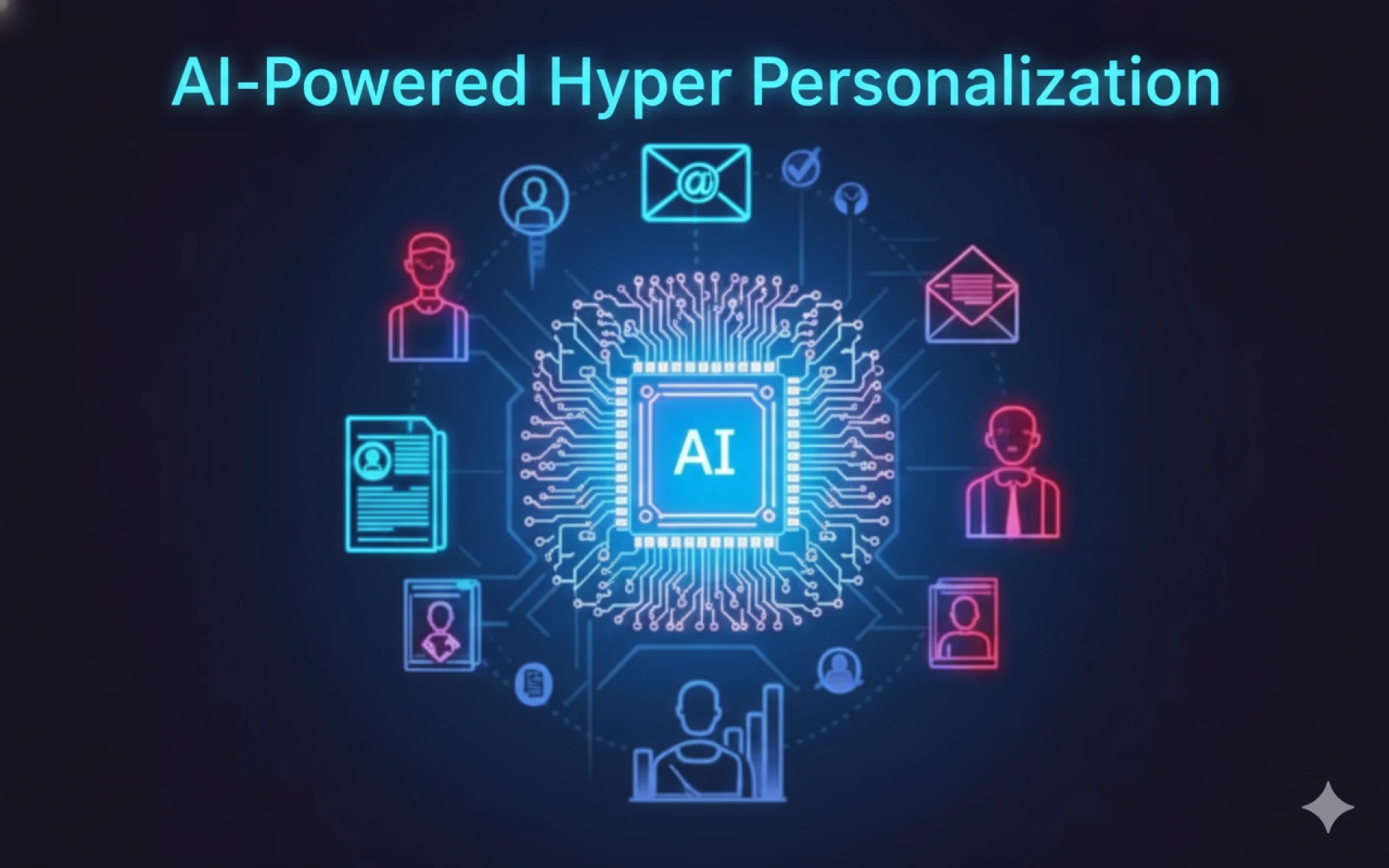

Most customer journeys were designed like train tracks. They consisted of one fixed path, a few branches, and many assumptions. That worked when you had a handful of channels and limited data. But in 2026, it’s painfully outdated. People jump between devices, channels, and contexts constantly, and they expect every touchpoint to “remember” them.
This is where AI-driven personalization steps in. Instead of forcing everyone through the same funnel, AI turns journeys into living systems that adapt in real time. Every click, scroll, pause, and purchase becomes a signal. The result is the shift from static experiences to an adaptive AI-driven user experience that feels human, contextual, and surprisingly intuitive. That shift is at the heart of the future of UX.
What Is AI-Driven Hyper-Personalization, Really?
Hyper-personalization goes beyond “Hi, [First Name]”. It’s not just inserting tokens into emails; it’s using machine learning and real-time data to adjust the entire experience from content to timing, channels, offers, and UI around each individual.
At its core, AI-driven personalization does three big things:
- Understands users at an individual level: It builds constantly evolving profiles based on behavior, preferences, context, and intent.
- Predicts what should happen next: It uses AI in user journey optimization to figure out the next best action: which message, which offer, which channel, and when.
- Adapts experiences in the moment: It changes what a user sees or receives right now, based on what they just did.
This is what makes journeys feel “hyper-personalized”: the experience responds dynamically instead of marching people through a pre-drawn flowchart.
The Data Backbone: Fuel for AI-Driven Personalization
None of this works without data. AI-driven personalization depends on a steady flow of signals, stitched together into a unified view of each customer.
Typical ingredients behind effective customer journey optimization:
- Behavioral data: Pages viewed, clicks, scroll depth, time on page, in-app events.
- Transactional data: Purchases, renewals, cart activity, usage tiers, contract details.
- Contextual data: Device type, location, time of day, session source.
- Interaction data: Support tickets, email opens, replies, chat transcripts, NPS surveys.
When all of this is connected, AI for personalized marketing and product experiences can move from guessing to genuinely understanding what people want and when. The magic isn’t “more data”; it’s connected data used responsibly.
AI in User Journey Optimization: From Static Maps to Living Systems
Old-school journey maps were sticky notes and diagrams that rarely got updated. With AI in user journey optimization, journeys turn into living models that are constantly learning from real behavior.
How AI reshapes customer journey optimization:
- Dynamic pathing: Instead of one fixed path, the system evaluates each step and decides the next best touchpoint based on live signals.
- Bottleneck detection: AI spots where people consistently drop off or stall, then suggests interventions (better messaging, different channel, clearer UI).
- Outcome-based routing: The journey adapts not just to behavior, but to goals: acquisition, activation, expansion, retention, or win-back.
In practice, this means your journeys can be both structured and flexible. You still define outcomes and guardrails, but AI in user journey optimization handles the micro-decisions along the way.
AI for Personalized Marketing: Beyond “Right Message, Right Time”
Most marketers talk about the “right message at the right time,” but AI pushes it further: right message, right time, right context and right channel. AI for personalized marketing turns campaigns into conversations that feel tailored instead of broadcast.
What this looks like in real life:
- Individual-level recommendations: Not “customers like you”; you, right now. Product suggestions, content offers, and pricing tiers based on your actual journey.
- Smart channel orchestration: Email, in-app, SMS, push, and ads coordinated so they complement rather than bombard.
- Adaptive creative: Headlines, visuals, and CTAs that shift based on user segment, behavior, or predicted intent.
With AI for personalized marketing, the campaign is no longer a rigid sequence; it’s a flexible canvas where each user’s path is slightly different and often more effective.
AI-Driven User Experience Inside Solutions
Personalization doesn’t stop at the marketing layer. AI-driven user experience reaches inside the product itself: menus, dashboards, recommendations, and workflows all change as the system learns more about each user.
Examples of AI-driven user experience in action:
- Adaptive onboarding: New users see a simplified setup flow; power users get shortcuts and advanced options.
- Context-aware dashboards: Key metrics, actions, or tools surface automatically based on role, past behavior, or current tasks.
- Support that feels proactive: In-app help surfaces before a user gets stuck, based on patterns of behavior that historically lead to frustration.
This is where AI-enhanced user interaction shines as interfaces nudge, guide, and support the user instead of just sitting there passively.
Building an AI-Driven Personalization Engine: Core Components
If you’re thinking about implementing AI-driven personalization, it helps to think in terms of systems rather than individual features. A robust engine usually includes:
- Unified customer profile
A single place where behavioral, transactional, and contextual data come together. This is the brainstem for customer journey optimization. - Decisioning layer
Models and rules that answer questions like “What’s the next best message?” or “Who should see this offer?” These answers form the core of AI in user journey optimization. - Content and experience layer
Modular content, layouts, and interactions that can be swapped in and out based on what the decisioning layer chooses, fuelling AI for personalized marketing and in-product personalization. - Feedback and learning loop
Everything is tracked: which decision was made, what the user did next, and how that ties to outcomes like activation, revenue, and retention. This is how AI-driven personalization keeps getting smarter.
When these pieces work together, you’re no longer just “sending campaigns”; you’re running an adaptive experience engine.
Guardrails: Ethics, Transparency, and Trust
Hyper-personalization can impress or creep people out depending on how it’s done. To make AI-driven personalization sustainable, you need strong guardrails.
Considerations for ethical, trustworthy AI-driven user experience:
- Consent and control: Make it clear what’s being personalized and why. Give users simple ways to opt out or dial down the intensity.
- Transparency: Use plain language to explain how AI in user journey optimization works at a high level (e.g., “We suggest content based on what you’ve interacted with before”).
- Fairness and bias: Regularly audit models to ensure AI for personalized marketing isn’t unfairly prioritizing or excluding certain groups.
Trust is part of the future of UX. If users feel respected and informed, they’re more likely to embrace personalized experiences rather than resist them.
The Bigger Picture
In crowded markets, products, prices, and features often look similar. What stands out is how it feels to be a customer: how understood, supported, and respected you are at every touchpoint. That’s exactly where AI-driven personalization and adaptive journeys shine.
By combining AI in user journey optimization, AI for personalized marketing, and deeply considered AI-enhanced user interaction, you turn generic pipelines into responsive ecosystems. And as expectations keep rising, that kind of adaptive, human-feeling experience won’t just be impressive. It will be the baseline for the brands that win.





























Sign in to leave a comment.