
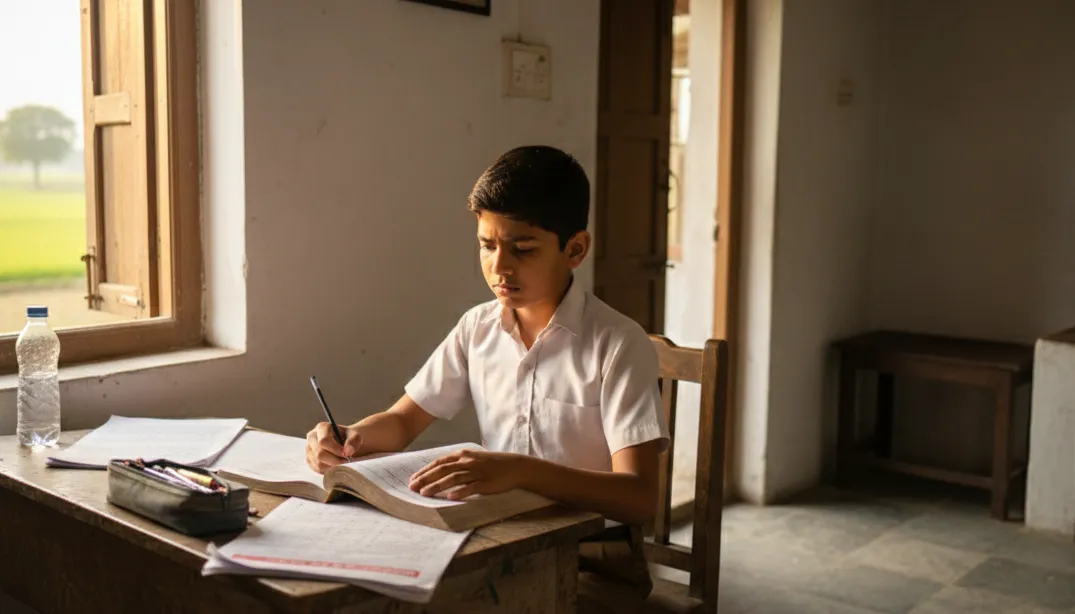
Gupta ji called me in December. Her daughter had been preparing since July. Strong in Maths. Good in English. GK average.
"Sharma ji, the Intelligence section. She keeps getting 12-15 out of 25. Every mock test. It doesn't improve. What's wrong? Is it something you're born with or can it be learned?"
This question comes up constantly about the Reasoning and Intelligence section. And the misconception behind it — that intelligence questions test innate intelligence that can't be trained — is responsible for most families underinvesting in this section.
Intelligence and Reasoning questions are not a talent test. They're a pattern recognition test. Patterns are learnable. Every question type in AISSEE Intelligence section follows specific rules. Learn the rules. Practice recognition. Score full marks.
Here's the complete strategy.
Why the Intelligence Section Feels Different
Intelligence questions feel harder to prepare for than Maths or English. Three reasons:
There's no textbook chapter on it. Students can't open a curriculum book and read "the rules for blood relations questions." They have to learn from practice papers and coaching material.
Initial exposure is confusing. When a student sees a series like 2, 5, 10, 17, 26, ? for the first time — it seems random. After seeing 30 similar series problems, the pattern (differences increasing by 2: 3, 5, 7, 9...) is obvious every time.
Wrong practice approach. Many students read the answer explanation and think they learned something. Then fail the same type next time. Actually solving under time pressure — not reading solutions — is what builds the skill.
The Complete Question Type Map
AISSEE Intelligence section at Class 6 level has approximately 8-10 question types that repeat every year. Learn each type's rule. Practice until the rule is automatic.
Type 1: Number Series
A sequence of numbers with a pattern. Find the next number or the missing number.
Pattern types: Add/subtract constant (2,5,8,11 — add 3). Multiply/divide (2,4,8,16 — multiply 2). Increasing differences (1,2,4,7,11 — differences are 1,2,3,4). Squares or cubes (1,4,9,16 — perfect squares). Alternating patterns (two interleavede series).
Practice method: 20 number series daily for 2 weeks. Identify which of the 5 pattern types applies to each. Speed builds within 2 weeks.
Type 2: Letter Series
Same concept but with letters. A,D,G,J,? (skip 2 letters each time).
Key skill: Know the position of every letter in the alphabet instantly. A=1, B=2... Z=26. This needs to be memorised cold. Many students calculate position each time, losing 20-30 seconds per question.
Practice: Write the alphabet with positions 5 times. Quiz yourself. Within 3 days this is automatic.
Type 3: Analogy — Number
16:4 :: 36:? The relationship is square root. Find the same relationship for the second pair.
Pattern types: Addition, subtraction, multiplication, division, squares, cubes, prime relationships.
Practice: 25 number analogies per session.
Type 4: Analogy — Word/Concept
Doctor:Hospital :: Teacher:?
These test category relationships: person-to-workplace, object-to-material, action-to-result, part-to-whole.
Practice: 20 word analogies per session. Learn relationship categories — they repeat.
Type 5: Odd One Out
Find the item that doesn't belong. Apple, Mango, Carrot, Banana. (Carrot — vegetable, others are fruits.)
Key: The grouping principle can be unexpected. Same category, same property, same first letter, same number of letters. Check multiple grouping principles before selecting.
Practice: 20 odd one out problems per session.
Type 6: Coding-Decoding
If CAT = 3120, what is DOG?
Typically: letter position value, reverse alphabets, shift by constant amount.
Practice: 15 coding problems per session. Identify the coding rule as a first step.
Type 7: Blood Relations
"A's father's brother's son is B. What is B to A?"
These are purely about keeping family relationship logic clear.
Practice tool: Draw a family tree for every blood relation problem. Never try to solve in your head. Tree drawn on rough paper: 30 seconds. Mental calculation: 2 minutes and often wrong.
20 blood relation problems per session with mandatory tree drawing.
Type 8: Direction and Distance
"A walks 5 km north, then 3 km east, then 2 km south. How far from starting point?"
Draw the path. Always. Never try to visualise mentally.
Pythagoras theorem applies when the path forms a right triangle. Final position is the hypotenuse.
15 direction problems per session. All with drawn diagrams.
Type 9: Mirror/Water Image
Which option is the correct mirror/water image of the given figure?
Mirror image: left-right reversal. Water image: top-bottom reversal.
Practice: 20 image problems per session.
The 6-Week Intelligence Section Plan
Week 1-2: Number series and letter series
20 number series daily. 20 letter series daily. Memorise alphabet positions.
Week 3: Analogies (number and word)
25 number analogies daily. 20 word analogies daily.
Week 4: Odd one out and coding-decoding
20 odd one out daily. 15 coding-decoding daily.
Week 5: Blood relations and directions
20 blood relations with tree drawing. 15 direction problems with diagram drawing.
Week 6: Mirror/water image and mixed revision
20 image problems daily. Then mixed sets of 25 questions covering all types together.
Total time investment: 25-30 minutes daily for 6 weeks.
After 6 weeks: Take a full mock Intelligence section under timed conditions. Most students see dramatic improvement — from 12-15 marks to 18-22 marks minimum.
Time Management in the Intelligence Section
AISSEE Class 6 paper: 125 questions in 150 minutes total. Intelligence section is 25 questions.
Target: complete Intelligence section in 25-30 minutes (approximately 60-70 seconds per question). This leaves more time for Maths and GK which need it.
Intelligence questions — once you know the rules — are actually the fastest questions in the paper. A number series question takes 20-30 seconds if you instantly recognise the pattern. A blood relation question with a drawn tree takes 45-60 seconds.
Students who haven't learned the patterns take 3-5 minutes per Intelligence question. Students who have — under 60 seconds.
This time difference alone is worth 10-15 marks across the full paper.
The Guessing Strategy for Intelligence Section
AISSEE has no negative marking. Every unanswered question is a lost opportunity.
For Intelligence questions where you genuinely can't see the pattern:
Eliminate obviously wrong options. Even without solving the question completely, two or three options can often be eliminated on basic logic. "This number is clearly too large." "This relationship type doesn't fit." Elimination from 4 options to 2 options improves guess probability from 25% to 50%.
Use time limitation strategically. If after 60 seconds you haven't found the answer — mark your best guess and move on. Don't spend 3 minutes on one Intelligence question. Wrong guess = 0 marks. Right guess = 1 mark. Moving on to attempt other questions is always better than time-sinking on one.
What Happened With Gupta Ji's Daughter
I gave her the 6-week plan. Each day: 30 minutes, specific type focus, timed practice.
She resisted initially. "These problems just don't come to me naturally."
I told her: "After 100 number series problems, patterns will come naturally. It's not born ability — it's trained recognition."
She did the 6 weeks.
December mock (before plan): 13/25. January mock (3 weeks into plan): 18/25. January exam actual: 21/25.
8 marks improvement in Intelligence alone. At competitive cutoffs, 8 marks is the difference between getting a school and not.
"It's not something you're born with" — confirmed. Pattern recognition is trained. Consistently.
For Sainik School exam preparation coaching that includes dedicated Intelligence and Reasoning section training — not just Maths and GK coverage — we prepare students for every section that determines the final score.
Bottom Line
AISSEE Intelligence section tests pattern recognition — not innate intelligence. Patterns are learnable.
8-10 question types repeat every year: number series, letter series, analogy (number and word), odd one out, coding-decoding, blood relations, directions, mirror/water image.
Each type has specific rules. Learn the rules. Practice recognition until automatic.
6-week plan: 30 minutes daily, one type per 1-2 weeks, then mixed practice.
Time target: complete Intelligence section in 25-30 minutes. This frees time for Maths and GK.
No negative marking — always attempt. Use elimination when stuck.
From 12-15 marks to 20+ marks is achievable for almost every student with 6 weeks of targeted practice.
The section that feels most "unprepared-for-able" is actually one of the most trainable sections in the paper.
Need structured Intelligence and Reasoning preparation alongside full AISSEE coaching? Contact us for a preparation programme that covers every section with specific strategies.
Want more AISSEE subject-wise preparation guides? Read our blog for complete strategy guides on every section.





























Sign in to leave a comment.