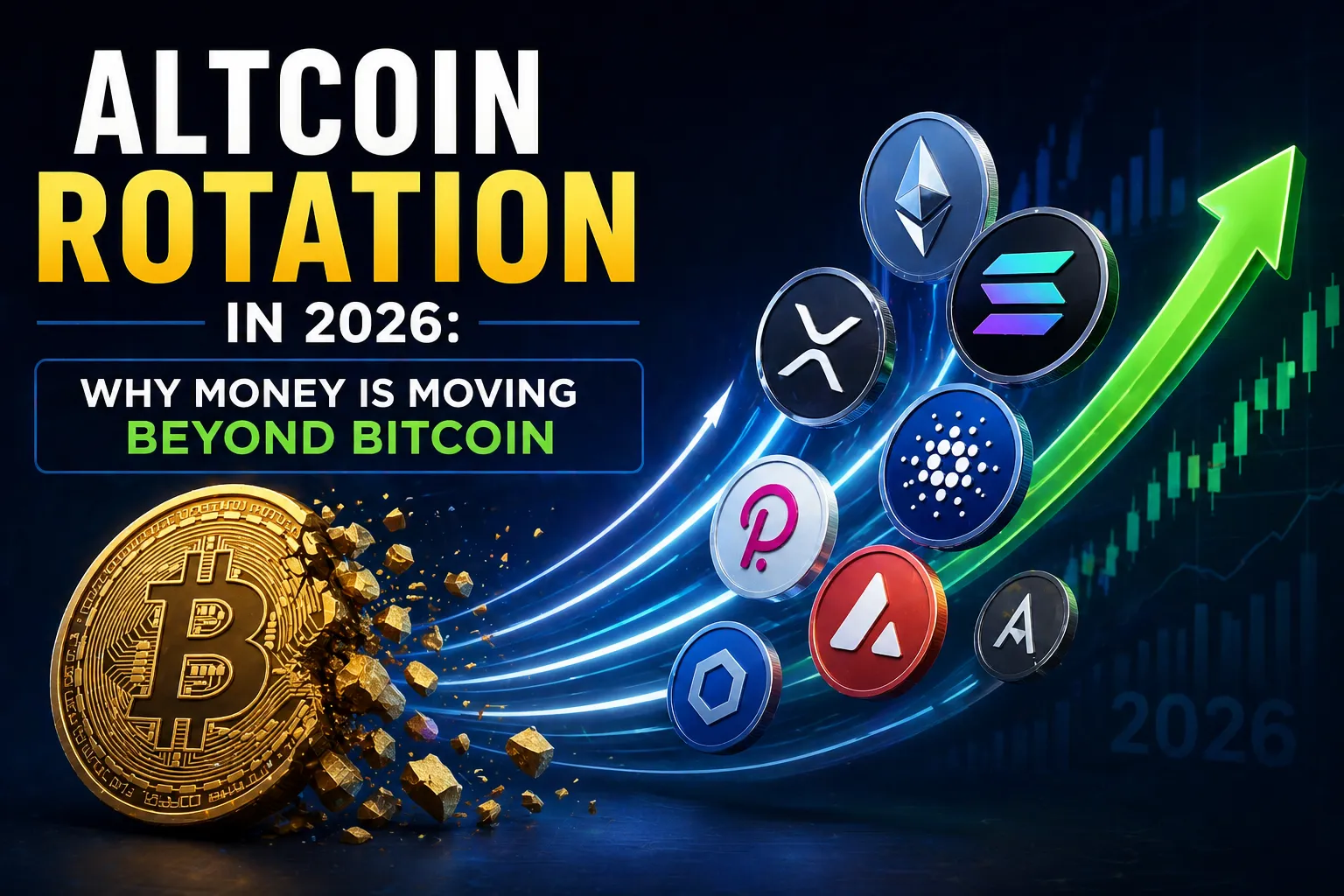

The crypto market does not move in a straight line. It works in cycles. One of the most important patterns traders and investors watch is altcoin rotation.
In simple terms, altcoin rotation means that money moves from Bitcoin into other cryptocurrencies, often called altcoins. This shift usually happens after Bitcoin shows strong movement or stabilizes.
In 2026, this trend is clearly visible again. Many market participants are closely watching how funds are moving across sectors like DeFi, AI tokens, and Layer-1 ecosystems.
This article explains what altcoin rotation is, why it happens, and what it means for the broader crypto market updates—without hype or unrealistic claims.
What Is Altcoin Rotation?
Altcoin rotation is a market phase where investors move capital from Bitcoin into altcoins.
Bitcoin is still the largest and most dominant cryptocurrency. It often leads the market. When Bitcoin rises strongly, it attracts attention and liquidity. After that initial move, some investors shift their funds into altcoins in search of better short-term opportunities.
This does not happen randomly. It follows a pattern that has been observed in multiple market cycles.
How the Rotation Cycle Usually Works
To understand this better, let’s break it into simple steps:
1. Bitcoin Leads the Market
Bitcoin starts gaining value due to macro factors, institutional interest, or market sentiment.
2. Bitcoin Stabilizes
After a strong move, Bitcoin may slow down or move sideways.
3. Capital Moves to Altcoins
Traders begin exploring altcoins that may offer higher returns in the short term.
4. Altcoins Gain Momentum
Selected sectors like DeFi or AI tokens begin to rise faster than Bitcoin.
This cycle is not fixed, but it has been observed across different time periods in the crypto market.
Why Altcoin Rotation Is Active in 2026
Several factors explain why this trend is happening now:
1. Bitcoin’s Market Position
Bitcoin still holds the largest share of the crypto market. When it shows strength, it builds confidence among investors.
After that confidence is established, traders often look for opportunities beyond Bitcoin.
2. Search for Higher Returns
Altcoins are generally more volatile than Bitcoin.
This means:
- Higher risk
- But also higher potential short-term gains
This is one reason why short-term traders focus on altcoins during rotation phases.
3. Sector-Based Growth
In 2026, capital is not flowing into all altcoins equally. It is more focused on specific sectors:
- DeFi (Decentralized Finance)
- AI-related tokens
- Layer-1 blockchain ecosystems
This shows a more mature market compared to earlier cycles.
4. Improved Market Awareness
Investors today have better access to information. They track trends, narratives, and project fundamentals more carefully.
This leads to more structured capital movement rather than random speculation.
Key Sectors Driving Altcoin Rotation
Let’s look at the main areas where activity is increasing.
DeFi (Decentralized Finance)
DeFi continues to be one of the core sectors in crypto. It includes services like:
- Lending
- Borrowing
- Trading without intermediaries
DeFi projects are gaining attention because they provide real use cases.
However, it is important to note that DeFi still carries risks such as:
- Smart contract vulnerabilities
- Liquidity issues
In recent altcoin news, DeFi remains a consistent area of interest, especially when market activity increases.
AI Tokens
AI-related cryptocurrencies are receiving attention due to the broader growth of artificial intelligence technology.
These projects aim to combine:
- Data processing
- Machine learning
- Decentralized infrastructure
While the concept is promising, this sector is still developing. Not all projects have strong fundamentals, so careful research is important.
Many traders are watching AI tokens closely, making them a key part of current crypto market updates.
Layer-1 Ecosystems
Layer-1 blockchains are the base networks where applications are built. Examples include platforms that support smart contracts and decentralized apps.
These ecosystems attract users, developers, and capital when:
- Network activity increases
- New projects launch
- Transaction efficiency improves
Layer-1 ecosystems often benefit during altcoin rotation because they form the foundation of many crypto applications.
Role of Market Sentiment
Market sentiment plays a major role in altcoin rotation.
When confidence is high:
- Traders are more willing to take risks
- Capital flows into smaller projects
When uncertainty increases:
- Funds move back to Bitcoin or stable assets
This is why altcoin trends can change quickly. They depend heavily on overall market mood.
Risks of Altcoin Rotation
While altcoin rotation creates opportunities, it also comes with risks.
1. High Volatility
Altcoins can rise quickly, but they can also fall just as fast.
2. Lack of Liquidity
Some altcoins have low trading volume, making them harder to buy or sell.
3. Project Quality
Not all projects have strong fundamentals. Some may not deliver on their promises.
4. Market Reversals
If Bitcoin drops suddenly, altcoins often fall even more.
These risks highlight the importance of careful decision-making.
Altcoin Price : What Can Be Expected?
Making exact price predictions in crypto is not possible. However, some general observations can be made.
Short-Term Outlook
During active rotation phases:
- Some altcoins may outperform Bitcoin
- Sector-based growth becomes visible
Long-Term Outlook
In the long run:
- Strong projects tend to survive
- Weak projects may fade away
Any altcoin price prediction should be based on:
- Market trends
- Project fundamentals
- Broader economic conditions
How Traders Approach Altcoin Rotation
Different traders use different strategies during this phase.
1. Sector Rotation
Traders move between sectors like:
- DeFi
- AI
- Infrastructure
2. Momentum Trading
Some traders focus on coins that are already gaining momentum.
3. Risk Management
Experienced traders limit their exposure and avoid investing everything in one asset.
These approaches show that strategy matters more than speculation.
Importance of Crypto Market Updates
Staying informed is essential during altcoin rotation.
Reliable crypto market updates help users:
- Track trends
- Understand market shifts
- Make informed decisions
It is always better to rely on verified sources rather than rumors or social media hype.
Tips for Navigating Altcoin Rotation Safely
Here are some simple and practical tips:
Do Your Own Research
Understand the project before investing.
Avoid Chasing Trends
Just because a coin is rising does not mean it will continue to rise.
Diversify
Do not invest everything in a single altcoin.
Set Limits
Decide in advance how much you are willing to risk.
Stay Updated
Follow reliable sources for ongoing market information.
How Altcoin Rotation Reflects Market Maturity
Compared to earlier years, the crypto market in 2026 shows more structure.
- Capital flows are more selective
- Users are more informed
- Projects are more focused on utility
Altcoin rotation is not just about price movement. It reflects how the market is evolving.
Final Thoughts
Altcoin rotation is a natural part of the crypto market cycle. It shows how capital moves in search of opportunities beyond Bitcoin.
In 2026, this trend is shaped by:
- Sector growth (DeFi, AI, Layer-1)
- Market sentiment
- Increasing awareness among investors
While there are opportunities, risks remain.
The key is to:
- Stay informed
- Focus on fundamentals
- Avoid emotional decisions
FAQs
1. What is altcoin rotation?
It is the movement of capital from Bitcoin into other cryptocurrencies.
2. Why do traders move to altcoins?
They look for higher short-term opportunities after Bitcoin stabilizes.
3. Are altcoins riskier than Bitcoin?
Yes, they are generally more volatile and carry higher risk.
4. Which sectors are trending in altcoins?
DeFi, AI tokens, and Layer-1 ecosystems are currently active areas.
5. Can altcoins outperform Bitcoin?
Sometimes, especially during rotation phases, but not always.
6. How can I stay updated?
Follow reliable crypto market updates and avoid unverified sources.























Sign in to leave a comment.