

Introduction
The Aluminum Foil Packaging Market has emerged as a critical component of the global packaging ecosystem, driven by evolving consumer preferences, sustainability concerns, and the growing demand for extended shelf life in food and pharmaceutical products. Known for its exceptional barrier properties, lightweight nature, and recyclability, aluminum foil packaging is increasingly favored across industries ranging from food & beverages to healthcare.
As supply chains become more complex and consumer expectations shift toward convenience and safety, aluminum foil packaging is not just a material choice—it is a strategic enabler of product integrity and brand differentiation. The market is witnessing steady transformation, fueled by innovations in flexible packaging, regulatory shifts, and circular economy initiatives.
Market Overview
The aluminum foil packaging market is estimated to expand from USD 28.0 billion in 2026 to USD 38.7 billion by 2031, exhibiting a 5.0% CAGR during the forecast period, according to Knowledge Sourcing Intelligence (KSI).
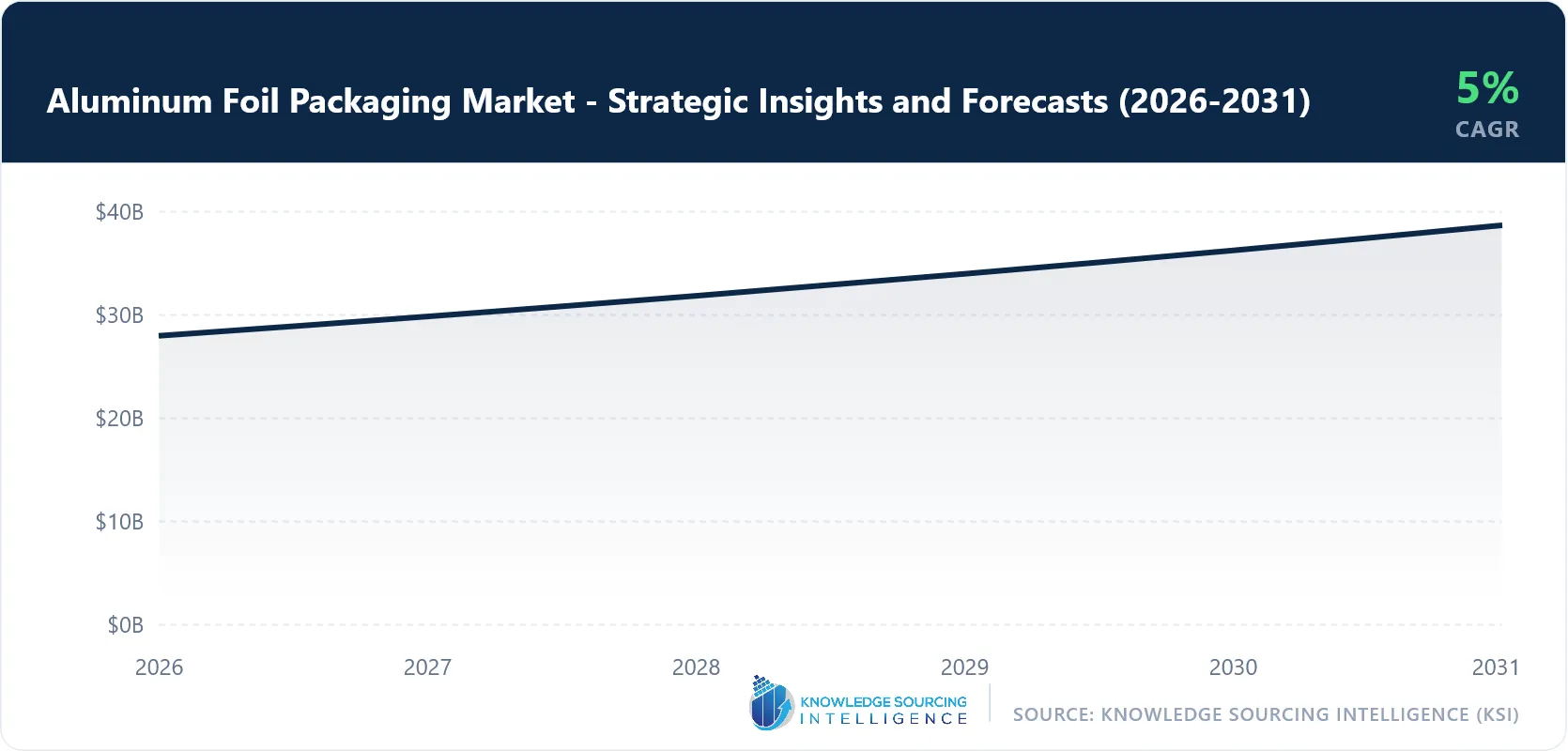
This growth trajectory is underpinned by strong demand from emerging economies, increased consumption of packaged foods, and the expansion of the pharmaceutical sector. Additionally, the rise of flexible packaging solutions and the shift from rigid to lightweight materials are reinforcing aluminum foil’s relevance in modern packaging strategies.
A key factor shaping market dynamics is the balance between cost efficiency and sustainability. While aluminum production is energy-intensive, its high recyclability rate offsets environmental concerns, making it a preferred material in regions with strong recycling infrastructure.
Key Drivers
Rising Demand for Packaged and Processed Foods
Urbanization, busy lifestyles, and the proliferation of organized retail have significantly increased the demand for ready-to-eat and convenience foods. Aluminum foil packaging plays a vital role in preserving freshness, flavor, and nutritional value, especially in products like dairy, confectionery, and frozen meals.
Superior Barrier Properties
Unlike many alternative materials, aluminum foil provides an effective barrier against moisture, oxygen, light, and contaminants. This makes it indispensable in food packaging solutions and pharmaceutical packaging, where product integrity is non-negotiable.
Growth of the Pharmaceutical Industry
The increasing global demand for medicines, vaccines, and healthcare products has amplified the use of aluminum foil in blister packs and strip packaging. Its tamper-proof and hygienic characteristics align well with stringent regulatory requirements.
Sustainability and Recycling Advantages
Despite concerns around energy consumption during production, aluminum is infinitely recyclable without loss of quality. Governments and organizations promoting sustainable packaging materials are encouraging the use of aluminum foil, especially in regions with established recycling systems.
Challenges and Restraints
Volatility in Raw Material Prices
Aluminum prices are highly sensitive to fluctuations in energy costs, mining outputs, and geopolitical factors. This volatility can impact profit margins for manufacturers and lead to pricing instability across the value chain.
Environmental Concerns in Production
The production of primary aluminum is energy-intensive and contributes to carbon emissions. While recycling mitigates this issue, regions lacking recycling infrastructure face sustainability challenges.
Competition from Alternative Materials
Materials such as biodegradable plastics, paper-based laminates, and advanced polymer films are gaining traction due to their lower cost and perceived environmental benefits. This competition is particularly strong in cost-sensitive markets.
Opportunities and Future Trends
Innovation in Flexible Packaging
The shift toward flexible packaging materials is creating new opportunities for aluminum foil manufacturers. Laminated foil structures are being developed to enhance durability, reduce thickness, and improve cost efficiency.
Growth in E-commerce and Food Delivery
The expansion of online food delivery platforms and e-commerce is increasing the demand for durable, lightweight, and protective packaging. Aluminum foil’s ability to maintain temperature and prevent contamination makes it highly suitable for this segment.
Sustainable Packaging Innovations
Companies are investing in low-carbon aluminum production and closed-loop recycling systems. The integration of circular economy principles is expected to redefine the competitive landscape.
Smart and Functional Packaging
Emerging technologies such as QR codes, anti-counterfeiting features, and temperature-sensitive coatings are being integrated into aluminum foil packaging, particularly in pharmaceuticals and premium food products.

Segment Analysis
By Type
- Rigid Aluminum Foil: Used in trays and containers, particularly for ready meals and bakery products.
- Flexible Aluminum Foil: Dominates the market due to its versatility in wraps, pouches, and laminates.
Flexible foil is expected to witness faster growth, driven by its compatibility with modern packaging machinery and reduced material usage.
By Application
- Food & Beverages: The largest segment, driven by demand for food preservation packaging and convenience products.
- Pharmaceuticals: Rapid growth due to increased healthcare spending and stringent packaging requirements.
- Cosmetics & Personal Care: Used for sachets and premium product packaging.
- Industrial Applications: Includes insulation and specialized packaging needs.
By Region
- Asia-Pacific: Largest and fastest-growing market.
- North America: Mature market with strong sustainability focus.
- Europe: Innovation-driven with strict environmental regulations.
- Rest of the World: Emerging opportunities in Latin America and the Middle East.
Regional Insights
Asia-Pacific
Countries like China and India are leading growth due to expanding middle-class populations, rapid urbanization, and increased consumption of packaged goods. The region also benefits from strong manufacturing capabilities and cost advantages.
North America
The United States remains a key market, driven by technological advancements and a high demand for pharmaceutical blister packaging. Sustainability initiatives are also influencing product innovation.
Europe
Germany, France, and the UK are at the forefront of adopting eco-friendly packaging solutions. Regulatory frameworks promoting recyclability are accelerating the use of aluminum foil.
Latin America and Middle East
These regions are witnessing gradual growth, supported by improving retail infrastructure and increasing awareness of packaged food safety.
Competitive Landscape
The Aluminum Foil Packaging Market is moderately fragmented, with both global and regional players competing on innovation, cost efficiency, and sustainability.
Key strategies observed in the market include:
- Product Innovation: कंपनियाँ thinner foils और multi-layer laminates विकसित कर रही हैं to reduce costs and improve performance.
- Sustainability Initiatives: Investment in recycling technologies and low-carbon aluminum production.
- Strategic Partnerships: Collaborations with food and pharmaceutical companies to develop customized packaging solutions.
- Capacity Expansion: особенно in Asia-Pacific to meet rising demand.
Companies are increasingly focusing on value-added products rather than commoditized foil, shifting competition toward technology and differentiation.
Conclusion
The Aluminum Foil Packaging Market is positioned for steady growth, supported by its unmatched functional properties and increasing relevance in a sustainability-driven world. While challenges such as raw material volatility and environmental concerns persist, ongoing innovations and recycling advancements are reshaping the market narrative.
Looking ahead, the convergence of sustainable packaging trends, technological innovation, and evolving consumer preferences will define the next phase of growth. Companies that invest in eco-friendly solutions, smart packaging technologies, and regional expansion strategies are likely to gain a competitive edge in this evolving landscape.
In essence, aluminum foil packaging is transitioning from a traditional material to a future-ready solution aligned with global packaging demands.




























Sign in to leave a comment.