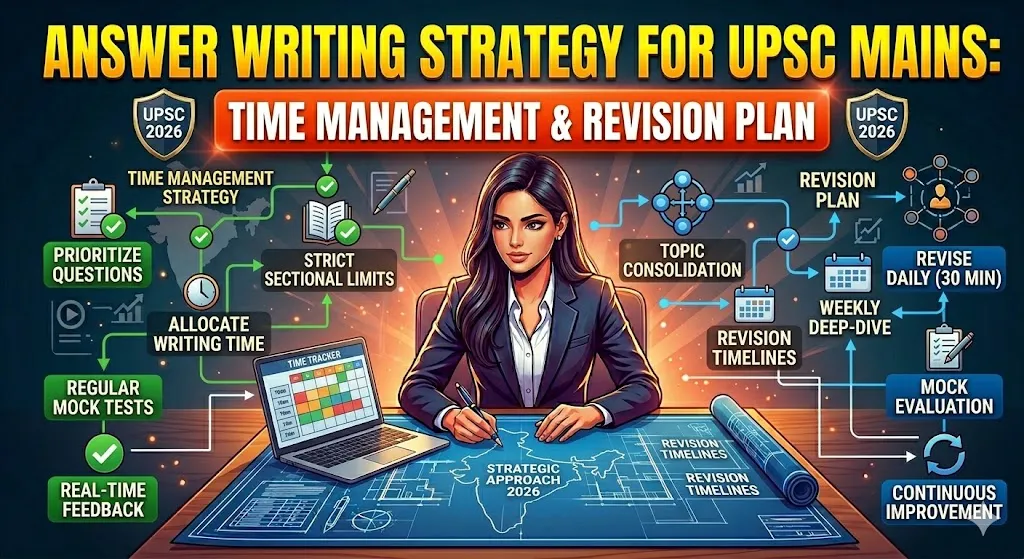

The transition from clearing the Preliminary stage to standing in front of the descriptive wall of the Civil Services Main Examination can feel overwhelming. With nine papers to navigate, your knowledge alone will not secure your name on the final merit list. What matters most is how you translate your insights onto paper under intense pressure. Developing a reliable, elite upsc mains answer writing strategy 2026 requires a dual focus: optimizing every single minute available in the exam hall and structuring your revision cycle so your thoughts flow effortlessly onto the answer booklet.
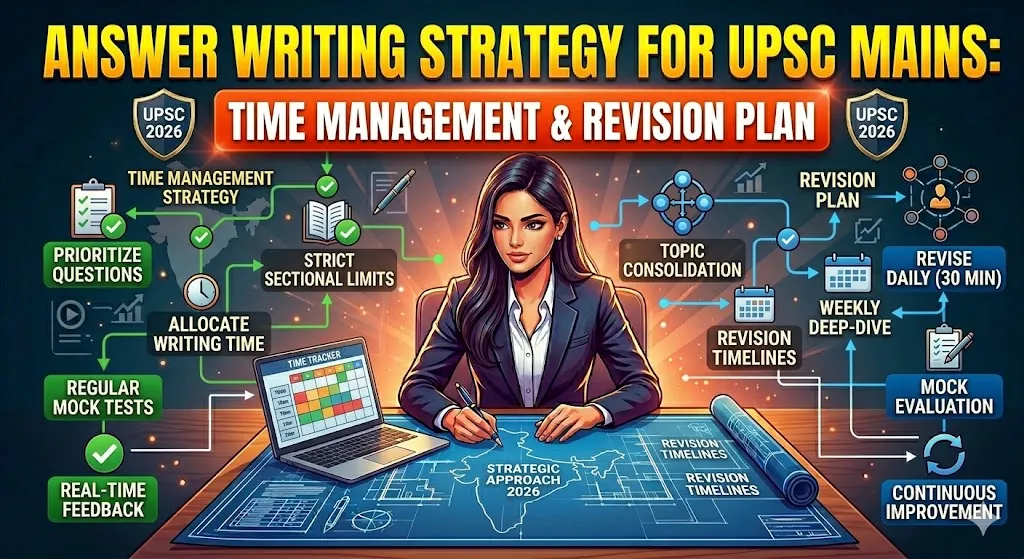
The Reality of Three Hours: Demystifying Time Management
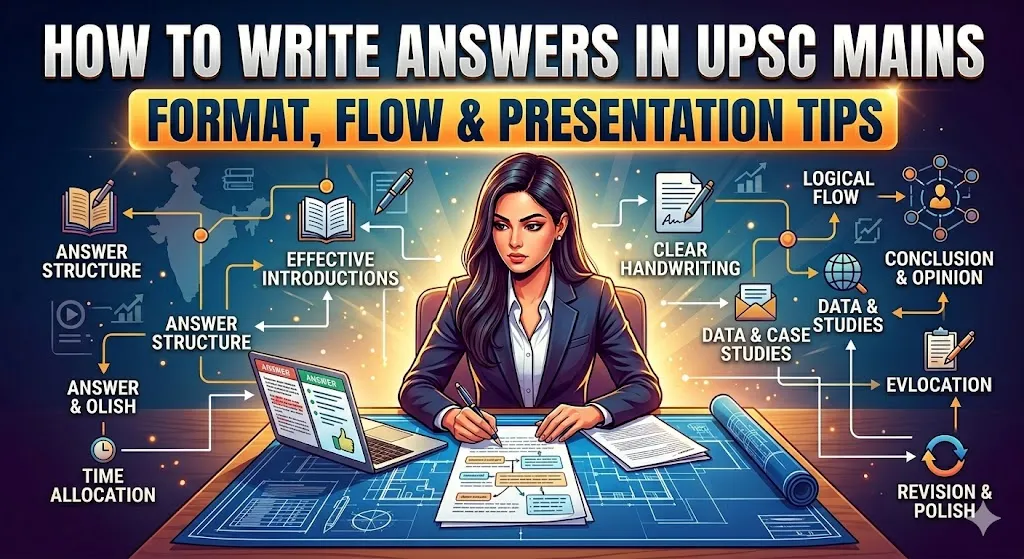
When you sit down for a General Studies paper, you face 20 questions to be answered in 180 minutes. This gives you exactly 7 to 9 minutes per question, leaving no room for hesitation or structural experiments. Figuring out how to write answers in upsc mains within this ticking window is the ultimate test of an aspirant's mental agility.
To maximize your score, split your approach based on the marks allocated:
- 10-Mark Questions (150 words): You have roughly 7 minutes. Spend 1 minute brainstorming, 5 minutes writing, and 1 minute aligning your structure.
- 15-Mark Questions (250 words): You have roughly 11 minutes. Spend 1.5 minutes structuring, 8.5 minutes writing, and 1 minute introducing data points or diagrams.
A highly disciplined mastery over how to write answers in upsc mains means knowing when to stop writing an answer to protect the rest of your paper from collapsing.
Anatomy of a High-Scoring Answer
Succeeding in this exam is less about grand prose and more about presentation, relevance, and precision. The evaluators screen hundreds of copies; your answers must be easily scannable and directly address the core directive (Discuss, Critically Examine, Evaluate). Consistent, top-tier upsc mains answer writing is a craft built on structural visibility.
A reliable, repeatable layout consists of:
1. The Introduction (10-15% of space)
Start with a crisp definition, a relevant constitutional article, or a recent statistic. For instance, if a question targets unemployment, leading with the latest Periodic Labour Force Survey (PLFS) data establishes immediate authority.
2. The Body (70-80% of space)
Break your body down into multidimensional bullet points. Address the sub-parts of the question explicitly. Use the PESTEL framework (Political, Economic, Social, Technological, Environmental, Legal) to ensure you do not look at an issue through a single lens. Broadening your points across these sectors will make your regular upsc mains answer writing practice highly rewarding.
3. The Way Forward & Conclusion (10-15% of space)
Never leave an answer on a negative note. Conclude with a futuristic, constructive solution, ideally aligning your thoughts with committee recommendations (e.g., NITI Aayog reports, Law Commission reports, or Administrative Reforms Commission blueprints).
The Integrated Revision Plan
Building a rapid retrieval system is impossible without a structured answer writing strategy for upsc mains. Reading new material right before the exam will only clutter your recollection. Instead, try this structured weekly revision protocol to complement your answer writing strategy for upsc mains:
[Monday to Friday] ---> Focused Content Building & Micro-Notes | [Saturday Morning] ---> Active Recall & Data Sheet Review | [Saturday Afternoon]-> Sectional Test (3 Hours Simulation) | [Sunday Morning] ---> Weak Area Analysis & Peer Evaluation
The 3-Tier Revision Formula
- Tier 1: Static Consolidation: Shrink your master notes into micro-diagrams, flowcharts, and mind maps. If your notes for GS-3 Internal Security are longer than 15 pages, condense them further.
- Tier 2: The Core Data Ledger: Maintain a 10-page dedicated register containing only Supreme Court judgments, constitutional articles, committee names, and global indices. Review this ledger every alternate day.
- Tier 3: The Retrospective Mock Log: After writing every test, list the structural errors you made. Reviewing this log right before stepping into the next mock test is a critical milestone for a comprehensive upsc mains answer writing strategy 2026.
Active Drills: Shifting from Reading to Writing
Relying entirely on full-length mock tests can lead to mental burnout. Integrating targeted, daily execution habits into your schedule keeps your writing sharp and sustainable.
- The 7-Minute Drill: Pick a single previous year question (PYQ) daily. Set a timer for 7 minutes and write it out completely without checking your reference material. This forces your brain to retrieve information rapidly.
- The Framework Blueprint Challenge: If you lack the time to write out full answers, take 5 random questions and spend just 2 minutes per question mapping out the introduction, bullet-point headings, and specific case studies you would use. Incorporating this into your daily upsc mains answer writing schedule will save you valuable time.
Feedback from the Field
"I spent my initial attempts just reading and accumulating books, thinking deep knowledge would translate to good marks. It didn't. It was only when I streamlined my answer writing strategy for upsc mains by strictly timing my responses and using structured sub-headings that my GS scores jumped from average to the top quartile."
— Siddharth Sharma, Selected Candidate
"The real turning point was learning to stop writing what I knew, and starting to write what the question actually asked. Managing to finish the paper with coherent, legible flowcharts in the last 15 minutes is what makes or breaks your selection. A rigid focus on my upsc mains answer writing strategy 2026 is what saved my attempt."
— Ananya Rao, Civil Services Aspirant
Frequently Asked Questions (FAQs)
Q1. Should I prioritize paragraph writing or bullet points in GS papers?
Bullet points are generally preferred for General Studies papers because they enhance scannability. Use paragraphs for your Essay paper and certain humanities-based Optional subjects where nuanced narrative continuity is required. Tailoring this choice based on the paper type is essential when understanding how to write answers in upsc mains.
Q2. Is it necessary to use complex vocabulary to score well?
No. Clear, concise, and grammatically correct language is far more effective. The evaluator is looking for depth of understanding, balanced perspectives, and analytical clarity, not literary flair.
Q3. How do I handle a question when I have absolutely no clue about the topic?
If you are completely blank, it is safer to leave the question to avoid wasting valuable minutes. However, if you understand the core theme but lack specific current data, write a clean, conceptual answer based on foundational static knowledge to secure marginal marks.
Q4. When should full-length test series be integrated into the schedule?
Full-length, 3-hour simulated tests should ideally balance your preparation throughout the post-prelims phase. Write at least one full-length paper weekly to build the physical stamina required to write for six hours a day during the actual examination week, which is a major focus area of an effective answer writing strategy for upsc mains.
Final Takeaway
An effective upsc mains answer writing strategy 2026 is not about writing perfectly; it is about writing clearly, relevantly, and consistently under extreme time constraints. By mastering the command words, maintaining a clean structure, anchoring your assertions with real-world data, and managing your time meticulously, you provide the evaluator with a scannable, high-value script. Treat answer writing as a daily craft, refine your structure with every mock test, and execute your plan with precision.

























Sign in to leave a comment.