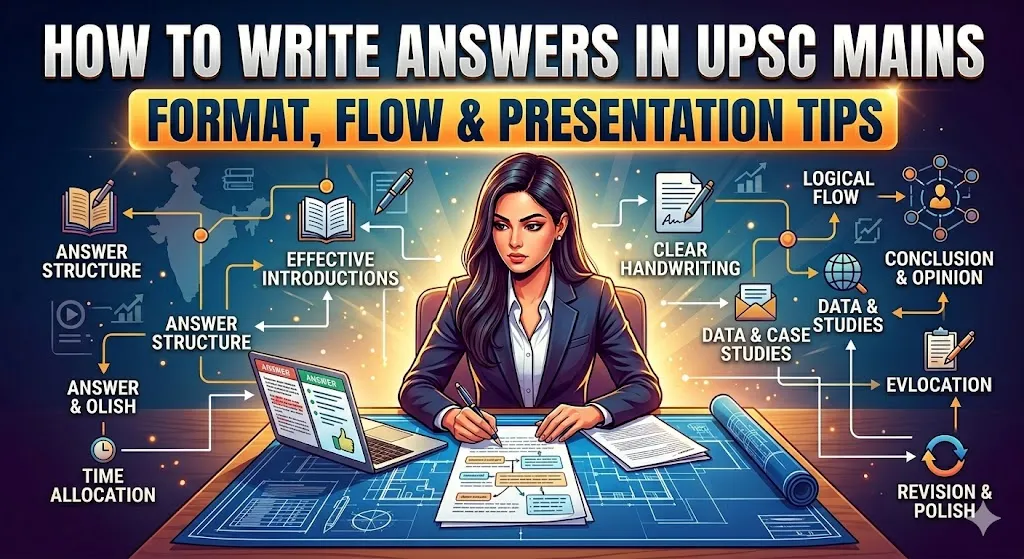

The Union Public Service Commission (UPSC) Civil Services Mains examination is less of a knowledge test and more of a presentation challenge. With the official UPSC calendar slating the Mains descriptive papers to begin on August 21, 2026, your window to convert massive piles of information into readable, high-scoring answers is closing fast. Every serious aspirant knows the core data points; what sets top-rankers apart is how they layout that information under intense time constraints. To stand out in a stack of thousands of answer sheets, you need a dynamic upsc mains answer writing strategy 2026. This blueprint skips over vague platitudes to focus entirely on structural formatting, logical transition flow, and visual presentation tips designed to satisfy the rigorous standards of UPSC evaluators.
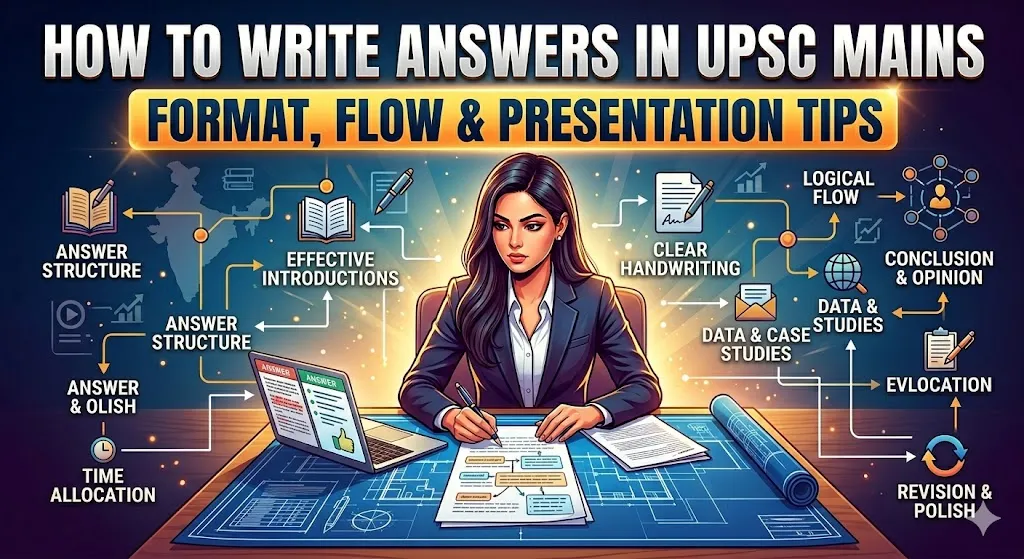
1. Format: The Structural Skeleton of Your Answer
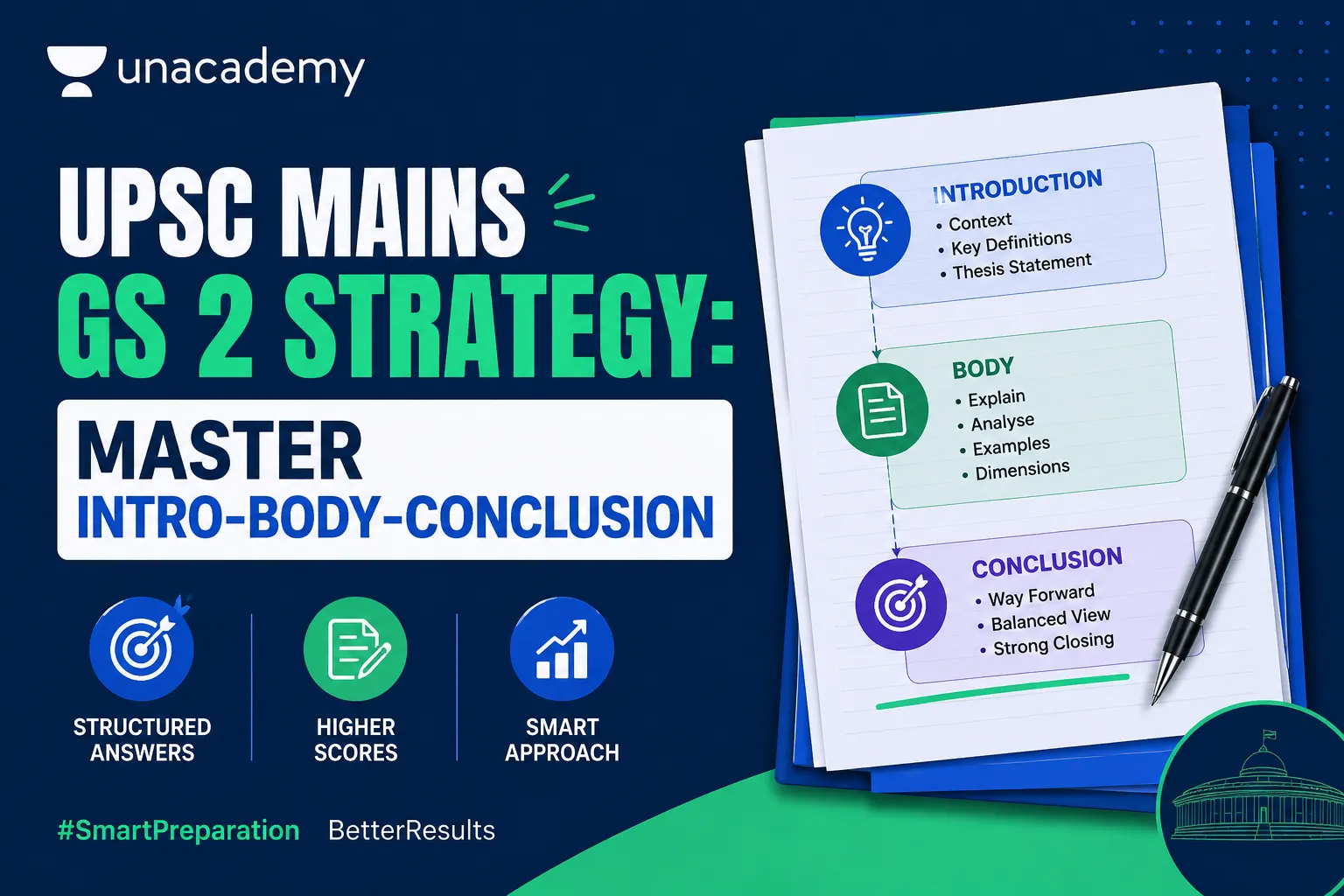
An unorganized answer forces the evaluator to scan your text to hunt for marks, which naturally decreases your score. Your answers need a predictable, highly visible layout. Gaining control over this structural layout is the first fundamental step in learning how to write answers in upsc mains efficiently. The universal gold standard for descriptive answers is the Introduction-Body-Conclusion (IBC) structure, but implementing it under exam-day stress requires structural discipline.
A well-practiced approach to how to write answers in upsc mains ensures that you do not freeze when confronted with an unconventional question topic. By adhering to a strict format, you can reliably turn even a challenging prompt into a systematically organized response.
The Intro-Hook (10% of space)
Do not repeat the question or provide generic historical padding. Start your answer by establishing direct relevance to the prompt within 2 to 3 sentences:
- The Empirical Opening: State a baseline statistic or ranking from an official repository (e.g., NITI Aayog, Reserve Bank of India, or a UN Report).
- The Constitutional Anchor: Open with an explicit Constitutional Article, legal statute, or a landmark Supreme Court directive.
- The Current Context: Connect the question to a notable geopolitical or socio-economic development from the past year.
The Multi-Dimensional Body (80% of space)
The core section of your text must address every element of the prompt directly. Divide your points using the SPECTRUM approach:
- Socio-cultural impacts
- Political and constitutional angles
- Economic constraints or benefits
- Climatic and environmental hazards
- Technological opportunities
- Regulatory and legal frameworks
The Pragmatic Vision (10% of space)
Never conclude with a generic summary. A proper administrative mindset requires a balanced, future-focused "Way Forward." Highlight actionable policy solutions by referencing administrative bodies like the 2nd Administrative Reforms Commission (ARC), Law Commission reports, or global best-case scenarios to round off your comprehensive upsc mains answer writing strategy 2026.
2. Flow: Ensuring Seamless Transitions
Logical transitions make your answers easy to follow. A well-written paper guides the evaluator from one point to the next without abrupt shifts. To build this smooth progression into your routine upsc mains answer writing drills, you must focus on the connective tissue of your paragraphs.
A chaotic flow breaks the evaluator's concentration. Prioritizing structured transitions within your daily upsc mains answer writing sessions directly correlates with higher marks, as it presents your knowledge in a clean, professional manner.
Derive Headings Directly from the Prompt
Do not invent decorative titles. If the question asks for "the localized causes and macroeconomic consequences of flash droughts," your two main body headings should read:
- Localized Causes of Flash Droughts
- Macroeconomic Consequences of Flash Droughts
This simple method instantly shows the evaluator that you are answering the exact question asked. It also helps you keep your thoughts organized while executing your upsc mains answer writing plan under tight time bounds.
The Keyword-First Layout
Avoid writing long, unbroken paragraphs that bury your main points. Instead, use a keyword-first bulleted layout. State your core analytical point in two or three bolded words, use a colon, and then provide your supporting explanation on the same line. This keeps your text punchy and easy to scan.
Expert Presentation Tip: Use structural transition words like "Concurrently," "Consequently," "In contrast," and "Moving forward" at the start of your sections to connect your arguments organically.
3. Presentation: Guiding the Examiner’s Eye
Evaluators read papers for hours at a time. Excellent visual presentation respects their time by highlighting your best points clearly. You can significantly improve the look of your paper by focusing on spatial layout and clear formatting. This visual layout is a cornerstone of a competitive answer writing strategy for upsc mains.
When refining your general answer writing strategy for upsc mains, remember that presentation is the vehicle that delivers your core content. Even the most brilliant analytical points can lose value if they are buried in an unreadable wall of ink.
Underlining and Boxing
Do not underline entire sentences; that defeats the purpose of highlighting. Be selective. Underline only 3 to 5 vital data points, article numbers, or case studies per page. Draw a clean box around high-yield values like specific committee names (e.g., Kelkar Committee) to make them pop out instantly, cementing a highly disciplined answer writing strategy for upsc mains.
The 3-Minute Diagram Rule
Diagrams, schematic maps, and flowcharts are highly effective presentation tools, but they should not become artistic distractions. If a visual aid takes more than 3 minutes to draw, it is too complex. Use simple block schematics to map out multi-party frameworks, and use rough geographic sketches to illustrate boundary dynamics or resource locations.
Insights from Selected Candidates
Learning from those who have successfully navigated the Mains exam provides practical validation for these presentation strategies.
"I struggled to improve my scores until I altered my answer writing strategy for upsc mains. I realized that having deep knowledge matters very little if the evaluator cannot find your key points within a few seconds. Shifting to scannable subheadings, precise bullet points, and clean underlining brought immediate improvements."
— Divya Hegde, IAS (Batch 2024)
"Completing 20 intense descriptive questions in 180 minutes is a physical sprint. I spent my final weeks practicing under strict exam-room conditions to ensure my presentation layout did not fall apart by the final hour. Consistent page layout and neat word spacing are just as vital as the data points you memorize to master your upsc mains answer writing speed."
— Vikram Rathore, IPS (Batch 2025)
Daily Micro-Time Matrix
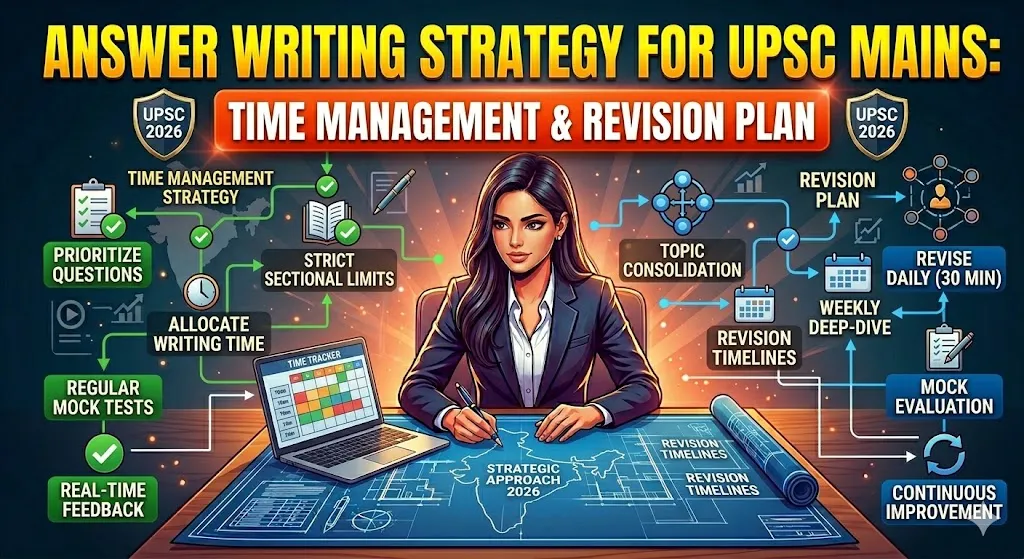
To maintain clean formatting and professional presentation across a full 3-hour exam session, your daily upsc mains answer writing strategy 2026 practice should adhere to strict time boundaries.
| Question Marks | Word Ceiling | Brainstorming Window | Active Writing Window |
|---|---|---|---|
| 10-Marker | 150 words | 1.0 minute | 6.0 minutes |
| 15-Marker | 250 words | 1.5 minutes | 9.5 minutes |
Frequently Asked Questions (FAQs)
Q1. Is it better to write answers in bullet points or paragraphs?
For the General Studies papers (GS I to IV), a bulleted layout using the keyword-first approach is highly recommended because it improves readability and makes the text easy to scan. However, for the Essay paper and specific humanities-based Optionals, a structured paragraph approach is often better suited for building an extended, narrative argument.
Q2. How can I improve my writing speed without ruining my presentation?
Speed is a direct result of clear structural habits. When you train your brain to follow a standard template—such as the IBC layout and the SPECTRUM framework—you spend less time wondering how to write answers in upsc mains and more time actively writing. Practice writing on blank, unruled papers with standard margins to build consistent spacing and scale.
Q3. Do evaluators penalize answers if you do not know the exact statistics?
If you cannot remember an exact figure, do not guess or write incorrect numbers. Instead, use accurate qualitative approximations. Writing "nearly half of the working population" is perfectly acceptable and far better than fabricating an incorrect percentage.
Q4. What is the most common presentation mistake made by beginners?
The most frequent mistake is creating large walls of text with no clear subheadings. When an answer lacks visual structure, the examiner has to read every word to find your core points. This increases the chance that your key arguments will be overlooked during a fast evaluation process, which is why a rigid structural framework is essential to a high-scoring upsc mains answer writing strategy 2026.
Final Takeaway
An outstanding presentation layout does not replace deep content; it enhances it. By combining an organized format, logical flow, and clean presentation tips into your answer writing strategy for upsc mains, you make your paper easy to read and evaluate. Approach your daily practice like a professional craftsman—refine your structural layout, use data points to support your arguments, and execute your plan with precision.


























Sign in to leave a comment.