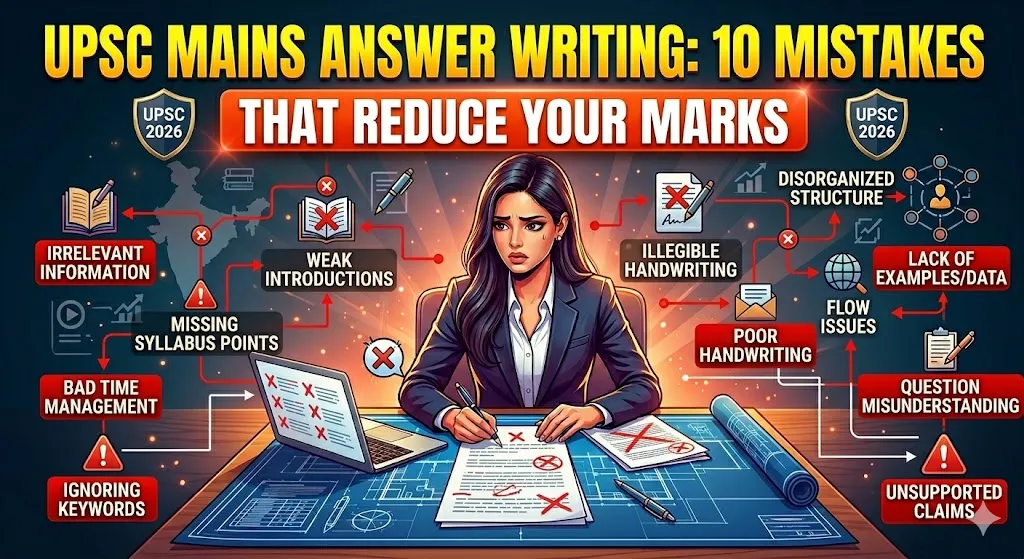

The Union Public Service Commission (UPSC) Civil Services Mains examination is famously brutal, not just because of the depth of the syllabus, but because of the sheer physical and mental endurance it demands. With the UPSC 2026 Mains exam officially scheduled to begin on August 21, 2026, your preparation window is steadily narrowing. At this stage, increasing your score isn't just about learning new facts; it is about eliminating structural and presentation flaws that quietly leak marks. Even with brilliant knowledge, making common presentation mistakes will cause your name to slide down the final merit list. To secure an elite rank, you need an error-free, highly disciplined upsc mains answer writing strategy 2026. This guide identifies the top 10 mistakes that reduce your marks in the descriptive papers and shows you exactly how to fix them.
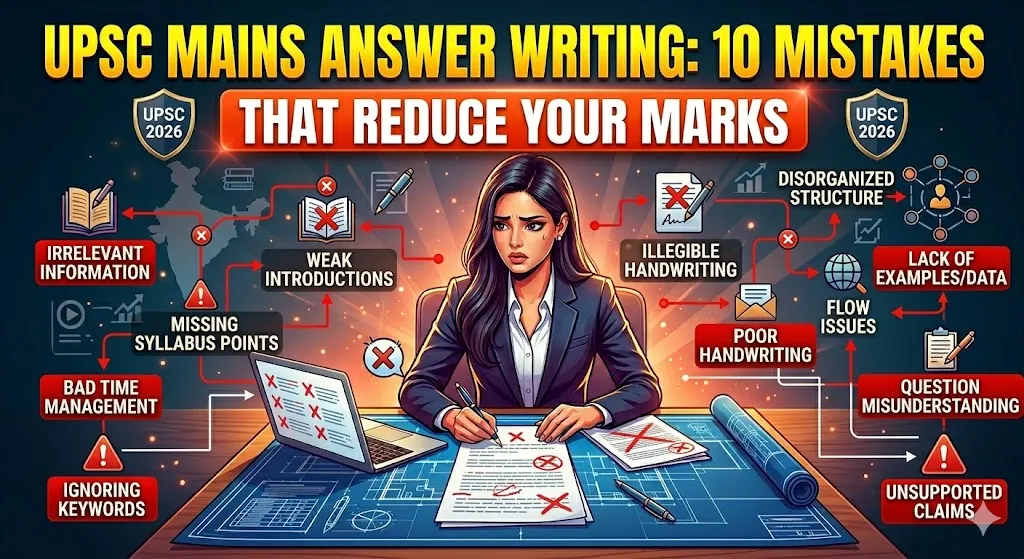
1. Misinterpreting Directive Words (Command Words)
The absolute quickest way to lose marks is to write an answer based on what you wish you were asked, rather than what is actually on the paper. Every question features a specific command word that mandates a unique logical framework. When analyzing the prompt, understanding how to write answers in upsc mains according to these directives prevents you from steering off-topic.
- The Mistake: Treating "Critically Evaluate," "Discuss," and "Examine" as identical invitations to write a general essay.
- The Correction: If a question asks you to critically evaluate, you must present a balanced argument featuring both pros and cons backed by hard empirical data, ending with an objective administrative verdict. If it asks you to discuss, it demands an impartial, multi-dimensional overview of the topic.
Learning to instantly deconstruct these subtle prompts is a core component of mastering how to write answers in upsc mains under pressure.
2. Creating Walls of Text Instead of Scannable Layouts
UPSC evaluators read hundreds of scripts per week. Forcing an examiner to wade through long, unbroken paragraphs to find your arguments creates immediate cognitive fatigue and lowers your score. Overcoming this is essential for effective upsc mains answer writing.
- The Mistake: Writing answers like a traditional university essay with long, dense paragraphs.
- The Correction: Transition completely to a keyword-first bulleted layout. Break your answer down using distinct, clean subheadings pulled directly from the question text. Bold your primary point in two or three words, add a colon, and write your explanation right next to it. This structural layout makes your answers incredibly easy to scan during a fast evaluation process. Continuous upsc mains answer writing practice will help cement this scannable style.
3. Leaving Questions Completely Unattempted
Leaving a 10-marker or 15-marker entirely blank is an unforced error that can derail your entire attempt. Completing the paper is the non-negotiable baseline of successful upsc mains answer writing.
- The Mistake: Spending too long polishing your early answers, leaving you with zero time to look at the final three or four questions.
- The Correction: Budget your time ruthlessly using a strict countdown matrix:
- 10-Mark Questions: Maximum 7 minutes (150 words)
- 15-Mark Questions: Maximum 11 minutes (250 words)
If your time is up on a question, stop writing, leave a small space, and move on. A partial answer can easily claw back 3 or 4 marks, but an empty page guarantees a zero. Accurate pace control must be built into your regular upsc mains answer writing mock sessions.
4. Neglecting Sub-Parts of a Multi-Pronged Question
UPSC frequently designs questions with two, three, or even four distinct sub-questions hidden inside a single prompt. If your approach lacks a rigorous answer writing strategy for upsc mains, you might naturally miss these hidden questions.
- The Mistake: Writing an incredible three-page response that beautifully answers the first half of a question while entirely ignoring the second half.
- The Correction: Before your pen touches the paper, spend 20 seconds underlining every sub-question. Your physical layout must feature distinct subheadings addressing each underlined part. Formulating a strict answer writing strategy for upsc mains ensures you allocate your word count proportionally across all sections to pick up partial marks smoothly.
5. Relying on Generalizations Without Hard Substantiation
Vague, conversational claims like "poverty is decreasing rapidly" or "environmental pollution is a major threat" do not belong in an administrator's answer script.
- The Mistake: Making sweeping, emotional assertions without providing factual backing.
- The Correction: Every major point you make must be anchored by objective evidence. Use specific constitutional articles, Supreme Court cases, NITI Aayog indices, or Economic Survey data. Grounding your points in factual evidence is a vital component of your overall answer writing strategy for upsc mains to elevate your answers from mediocre to exceptional.
6. Overcomplicating Diagrams and Visual Aids
Diagrams, flowcharts, and maps can be incredibly effective space-savers, but they can easily turn into a massive waste of time if you aren't careful.
- The Mistake: Spending four minutes drawing highly detailed, artistic illustrations that add no real intellectual value to the page.
- The Correction: Follow the strict 30-second rule. Use simple block schematics to illustrate administrative workflows, or quick hub-and-spoke models to list out multi-dimensional impacts. If a diagram takes more than half a minute to sketch out, scratch it and stick to neat bullet points. A practical answer writing strategy for upsc mains values speed and clarity far above artistic flair.
7. Writing a One-Dimensional Answer
An administrator must be able to view an issue through multiple perspectives simultaneously. Looking at a complex socio-economic issue through a single lens shows a lack of analytical depth, a mistake that undermines a solid upsc mains answer writing strategy 2026.
- The Mistake: Focusing purely on the political or economic angle of a topic while ignoring everything else.
- The Correction: Train your brain to apply the PESTLE approach to every body section to keep your multi-dimensional analysis on track:
- Political & Institutional layers
- Economic constraints
- Socio-cultural impacts
- Technological interventions
- Legal and regulatory environments
- Environmental and ethical concerns
8. Forgetting the Introduction-Body-Conclusion (IBC) Alignment
A disjointed response that jumps straight into points without context or ends abruptly without a solution reads poorly and lacks professional polish.
- The Mistake: Jumping straight into a bulleted list of points without a proper introduction, or missing a forward-looking conclusion.
- The Correction: Maintain structural discipline. Spend the first 10% of your words on a punchy, factual intro-hook. Spend 80% on your multi-dimensional body, and save the final 10% for a solution-oriented, futuristic "Way Forward" that leaves the examiner with a positive impression, a vital component of a well-rounded upsc mains answer writing strategy 2026.
9. Over-Writing on Familiar Topics
It is incredibly tempting to dump every piece of information you know when a question aligns perfectly with your favorite optional or static topic. This lack of discipline can disrupt your entire plan on how to write answers in upsc mains.
- The Mistake: Writing a brilliant 400-word essay on a 150-word question just because you memorized the topic thoroughly.
- The Correction: Respect the word ceiling. Writing past the word limit doesn't earn you extra credit; it simply steals precious time from your remaining questions. Keep your points concise, state your evidence clearly, and move on to the next prompt. Managing this balance carefully is an important milestone in learning how to write answers in upsc mains.
10. Neglecting a Balanced, Solution-Oriented Conclusion
UPSC is looking for future civil servants, not cynical commentators. Ending your response with a purely critical, negative perspective is a significant red flag.
- The Mistake: Ending an answer with a bitter critique of an institutional policy without providing any viable remedies.
- The Correction: Always conclude with an actionable, positive resolution. Cite formal institutional frameworks, such as the 2nd Administrative Reforms Commission (ARC) guidelines or international best practices, to ground your final paragraph.
Candidate Perspectives: Learning from the Field
Reviewing the practical experiences of those who have successfully navigated the system provides realistic guideposts for your own preparation.
"In my first attempt, I treated how to write answers in upsc mains as a test of pure memory, trying to pack every statistic I knew into a single page. I ended up missing the cutoff because I left three questions totally unattempted. My scores improved dramatically when I focused on clean presentation, keeping my word count under control, and completing the paper on time."
— Karan Verma, IAS (Batch 2024)
"I used to think my handwriting and spatial layout didn't matter as long as my content was solid. But during mock evaluations, I realized that neat formatting, careful page margins, and precise underlining made a huge difference. Shifting to a highly structured approach to upsc mains answer writing completely transformed my results."
— Meera Nair, IFS (Batch 2025)
Frequently Asked Questions (FAQs)
Q1. How do I handle a question when I have absolutely no data or static knowledge about the topic?
If you are completely unfamiliar with a topic, do not try to bluff or write paragraphs of generic text; the evaluators will spot it immediately. If you have some peripheral understanding, write a brief, highly structured response using your basic conceptual knowledge. If you truly know nothing about the topic, it is far safer to leave the question blank and allocate that saved time to maximize your scores on the remaining questions.
Q2. Does bad handwriting automatically lead to lower marks in UPSC Mains?
Your handwriting does not need to look perfect, but it must be completely legible under a fast reading pace. If an examiner has to struggle or strain their eyes to read your sentences, it naturally hurts your scoring potential. Use your regular upsc mains answer writing practice to build a stable writing style with uniform letter sizes and clean line spacing.
Q3. Should I prioritize writing in bullet points or traditional paragraphs?
For the General Studies papers (GS I through GS IV), a bulleted layout using scannable subheadings is highly recommended because it keeps your answers clear and concise. For the Essay paper and specific humanities-based Optional subjects, a well-structured paragraph format is usually better suited for building an extended, narrative argument.
Q4. How many points should I aim to write for a standard 10-mark and 15-mark question?
As a general rule of thumb, aim to provide 5 to 6 distinct, well-substantiated points for a 10-mark question, and 8 to 10 points for a 15-mark question. Ensure that these points are evenly distributed across all sub-parts of the prompt rather than clustering them under a single heading, which is a key pillar of a high-scoring answer writing strategy for upsc mains.
Final Takeaway
Eliminating these ten common mistakes from your writing routine is just as important as reading new study material. By focusing on command words, keeping your layout scannable, managing your time carefully, and supporting your claims with hard data, you make your paper incredibly easy to evaluate. Treat your daily practice like a meticulous craft, refine your presentation with a solid upsc mains answer writing strategy 2026, and execute your plan with total precision on exam day.


























Sign in to leave a comment.