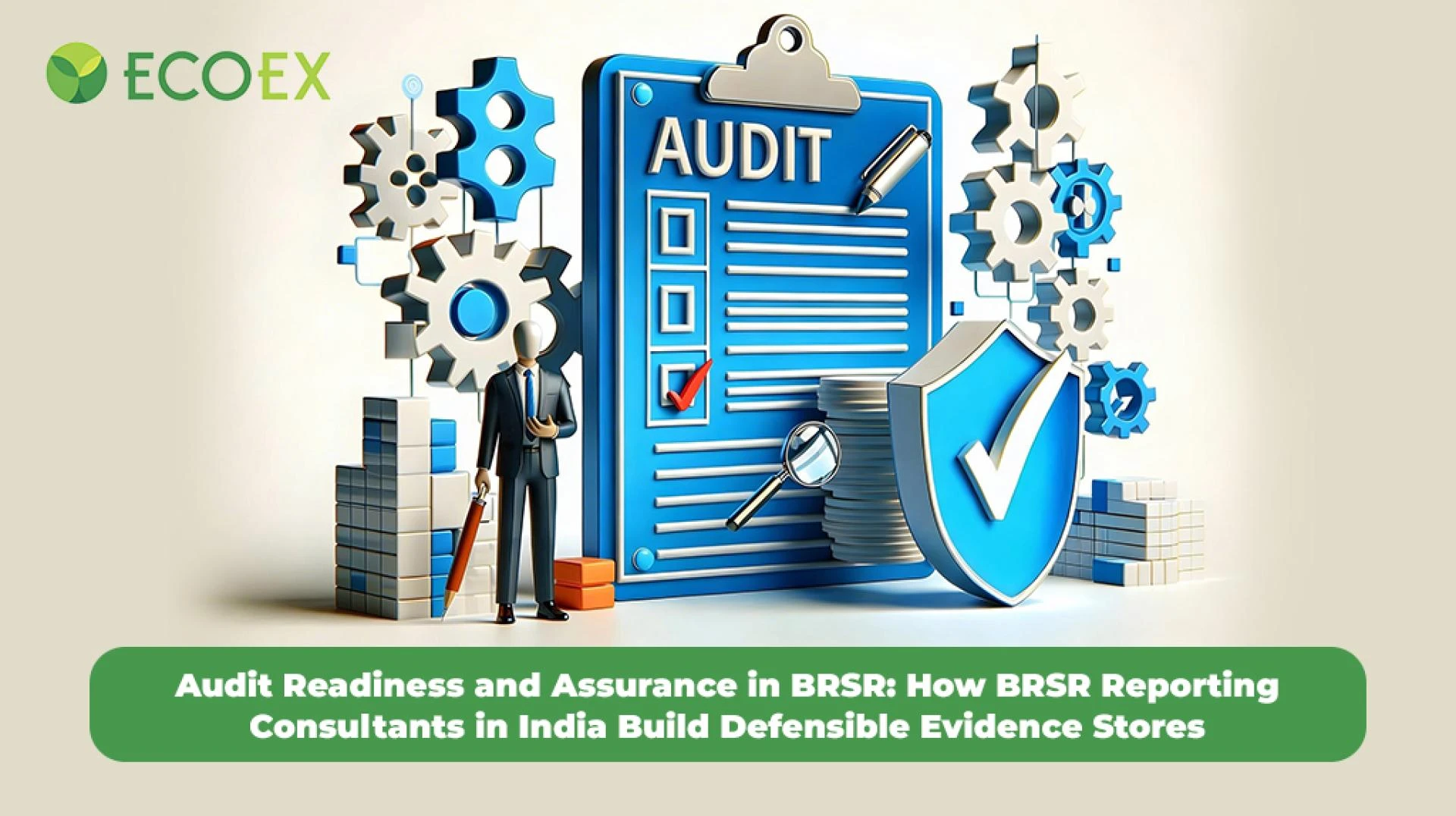

BRSR reporting looks neat and polished in annual reports. Clean tables. Confident numbers. Strong sustainability narratives. But anyone who has actually prepared a BRSR knows the uncomfortable truth. Writing the story is easy. Defending the data is hard.
This is where most organisations in India feel the pressure. Regulators now expect substance, not slogans. Auditors no longer accept spreadsheets built two days before submission. Investors want proof that ESG numbers come from real operations, not creative formatting. Suddenly, BRSR reporting consultancy in India becomes the most decorated survival tool.
The stakes are real. The top 1,000 listed companies must comply with BRSR requirements. At the same time, assurance expectations keep rising. Limited assurance today quietly points toward reasonable assurance tomorrow. Companies that fail to prepare face qualification remarks, credibility damage, and painful audit escalations.
The biggest risk lies in evidence quality. Weak data lineage. Missing records. Inconsistent calculations. Informal approvals. These gaps trigger audit red flags fast. Fixing them at year-end costs money, time, and reputation.
This article shows how BRSR reporting consultants help organisations avoid that chaos. You will learn how they design audit-ready sustainability data, build defensible evidence stores, and embed assurance thinking from day one. You will see why modern BRSR reporting focuses as much on governance and documentation as on metrics.
Read on if you want fewer audit surprises, smoother assurance engagements, and BRSR disclosures that stand up to serious scrutiny.
The Shift from Disclosure to Defensibility in BRSR Reporting
BRSR reporting in India has matured quickly. Early disclosures focused on narrative completeness. Today, the conversation has shifted to defensibility.
Regulators, assurance providers, and investors now ask tougher questions. They examine how each metric was calculated. They test whether disclosures align with operational records. They challenge inconsistencies across years. This shift makes BRSR audit readiness a core requirement.
Evidence matters as much as disclosure. A reported emission figure without traceable support invites audit risk. A diversity metric without documented HR records raises concerns. Numbers without proof weaken trust.
This reality has changed the role of a BRSR reporting consultancy in India. Consultants no longer act only as report writers. They operate as compliance architects. They design systems where every ESG metric connects to verifiable evidence.
Industry assurance data shows that a significant portion of ESG audit observations relate to documentation gaps, not incorrect intent. That insight explains why defensible evidence management now sits at the heart of BRSR engagements.
Consultants help organisations treat BRSR reporting like financial reporting. They apply governance logic. They document assumptions. They enforce controls. This shift transforms sustainability reporting from storytelling into assurance-grade ESG reporting.
Understanding What Auditors Actually Test in a BRSR Assurance Process
Many organisations misunderstand what assurance providers test during BRSR audits. Auditors do not only check final numbers. They test systems.
They examine data lineage in ESG reporting. They trace metrics back to source records. They verify consistency across reporting periods. They assess whether internal controls exist and function.
Auditors also test authenticity. They review whether evidence originates from real operational systems or informal spreadsheets. They assess approval workflows. They flag unsupported manual overrides as high risk.
This is where BRSR reporting consultancy in India adds real value. Consultants anticipate audit queries before auditors raise them. They map each disclosure to its underlying data source. They document calculation logic clearly.
They also distinguish between surface-level documentation and auditor-grade evidence. A screenshot without metadata rarely passes assurance. A versioned record with timestamps and approvals does.
This preparation matters because assurance expectations continue to rise. Even limited assurance BRSR engagements now involve deeper testing than earlier years. Consultants who understand audit behaviour help organisations stay ahead of scrutiny.
Designing Evidence Architectures Instead of Document Repositories
Many companies still treat evidence storage as a digital filing cabinet. Folders grow. Files scatter. Ownership blurs.
BRSR reporting consultants reject this approach. They design compliance evidence repositories that function as evidence architectures, not storage dumps.
Evidence architectures link each ESG metric to supporting artefacts. Contracts connect to supplier disclosures. Invoices link to energy data. Waste manifests support for environmental metrics. HR records validate social indicators.
This structure supports defensible evidence management across audit cycles. Version control prevents confusion. Metadata tagging improves searchability. Timestamping preserves historical context.
Role-based access ensures accountability. Only authorised users modify records. Approval trails remain intact. These features support BRSR governance controls naturally.
Static folders collapse under audit pressure. Structured evidence architectures scale with regulatory expectations. That difference defines audit readiness.
Data Lineage and Traceability Across ESG and Compliance Systems
Data lineage decides whether a BRSR disclosure survives assurance or collapses under questioning. Auditors do not trust numbers that appear magically in reports. They demand a clear, uninterrupted trail from operational activity to final disclosure.
This is where data lineage in ESG reporting becomes non-negotiable. Every metric must trace back to its origin. Energy consumption links to utility invoices. Waste quantities map to manifests and recycler certificates. Workforce diversity aligns with HR systems. Any break in this chain raises immediate audit risk.
BRSR reporting consultancy in India focuses heavily on preserving this continuity. Consultants map ESG metrics across ERP platforms, EPR systems, waste compliance tools, and supplier databases. They design workflows where data flows forward without manual rewriting or copy-paste risks.
Traceability also protects against silent errors. If a source dataset changes, consultants ensure the impact is reflected transparently across disclosures. This visibility supports evidence traceability systems and strengthens confidence in verified sustainability metrics.
Auditors flag broken lineage as a high-risk issue. Consultants prevent that scenario by designing systems where traceability exists by default, not reconstruction.
Internal Controls and Validation Frameworks for BRSR Metrics
Strong BRSR reporting depends on prevention, not correction. Internal controls turn that philosophy into practice.
Consultants help organisations implement internal controls for BRSR that mirror financial reporting discipline. These controls operate before audit season begins. Validation rules flag anomalies early. Threshold checks identify unrealistic values. Variance analysis highlights unexplained year-on-year shifts.
Peer benchmarking also plays a role. Metrics that fall far outside industry ranges receive scrutiny before publication. Automated exception alerts prompt investigation rather than embarrassment.
These controls strengthen regulatory disclosure validation and reduce reliance on auditor intervention. Assurance providers trust systems that demonstrate discipline.
Companies with strong validation frameworks experience smoother assurance cycles and lower remediation costs. Consultants design these frameworks so they run quietly in the background, supporting audit-ready sustainability data without slowing operations.
Preparing for Limited vs Reasonable Assurance in BRSR
Assurance expectations do not remain static. Many organisations underestimate how quickly limited assurance BRSR evolves into expectations closer to reasonable assurance ESG.
Limited assurance focuses on plausibility. Reasonable assurance demands proof, tested controls, and consistent governance. Evidence depth increases sharply.
BRSR reporting consultants assess maturity early. They evaluate data quality, control strength, and governance readiness. Based on this assessment, they design scalable evidence systems that support gradual assurance progression.
This approach avoids annual rebuilds. Organisations do not start from scratch every year. Evidence stores grow stronger over time. Controls mature naturally.
This strategy supports risk-based ESG assurance. Companies prioritise high-risk disclosures first. They strengthen systems incrementally. Consultants guide this journey with long-term assurance in mind.
Role of Digital Platforms in Creating Audit-Ready BRSR Workflows
Manual evidence assembly fails under modern assurance pressure. Digital systems fix that problem permanently.
Digital compliance platforms enable real-time evidence capture. Every upload records metadata. Every change is logged automatically. Every approval leaves a timestamped trail.
Consultants configure platforms so ESG audit trails emerge as a natural by-product of daily operations. Teams no longer chase documents at year-end. Evidence already exists.
Dashboards track readiness continuously. Gaps appear early. Remediation starts calmly. Audits feel predictable.
This approach strengthens assurance-grade ESG reporting because systems enforce discipline without relying on memory or heroics. Consultants ensure platforms align with BRSR requirements rather than generic reporting.
Reducing Audit Risk Through Standardisation and Process Discipline
Inconsistency remains one of the biggest threats to BRSR assurance. Different business units using different calculation methods confuse auditors. Varying documentation formats raise red flags. Undefined ownership weakens accountability.
Consultants solve this through standardisation. They define calculation logic clearly. They document assumptions explicitly. They align reporting methodologies across units.
Process discipline follows naturally. Clear ownership ensures accountability. Repeatable workflows improve reliability. BRSR governance controls strengthen quietly but effectively.
This discipline reduces audit friction. Auditors review once, not repeatedly. Trust builds across reporting cycles.
Future-Proofing Evidence Stores for Regulatory and Investor Scrutiny
Future-proofing evidence stores means building BRSR documentation systems that stay reliable even as rules tighten, audits deepen, and investor questions get sharper. It is not about preparing for this year’s assurance alone. It is about making sure next year’s scrutiny does not force a rebuild.
Regulatory expectations in India continue to evolve. BRSR indicators expand. Assurance scopes deepen. Cross-verification across ESG, financial, and operational data becomes common. Investors now compare disclosures across years, peers, and even global frameworks. In this environment, weak or rigid evidence systems fail fast.
BRSR reporting consultants approach future-proofing by designing evidence stores as adaptive systems, not static archives. They structure the documentation so new metrics can be added without disrupting existing records. For example, if a new environmental indicator becomes mandatory, the system already supports versioning, approvals, and traceability. Teams add data rather than redesign workflows.
Another key element involves anticipating investor scrutiny. Frequently, investors enquire only, "What is the number?" They ask, “How did you calculate it?”, “Has the method changed?”, and “Can you show consistency over time?” Future-ready evidence stores preserve historical context. They retain prior-year calculations, assumptions, and approvals so trends remain defensible.
Consultants also future-proof systems by aligning evidence with multiple disclosure needs. The same dataset may serve BRSR, internal ESG dashboards, lender due diligence, or sustainability-linked financing reviews. Structured and well-tagged evidence avoids duplication and reduces response time during scrutiny.
Technology plays a supporting role. Digital systems enable scalable storage, immutable logs, and continuous updates without data loss. More importantly, consultants ensure governance rules stay intact even as systems grow. Ownership remains defined. Controls remain enforced. Audit trails remain unbroken.
The real outcome of future-proofing is confidence. Organisations stop reacting nervously to new regulations or investor questions. They respond calmly with proof. Evidence becomes a strategic asset, not a compliance headache.
In short, future-proof evidence stores protect credibility. They allow organisations to evolve with regulation instead of chasing it.
Conclusion
BRSR reporting no longer succeeds on narrative strength alone. Evidence quality defines credibility. BRSR reporting consultancy in India now centres on audit readiness, assurance discipline, and defensible documentation. Consultants build systems that withstand scrutiny, not just reports that look good.
They design evidence architectures. They preserve data lineage. They enforce controls. They prepare organisations for rising assurance expectations. This approach protects reputation, reduces audit risk, and strengthens investor trust. BRSR reporting becomes governance infrastructure, not annual stress.
In today’s regulatory environment, defensible evidence decides who leads and who explains. Audit-ready organisations stay ahead.
Frequently Asked Questions
1. Why is audit readiness critical in BRSR reporting?
Audit readiness ensures disclosures withstand regulatory, investor, and assurance scrutiny without last-minute corrections.
2. What do auditors test during BRSR assurance?
Auditors test data lineage, evidence authenticity, internal controls, and consistency across reporting periods.
3. How do consultants help with BRSR assurance preparation?
They design evidence architectures, implement controls, and align disclosures with verifiable operational records.
4. What is the difference between limited and reasonable assurance in BRSR?
Limited assurance checks plausibility, while reasonable assurance requires deeper evidence and tested controls.
5. Can digital platforms improve BRSR audit outcomes?
Yes. Digital platforms create real-time audit trails and reduce reliance on manual reconciliations.






















Sign in to leave a comment.