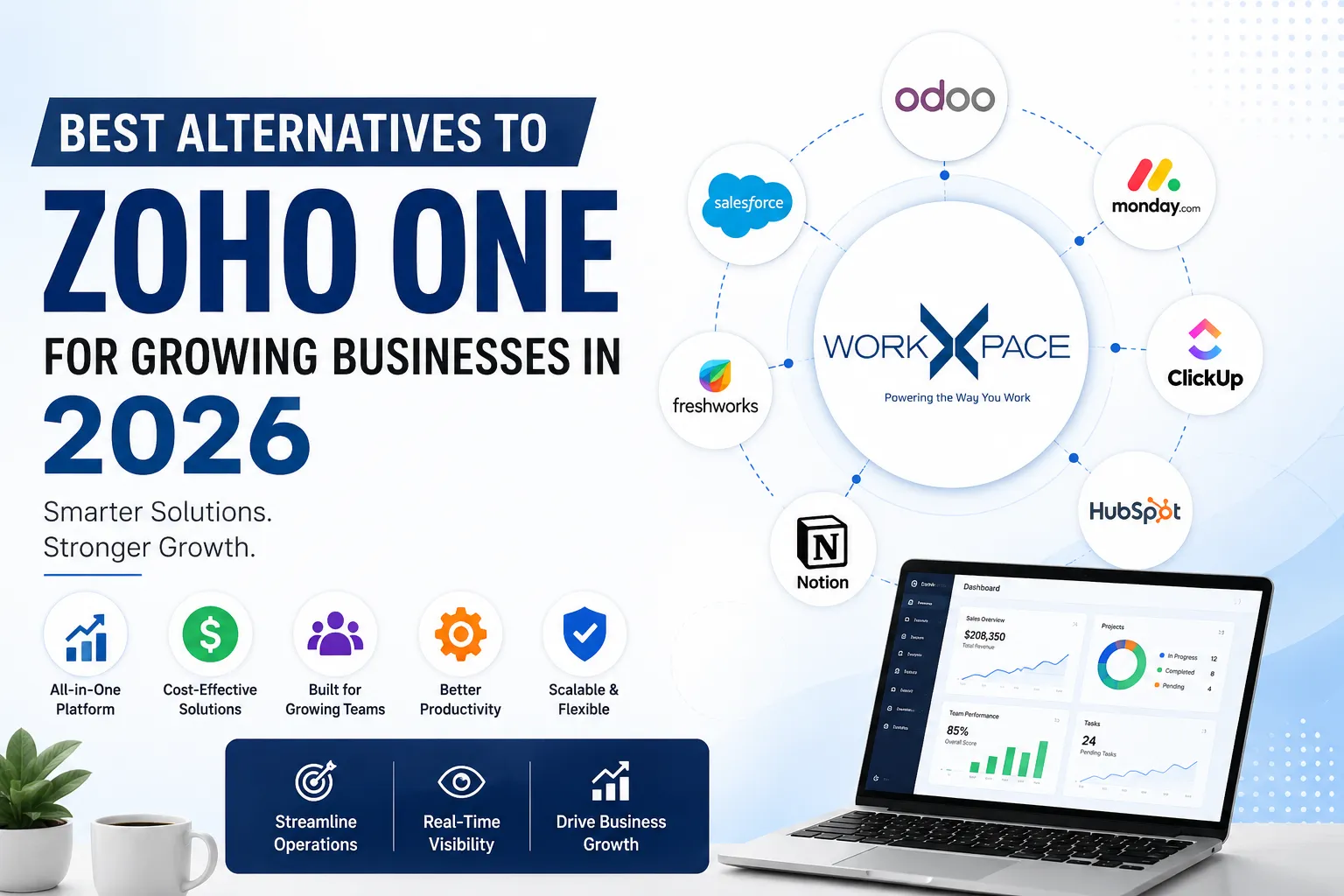

Zoho One was a genuinely bold idea when it launched: one subscription, 45+ integrated applications, covering everything from CRM and HR to Finance, Marketing, and Projects — all under one roof.
And for many businesses, it delivers. Reviews consistently note the value of having everything in one ecosystem, with data flowing between tools without complex third-party connectors. For a business that is willing to invest the time to configure it, Zoho One can work well.
But there is a growing category of businesses — particularly those scaling past 20 to 50 employees — that start hitting Zoho One's real limitations. Not the headline features, but the friction underneath them: the setup complexity, the inconsistent quality across apps, the per-seat pricing model that gets expensive fast, and the absence of true real-time executive visibility.
If you are in that category — you want what Zoho One promised, but you need it to work the way your growing business operates — this article is for you.
Here are the best alternatives to Zoho One for growing businesses in 2026.
Why Growing Businesses Start Looking Beyond Zoho One
Before we look at alternatives, it is worth being specific about the problems that drive businesses to look elsewhere — because not every business has the same pain point.
The "45 apps" problem. Zoho One includes over 45 applications. In practice, most businesses use 8 to 12 of them regularly. The rest are available, but they require individual configuration, onboarding, and management. The breadth that makes Zoho One attractive also makes it overwhelming. Users consistently note that while the platform is comprehensive, many apps feel less polished than dedicated standalone tools, and setup requires significant effort.
The per-seat pricing trap. Zoho One's All Employee plan requires a license for every person on payroll — whether they use the platform or not. At $37 per user per month on the annual plan, a 50-person company is looking at $22,200 per year before add-ons, implementation, or support costs. The Flexible User plan addresses this — but at $90 per user per month, the flexibility costs significantly more.
The real-time visibility gap. Zoho One gives leadership access to data across departments. What it does not give you is a unified, real-time command center — a single view where a CEO can see live KPIs across Sales, HR, Projects, and Finance simultaneously, and drill down into root causes without assembling reports. For growing businesses where leadership needs to move fast, this gap matters.
Implementation overhead. Zoho One is not plug-and-play. Most businesses need a Zoho implementation partner to set it up properly — which adds cost and timelines before the platform delivers value.
If any of these resonate, here are the platforms worth evaluating.
1. WorkXpace — Best Overall Alternative for Growing Businesses
For businesses that want a true Business Operating System — not just a bundle of apps — WorkXpace is the strongest alternative to Zoho One in 2026.
WorkXpace is built from the ground up as an organisation's unified operating platform. Where Zoho One gives you 45+ loosely connected applications, WorkXpace delivers a tightly integrated system where HR, Sales CRM, Project Management, Time Tracking, Performance Analytics, and Workflow Automation all share a single data layer — and feed into a real-time command center dashboard that leadership can use.
The difference is not cosmetic. It is architectural.
What makes WorkXpace the right choice for growing businesses:
Unified command center visibility. A CEO using WorkXpace does not need to open five different Zoho apps to understand business health. One dashboard shows live KPIs across all departments — Sales pipeline, HR headcount, project delivery status, performance metrics — in real time. This is the visibility growing businesses need as they scale.
AI-powered workflow intelligence. WorkXpace does not just track work — it actively surfaces risks, automates repetitive processes, and keeps execution aligned with strategy. In 2026, AI-powered operations are not a luxury; they are a competitive requirement.
No seat-trap pricing. Unlike Zoho One's All Employee mandate that requires every person on payroll to be licensed, WorkXpace offers straightforward pricing designed to scale with business value — not with headcount. No hidden add-ons. No implementation partner required to get started.
Outcome-based execution tracking. WorkXpace tracks progress against goals, not just activity. OKRs, quarterly milestones, team performance scorecards — visible in real time, not buried in quarterly review slides.
Fast implementation. WorkXpace is designed for growing businesses that cannot afford a six-month onboarding project. The platform is built to deliver value quickly, without a dedicated Zoho partner on retainer.
For a growing business that needs operational clarity, real-time visibility, and a platform that scales without complexity — WorkXpace is the Zoho One alternative built specifically for this stage.
2. Odoo — Best for Technical Teams Who Need Deep Customisation
Odoo is the closest structural competitor to Zoho One — a broad, modular platform covering CRM, HR, Inventory, Accounting, Projects, and more.
Odoo's Community edition is open source and free to download, which makes it attractive for businesses with in-house technical resources. The Enterprise edition adds more modules, cloud hosting, and official support.
Where Odoo works well: Businesses that need deep customisation of their operational workflows — particularly in manufacturing, inventory, or logistics — and have the technical team implementing and maintaining it.
Where Odoo falls short for growing businesses: The implementation burden is significant. Odoo requires server setup, module configuration, and ongoing developer maintenance. Most businesses without a dedicated technical team end up relying on an Odoo partner — which adds considerable cost. Additionally, like Zoho One, Odoo is transaction-focused rather than intelligence-focused. It records what happened; it does not give leadership real-time visibility into what is happening now and why.
Best for: Tech-forward businesses in operations-heavy industries (manufacturing, logistics, retail) with in-house developers or a willing implementation budget.
3. Monday.com — Best for Project and Work Management
Monday.com has become one of the most popular work management platforms globally, and for good reason. Its visual interface is intuitive, the workflow automation is well-executed, and the platform scales comfortably from small teams to enterprise departments.
Where Monday.com works well: Teams whose primary operational challenges are project execution, task management, and cross-team collaboration. If your bottleneck is "we don't know who is doing what and when it's due," Monday.com solves that cleanly.
Where Monday.com falls short: It is a project and work management tool, not a full Business Operating System. Monday.com does not natively replace a CRM, an HRMS, or a financial management system. To achieve Zoho One-level coverage, you will need Monday.com plus several other platforms — which reintroduces the fragmentation problem you were trying to solve in the first place.
Best for: Growing businesses that already have a CRM and HR system in place and primarily need a stronger project execution and team coordination layer.
4. ClickUp — Best for Versatile, Budget-Conscious Teams
ClickUp has grown into a comprehensive productivity and work management platform — covering tasks, docs, goals, time tracking, and lightweight CRM functionality. Its free tier is genuinely capable, and the paid plans are among the most competitively priced in the category.
Where ClickUp works well: Teams that need maximum flexibility in how they organise work, with a strong emphasis on documentation and task management. ClickUp's ability to customise views, workflows, and automation makes it adaptable to a wide range of business types.
Where ClickUp falls short: Like Monday.com, ClickUp is primarily a productivity and project management tool. It does not fully replace an HRMS or a dedicated CRM. And while ClickUp's flexibility is a strength, it is also its primary weakness — configuring ClickUp for a full organisation requires significant setup time and ongoing management.
Best for: Smaller growing teams (under 30 people) that want a powerful, affordable task and project management platform and are comfortable setting it up themselves.
5. HubSpot — Best for Sales and Marketing-Led Businesses
HubSpot started as a marketing automation platform and has grown into a broader business suite — covering CRM, Sales, Marketing, Customer Service, and CMS in one platform.
Where HubSpot works well: Businesses where sales and marketing are the primary operational drivers. HubSpot's CRM is genuinely excellent — polished, intuitive, and deeply connected to its marketing and service tools.
Where HubSpot falls short: HubSpot is not a full operational platform. It does not cover HR, project management, or internal operations in any meaningful depth. And at scale, HubSpot's pricing becomes one of the most expensive in the SaaS category — particularly for the Marketing Hub and Sales Hub at higher tiers. For businesses that need operational coverage beyond revenue functions, HubSpot leaves significant gaps.
Best for: Sales and marketing-led businesses where pipeline visibility, lead nurturing, and customer lifecycle management are the top priorities.
6. Notion — Best for Knowledge-Centric Small Teams
Notion has evolved from a simple note-taking tool into a capable knowledge management and lightweight project management platform. Its AI features have improved significantly, and for small, information-driven teams, it can replace several disconnected tools.
Where Notion works well: Small teams that run on documentation, SOPs, wikis, and light project tracking. Notion is excellent at creating a shared knowledge base that keeps everyone aligned.
Where Notion falls short: Notion is not an operational platform. It does not manage sales pipelines, HR workflows, performance tracking, or financial visibility. It is a knowledge workspace — powerful within that scope, but not a substitute for a Business Operating System.
Best for: Early-stage startups and small teams (under 15 people) that need a central knowledge base and lightweight collaboration tool, not a full operational stack.
Side-by-Side Comparison
| Capability | Zoho One | WorkXpace | Odoo | Monday.com | ClickUp | HubSpot |
| Unified HR + CRM + Projects | ✅ | ✅ | ✅ | ❌ | ❌ | ❌ |
| Real-time CEO dashboard | ❌ | ✅ | ❌ | ❌ | ❌ | Partial |
| AI-powered workflows | Partial | ✅ | ❌ | Partial | Partial | Partial |
| Transparent per-value pricing | ❌ | ✅ | ❌ | ✅ | ✅ | ❌ |
| Fast implementation | ❌ | ✅ | ❌ | ✅ | ✅ | ✅ |
| Outcome tracking | Partial | ✅ | ❌ | Partial | Partial | Partial |
| Built for growing SMEs | ✅ | ✅ | Partial | ✅ | ✅ | Partial |
How to Choose the Right Alternative
The best Zoho One alternative depends on what is actually limiting you — and what your business needs most at this stage of growth.
Choose WorkXpace if you want a true Business Operating System — unified visibility across HR, Sales, Projects, and Operations, with AI-powered workflows and real-time leadership intelligence. This is the right choice for businesses that found Zoho One too complex, too fragmented, or too expensive relative to the value delivered.
Choose Odoo if you are in an operations-heavy industry, have technical resources, and need deep customisation of your business workflows. Be prepared for a significant investment.
Choose Monday.com or ClickUp if your primary pain point is project and task management, and you already have separate CRM and HR systems you are not looking to replace.
Choose HubSpot if your business is primarily sales and marketing-driven, and operational coverage beyond the revenue funnel is not a near-term priority.
Choose Notion if you are a small team in the early stage, and your primary need is documentation and lightweight collaboration, not operational management.
The Real Question Behind the Alternative Search
When businesses start searching for Zoho One alternative, they are rarely just looking for a cheaper subscription or a different interface.
They are looking for a platform that works the way their business operates — one that gives leadership real visibility, keeps teams aligned, and scales without demanding constant administration.
Zoho One was designed to be everything for everyone. The best alternative is the platform designed to be exactly what your business needs — unified, intelligent, and built to grow with you.





























Sign in to leave a comment.