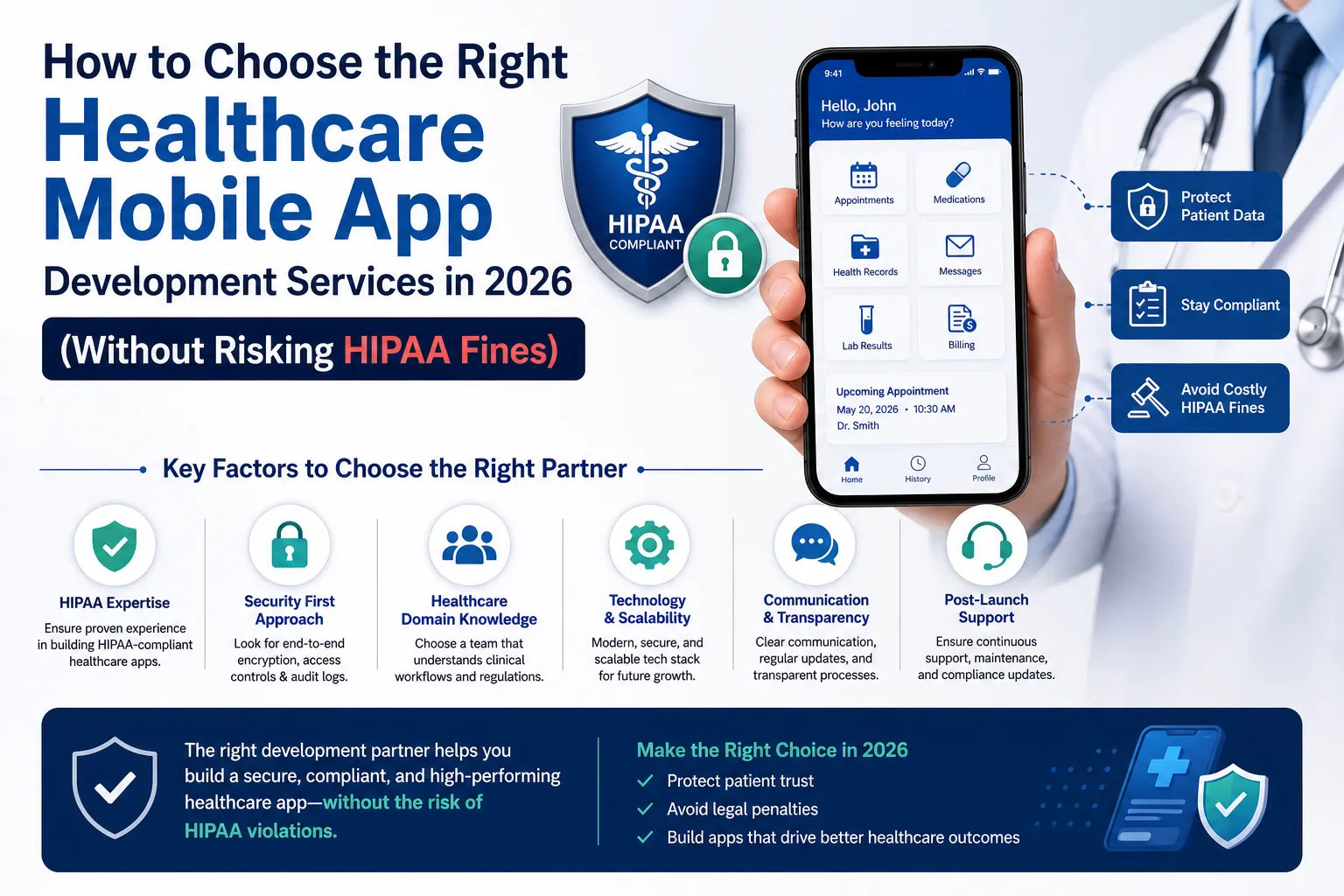

Healthcare mobile app development is not a procurement decision you can afford to rush. With HIPAA violation penalties now reaching up to $2,190,294 per violation category annually as of January 2026, and with nearly 57 million individuals having their protected health information exposed in 2025 alone, the consequences of choosing the wrong development partner extend well beyond a failed product launch. They can include regulatory investigations, OCR settlements, and reputational damage that persists long after the technical problem is corrected.
This guide is written for healthcare founders, digital health product leaders, and clinical IT decision-makers who are evaluating healthcare mobile app development services and want a clear, practical framework for making the right call — before a contract is signed.
Why Most Healthcare App Projects Fail Before They Launch
The Two Most Common MVP Mistakes Healthcare Founders Make
The first mistake is overbuilt: founders attempt to launch with every feature planned for the product's first two years, which buries the budget in integrations and UI complexity before a single user has validated core assumptions. The second — and more dangerous — mistake is under-architect: teams launch a stripped-down MVP without establishing the HIPAA-compliant infrastructure required to support it, then discover mid-growth that the data model, access controls, and audit logging are insufficient for the clinical environment they are trying to enter. In regulated healthcare, an MVP is not a permission slip to defer architecture decisions. It is a scoped product built on a compliance-ready foundation.
Why Building Compliance as an Afterthought Costs 3–5× More to Fix
The cost differential between building HIPAA compliance into a healthcare app from the beginning versus retrofitting it after launch has been consistently documented at three to five times the original investment. The reason is structural: encryption must be woven into data models before any patient records are written. Access control logic must be architected as a core service, not a permission layer added to finished endpoints. Audit logging must be embedded in every data transaction from the first sprint, not instrumented on top of a completed system. Teams that learn this in production — while the platform is live, with real patient data flowing through non-compliant infrastructure — pay for emergency development cycles under regulatory pressure. The organisations that deliver compliant healthcare apps on time are the ones whose development partners treat sprint zero as a compliance scoping exercise, not a feature planning session.
Key benchmark: HIPAA compliance overhead typically adds 20–30% to a healthcare app development budget compared to a general-purpose consumer application of equivalent complexity. That premium is not optional — it is the cost of operating legally in a regulated environment.
What "Production-Ready" Really Means in a Regulated Healthcare Environment
In consumer app development, production-ready means the app is stable and passes QA. In healthcare, production-ready means the platform has completed HIPAA compliance testing, all third-party vendors are covered by signed Business Associate Agreements, encryption has been validated at rest and in transit, the audit trail is tamper-proof and six-year-compliant, the incident response plan has been documented and tested, and a privacy officer has signed off on the data handling procedures. Healthcare organisations that evaluate development partners purely on delivery speed or feature completeness are measuring the wrong things. The correct evaluation framework starts with whether the vendor can deliver a platform that is safe to operate in a clinical environment.
What a Qualified Healthcare Mobile App Development Company Must Demonstrate
HIPAA-First Architecture vs. HIPAA-Bolted-On — How to Tell the Difference
The difference between these two approaches shows up in the discovery phase conversations, not in the sales deck. A development partner with genuine HIPAA-first experience will ask about your data model and PHI classification before discussing features. They will raise data minimisation as a design constraint — arguing that fields you do not need should not be collected at all, rather than collecting everything and filtering later. They will describe how they structure audit logging as an independent service rather than a table in the application database. They will have a specific answer for how they configure cloud environments for HIPAA eligibility, not a general assurance that they use AWS or Azure. Partners who rely on post-launch security scans to identify compliance issues have told you everything you need to know about their approach before you have asked a single technical question.
EHR Integration Experience: Epic, Cerner, and FHIR Interoperability
If your healthcare app needs to connect to an electronic health record system — and most clinical applications do — your development partner's EHR integration experience is not a secondary consideration. It is a primary qualification. Epic and Oracle Health (formerly Cerner) hold the largest market share in US hospital environments, and each exposes data through distinct developer programmes, FHIR R4 API implementations, and SMART on FHIR authentication flows that behave differently from each other and from generic FHIR documentation. A team that treats Epic and Cerner as interchangeable has not shipped a production EHR integration. A qualified partner will distinguish between HL7 v2.x message types — ADT, ORU, ORM — and FHIR R4 resources without prompting, and will have a specific answer for how they handle authentication token expiry differences between the two platforms.
Third-Party Audit Credentials — SOC 2 Type II and HITRUST CSF Explained
HHS does not certify development companies as HIPAA-compliant. What enterprise healthcare buyers and procurement teams actually evaluate are third-party attestations that demonstrate a mature, independently verified compliance posture. SOC 2 Type II is an audit report confirming that a vendor's security controls for availability, confidentiality, and processing integrity have operated effectively over a defined period — typically six months or longer. HITRUST CSF is a comprehensive certification framework that incorporates HIPAA requirements alongside dozens of other regulatory standards and is increasingly required by hospital systems before any vendor relationship is established. Ask every development partner you evaluate for their most recent SOC 2 Type II report. Ask whether they are pursuing HITRUST CSF certification. If they cannot produce either, ask why not.
Real Cost Benchmarks for Healthcare Mobile App Development Services in 2026
MVP vs. Full-Featured App — Cost Ranges and What Drives Them
Healthcare app development costs in 2026 range from approximately $40,000 to $80,000 for a basic MVP covering patient registration, appointment booking, and secure messaging, through $80,000 to $200,000 for mid-tier platforms incorporating telemedicine or EHR integration, up to $200,000 to $500,000 or more for complex AI-driven or multi-platform enterprise solutions. The variables that most aggressively drive cost upward are the number and complexity of EHR integrations — each major integration with Epic or Cerner adds development time and vendor approval overhead — the scope of real-time data requirements, and the compliance surface area determined by the categories of PHI the application handles. Starting with a scoped MVP and phasing integrations based on validated user demand is consistently the most cost-effective approach for organizations with bounded initial budgets.
How Compliance Overhead Adds 20–30% to Your Development Budget
The compliance overhead in a healthcare application is not a line item that can be negotiated away. It is the cost of operating in a regulated environment: risk analysis documentation, security architecture design, HIPAA-compliant cloud configuration, BAA negotiation with every vendor in the technology stack, penetration testing, compliance-specific QA activities, and privacy officer review before launch. Development teams with genuine healthcare experience build these activities into their project plans from the start. Teams without that experience discover them during development and absorb the cost as schedule overruns and unplanned sprints. The 20–30% compliance premium is not optional — it is what distinguishes a platform that can operate legally in clinical environments from one that cannot.
Offshore vs. US-Based Teams — What the Hourly Rate Gap Really Means for Quality
The hourly rate differential between US-based developers, who bill at approximately $150 to $250 per hour, and offshore teams in South Asia, who bill at $15 to $60 per hour, is real. So are the hidden costs that frequently close that gap. Communication overhead, time zone friction, misunderstood regulatory requirements, and rework cycles add 20 to 40% to offshore project budgets in practice, according to multiple published analyses of healthcare software projects. In the specific context of healthcare mobile app development services, the risk of an offshore team that does not understand HIPAA at a technical depth is not a cost risk — it is a compliance risk. The resulting platform may function but fail an OCR investigation. Many organisations find a hybrid model — US-based compliance and architecture leadership with offshore execution for well-defined development tasks — delivers the best balance of cost and quality without the regulatory exposure of a fully offshore build.
The 7-Step Vetting Process Before You Sign a Development Contract
Before any engagement, work through these seven steps with every development partner you are seriously evaluating. Use the table below as your reference checklist.
Step
| Action
| What to look for
|
1
| Audit the portfolio
| Ask for two or three completed projects in your specific app category — telemedicine, RPM, patient portal — not just a list of clients.
|
2
| Test HIPAA depth
| Ask how they handled PHI storage and access control in a recent project. Vague answers signal surface-level familiarity.
|
3
| Probe EHR experience
| Ask which version of FHIR they have shipped to production — R4 or earlier — and whether they have completed an Epic App Orchard submission.
|
4
| Request audit credentials
| Ask for their most recent SOC 2 Type II report and whether they hold or are pursuing HITRUST CSF certification.
|
5
| Review the BAA
| Confirm they will sign a BAA before any project work begins, and review the permitted uses clause and subcontractor obligations section.
|
6
| Clarify IP ownership
| Confirm all custom code vests with you at completion. Watch for clauses that retain developer rights to reuse architectural components.
|
7
| Evaluate post-launch model
| Healthcare compliance does not end at launch. Confirm they offer ongoing security monitoring, compliance updates, and HIPAA-aligned incident response support.
|
Portfolio Red Flags and Green Flags Specific to Healthcare Software
Green flags in a healthcare software portfolio include documented case studies that describe specific HIPAA compliance decisions — not just screenshots of completed interfaces — published client references from HIPAA-covered entities, and evidence of platform deployments that have operated in live clinical environments for more than twelve months. Red flags include portfolios that list healthcare clients but describe only front-end features with no mention of security architecture, claims of HIPAA compliance without any supporting audit credential, and timelines that suggest a clinical-grade platform was delivered in fewer than four months. In healthcare, a fast delivery claim without a compliance framework is a warning, not a selling point.
Questions to Ask About Security Architecture on Day One
The questions that reveal the most about a development partner's HIPAA competence are the ones that require specific technical answers: How do you structure audit logging as a service, and how do you ensure it is tamper-proof? Which cloud services do you use for HIPAA-eligible environments, and can you describe the BAA configuration with each provider? How do you handle PHI in your development and staging environments during the build phase? What is your process for conducting and documenting a risk analysis before launching? A partner with genuine healthcare mobile app development experience will answer each of these questions with specifics. One that is learning on your project will hedge, generalize, or defer to the client.
Contract Clauses That Protect You — BAA, Liability, and IP Ownership
Three contract elements matter most in healthcare software development agreements. First, the Business Associate Agreement must be signed before any project work begins — not after discovery, not after design, before. Review the permitted uses of PHI clause with particular care, as vendors frequently include language that permits broader use of patient data than the clinical use case requires. Second, the liability clause must bear a meaningful relationship to the actual cost of a data breach — which averages $7.42 million in the healthcare sector per IBM's 2025 report. A liability cap of $10,000 on a platform handling thousands of patient records is not a protection; it is a signal. Third, all intellectual property in custom-built code must vest entirely with you at project completion, with no retained developer rights to reuse architectural components in other products. Any ambiguity in this clause is worth resolving before a signature.






















Sign in to leave a comment.