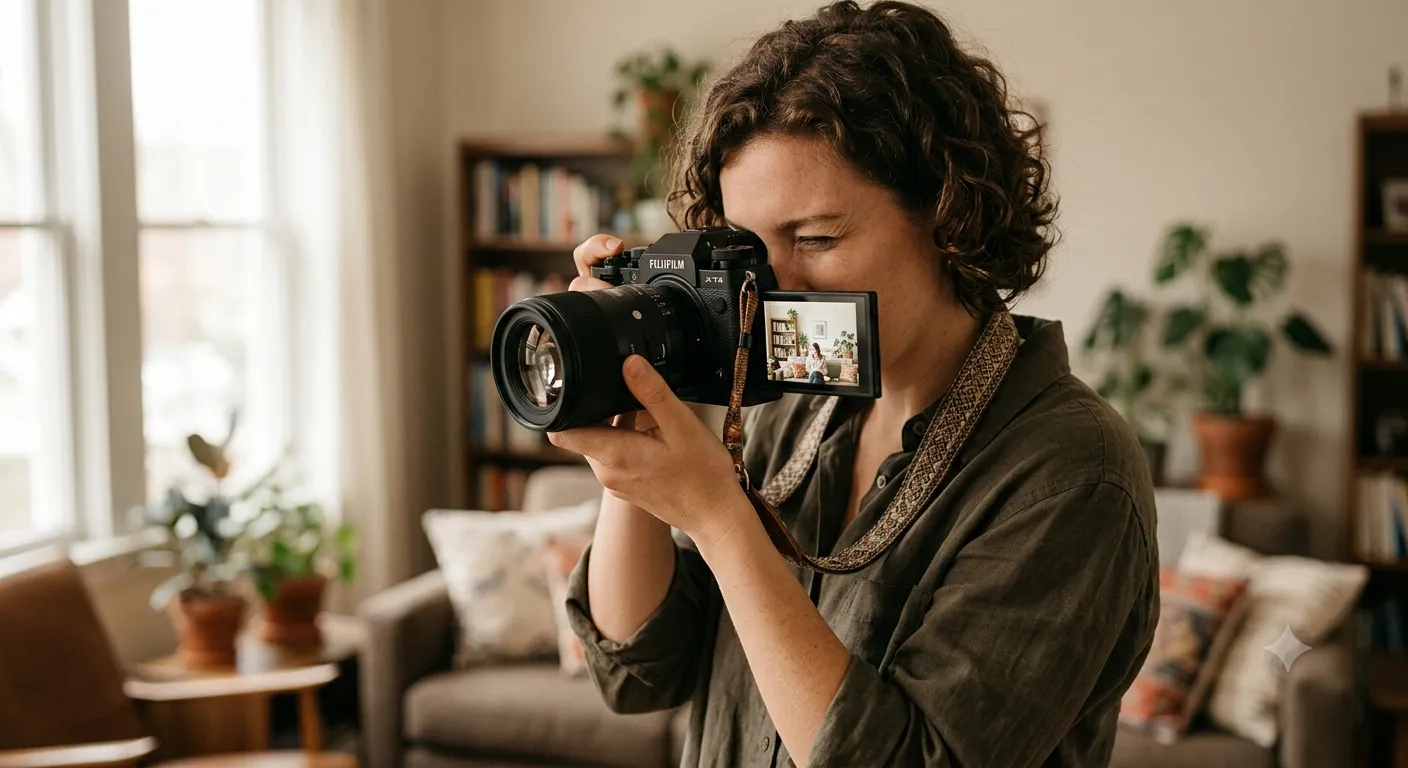


Shooting indoors without flash comes down to three settings working together: a wide aperture (f/1.4 to f/2.8), a shutter speed you can reasonably hand-hold without motion blur (roughly 1/60s to 1/125s for stills of people, faster for movement), and letting ISO rise as needed to fill the exposure gap, even into the 3200-6400 range on modern cameras, rather than fighting it to stay artificially low. Most beginners underexpose indoor shots because they're too cautious about raising ISO, ending up with dark, noisy images anyway after brightening them in editing, which is often worse than a clean shot captured correctly at a higher ISO in-camera.
The core challenge indoors is simply light volume — a typical living room, restaurant, or indoor wedding hall in Pakistan has a fraction of the light available outdoors, even with all the lights on. Flash solves this by adding light, but many photographers prefer to avoid flash for a softer, more natural look, or because flash isn't practical or welcome in certain settings like a formal dinner or a quiet indoor ceremony. Using a fast Sigma lens with a wide aperture can also help capture more available light while maintaining natural-looking results in these situations.
This guide covers exactly which settings to prioritize and why, how to choose gear that makes available-light indoor shooting genuinely workable, and how to handle the specific challenge of mixed or warm-toned indoor lighting common in Pakistani homes and venues.
What Aperture Should You Use for Indoor Photography Without Flash?
Aperture is your single biggest lever for gathering more light without a flash, since a wider aperture (a smaller f-number) lets proportionally more light reach the sensor for a given shutter speed and ISO. For available-light indoor work, apertures between f/1.4 and f/2.8 are the practical sweet spot — wide enough to let in meaningfully more light than a typical kit lens's f/3.5-5.6 range, while still leaving enough depth of field to keep more than just a single eyelash in focus.
This is exactly where fast prime lenses earn their reputation for indoor and event work. A lens like a 35mm F1.4 DG DN Art or 50mm F1.4 DG DN Art gathers roughly four times more light than an f/2.8 zoom at the same settings, which in practice can be the difference between a clean ISO 1600 shot and a noisy ISO 6400 shot in the same room. The trade-off is a shallower depth of field at very wide apertures, which takes some getting used to for group shots where you need enough people in focus.
Real scenario: A photographer shooting an indoor Eid family gathering in a Lahore living room lit only by ceiling lights and a couple of lamps found his kit zoom lens, maxing out at f/4, forcing ISO 6400 with visibly noisy, muddy shadows. Switching to a 30mm F1.4 DC DN prime for the rest of the evening let him drop to ISO 1600 at the same shutter speed, producing noticeably cleaner files with better shadow detail and color, though he did need to be more careful with focus accuracy on group shots given the shallower depth of field at f/1.4.
What Shutter Speed Keeps Indoor Shots Sharp Without a Tripod?
Shutter speed indoors is a balancing act between two kinds of blur: camera shake from your own hands, and subject motion blur if people are moving. The commonly cited hand-holding guideline is keeping shutter speed at least as fast as one over your focal length (so 1/50s for a 50mm lens, 1/100s for a 100mm lens), though image stabilization in the lens or camera body can often let you go a stop or two slower than that guideline while still getting sharp results.
For photographing people who are relatively still, indoor conversation, seated portraits, quiet moments, 1/60s to 1/125s is usually sufficient to avoid both camera shake and minor subject movement. For anyone moving more actively, kids playing, someone gesturing while talking, dancing at an indoor mehndi, you'll want to push shutter speed up to 1/250s or faster to freeze that motion cleanly, which means leaning more heavily on aperture and ISO to compensate for the light you're giving up.
Real scenario: A photographer covering an indoor mehndi function in Karachi initially shot at 1/60s to keep ISO manageable, but found dancing guests consistently came out with visible motion blur on hands and clothing even though faces looked reasonably sharp. Raising shutter speed to 1/250s for the dancing segments cleaned up the motion blur significantly, requiring ISO to climb higher than he'd have liked, but resulted in genuinely usable, sharp images instead of technically well-exposed but blurry ones.
How High Can You Push ISO Before Noise Becomes a Problem?
This depends heavily on your specific camera body, since sensor technology and noise handling vary significantly between models and generations, but as a general rule, most current mirrorless cameras produce very usable images up to ISO 3200, and many hold up reasonably well even at ISO 6400, particularly when exposure is accurate rather than underexposed and pushed up in editing afterward.
The mistake many photographers make is treating high ISO as something to avoid at nearly any cost, ending up with underexposed shots at ISO 800 or 1600 that then need heavy brightening in post-processing, which actually introduces more visible noise than if they'd simply shot at ISO 3200 correctly exposed in-camera to begin with. Noise from underexposure and correction is generally worse-looking than noise from a properly exposed high-ISO shot, because noise in shadows that get pushed brighter in editing is amplified along with the exposure correction.
| ISO Range | Typical Indoor Use Case | Noise Expectation (modern mirrorless) |
| 100–800 | Bright indoor rooms, large windows, daytime light | Minimal to no visible noise |
| 1600–3200 | Typical evening indoor lighting, most home/venue settings | Light, generally very usable noise |
| 3200–6400 | Dim indoor venues, restaurants, evening events without flash | Moderate noise, still usable especially in good light camera bodies |
| 6400+ | Very low light, last-resort settings | Noticeable noise, best reserved for when the shot matters more than perfect cleanliness |
Real scenario: A content creator filming an indoor product review in a Karachi apartment with only ambient window and lamp light kept ISO capped at 800 out of habit, resulting in underexposed footage he then brightened significantly in editing, revealing chunky, blotchy noise in the shadows. Letting ISO rise to 3200 for the same setup produced a properly exposed image straight out of camera with noticeably finer, less distracting noise, even though the ISO number itself looked higher on paper.

Does Lens Choice Matter More Than Camera Settings Indoors?
Settings can only work with the light your lens actually lets through, so lens choice genuinely compounds with your settings rather than being a separate concern. A camera body with excellent high-ISO performance paired with a slow kit lens still struggles more indoors than a modest camera body paired with a fast f/1.4 or f/1.8 prime, because the prime is doing real optical work to gather light before the sensor and ISO settings even come into play.
This doesn't mean every indoor shooter needs the widest, most expensive aperture available. An f/1.8 prime is meaningfully better than an f/3.5-5.6 kit zoom for indoor work while typically costing less than an f/1.4 equivalent, making it a reasonable middle ground for photographers on a budget who still want a real improvement over their kit lens. Zoom flexibility is also a genuine trade-off worth acknowledging — a fast zoom like an f/2.8 standard zoom gathers less light than a prime but offers framing flexibility a prime can't, which matters in tight indoor spaces where you can't physically move back.
Real scenario: A portrait photographer shooting indoor headshots for a small Lahore business used a 24-70mm F2.8 DG DN zoom for its framing flexibility across a cramped office space, accepting a stop less light than a prime would offer in exchange for not needing to physically reposition between wide environmental shots and tighter headshots. In a larger room with more space to move, a prime lens would likely have delivered cleaner low-light files, but the zoom's flexibility was worth the trade-off in that specific tight space.
Conclusion
Indoor, no-flash photography comes down to letting your aperture do as much work as your gear allows, choosing a shutter speed that matches how still or active your subject actually is, and treating ISO as a tool to use confidently rather than a number to minimize at all costs. Check what your widest usable aperture actually is before your next indoor shoot, and if you're regularly frustrated by noisy, dark indoor images, a fast prime lens paired with a willingness to shoot at ISO 3200 or higher will likely solve more of the problem than any amount of settings tweaking on a slower lens.
What's the best ISO setting for indoor photography without flash?
There's no single fixed number, it depends on your available light and camera body, but most modern mirrorless cameras handle ISO 1600-3200 very well for typical indoor evening lighting, with some bodies staying usable up to 6400 in genuinely dim conditions. Prioritize a correctly exposed shot at a higher ISO over an underexposed shot at a lower one.
Can I shoot indoors without flash using a kit lens?
Yes, but a typical kit lens's narrower maximum aperture (often f/3.5-5.6) means you'll need to push ISO significantly higher or accept slower shutter speeds to compensate, which increases both noise and motion blur risk. It's workable in brighter rooms but becomes genuinely limiting in dim indoor venues without flash.
Why do my indoor photos look grainy even at a moderate ISO?
Graininess at a moderate ISO usually means the shot was underexposed and then brightened in editing, which amplifies noise more than a correctly exposed shot at that same ISO would show. Try increasing ISO further in-camera to get a properly exposed image straight away rather than compensating for underexposure afterward.
Is a wide-angle or a standard focal length better for indoor photography without flash?
This depends more on the space and subject than on light-gathering ability, since both wide and standard focal lengths are available at fast apertures. Wide-angle focal lengths (24-35mm equivalent) suit tight rooms where you can't back up, while standard focal lengths (50mm) suit more natural-perspective portraits when you have a bit more space to work with.
Should I use auto ISO for indoor photography without flash?
Auto ISO can work well indoors since lighting often changes as you move through a room or event, letting the camera adjust ISO automatically while you control aperture and shutter speed manually. Just set a sensible maximum ISO limit in your camera's auto ISO settings so it doesn't push into an unusably noisy range without you noticing.


















Sign in to leave a comment.