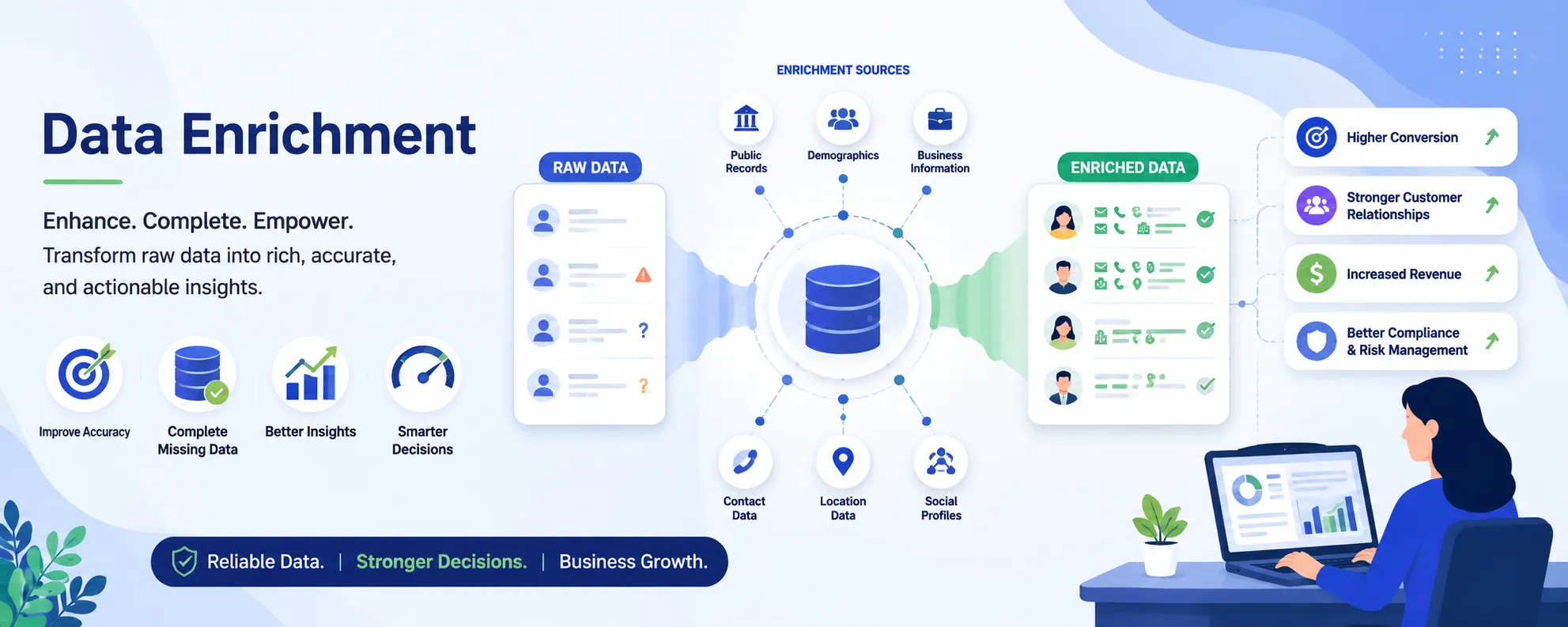

Data drives every modern business decision. But raw data alone is not enough. Incomplete, outdated, or inaccurate data can quietly damage your marketing performance, slow down your sales team, and lead to missed opportunities. This is why many organizations are increasingly investing in data enrichment services to improve the quality and reliability of their data.
Many organizations underestimate this risk. Research consistently shows that a large portion of CRM data becomes outdated within a year. Without reliable data enrichment services in place, sales teams waste time chasing the wrong leads, and marketing campaigns fail to reach the right audience.
This is where data enrichment becomes a competitive advantage. Data enrichment helps businesses transform raw datasets into meaningful, actionable insights. It fills in the missing gaps, validates existing records, and adds valuable context that improves decision making across teams.
What is Data Enrichment
Data enrichment is the process of enhancing existing data by adding new, relevant information. It transforms basic records into detailed, valuable profiles that enable better targeting, segmentation, and personalization.
For example, a simple contact record can be enriched with additional details such as company size, job role, industry, technology usage, and even purchase intent signals. This added context helps businesses make more informed decisions and deliver more relevant experiences.
Modern data enrichment typically includes several types of data:
- Firmographic data – Information about organizations, such as company revenue, industry, and employee count
- Demographic data – Personal attributes like location, age group, and gender
- Technographic data – Insights into the tools, software, and platforms being used
- Behavioral data – Data reflecting user actions, interests, and engagement patterns
As of 2026, data enrichment has evolved significantly. Businesses increasingly rely on real-time enrichment powered by artificial intelligence. Instead of relying on static, outdated records, modern systems continuously update and refine data to ensure accuracy, relevance, and timeliness.
Why Data Enrichment Matters More Than Ever
The modern business landscape has changed dramatically. Today’s buyers are better informed, competition is more intense, and personalization is no longer optional it’s a necessity.
Without enriched data, companies often struggle to:
- Reach the right audience
- Deliver relevant and personalized experiences
- Convert leads into paying customers
- Maintain efficient and scalable sales pipelines
In contrast, organizations that invest in data enrichment gain a significant competitive advantage. They achieve higher engagement rates because their messaging is timely and relevant. Sales teams close deals faster with access to deeper, more accurate insights. Marketing campaigns perform better due to precise targeting and segmentation.
In simple terms, data enrichment removes guesswork and enables businesses to make confident, data-driven decisions at every stage of the customer journey.
How We Selected These Companies
Choosing the right data enrichment partner can be overwhelming. With hundreds of tools and service providers available each claiming to offer the best solution making the right choice requires careful evaluation.
To simplify this process, we assessed companies based on several practical and performance-driven criteria.
First, we prioritized data accuracy, as outdated or incorrect information undermines the entire purpose of data enrichment. We then evaluated integration capabilities to ensure these tools work seamlessly with CRM systems and marketing platforms.
Next, we considered scalability, focusing on whether each provider can support growing data volumes and evolving business needs. We also analyzed pricing models, global data coverage, and industry specialization to understand the overall value each company delivers.
This structured approach ensures that the companies listed are not only popular, but also reliable, scalable, and effective for real-world use.
15 Best Data Enrichment Companies in 2026
1. HabileData
HabileData is a leading provider of full-service data enrichment and data processing solutions. It supports large volumes of B2B and B2C enrichment through structured workflows and experienced teams.
HabileData delivers services such as data enrichment, cleansing, standardization, normalization, and attribute appending. It also handles manual research, catalog enrichment, and CRM data hygiene.
It is widely used across industries including eCommerce, real estate, healthcare, and financial services.
2. Hitech BPO
Hitech BPO brings over two decades of experience in data management and enrichment. It supports global clients with large-scale data cleansing, validation, and processing operations.
The company is known for its accuracy, consistency, and ability to manage ongoing enrichment needs. It also provides manual verification when automated systems fall short.
It is trusted by enterprises requiring long-term, high-volume data support.
3. ZoomInfo
ZoomInfo is one of the most widely used B2B data platforms, offering extensive coverage of companies and decision-makers across global markets. It is a powerful solution for both sales and marketing teams.
The platform combines firmographic, technographic, and intent data in a single system, delivering deep insights into organizational structures and buying signals.
It integrates seamlessly with major CRM platforms, helping teams automate engagement and outreach.
4. Clearbit
Clearbit is well known for its real-time data enrichment capabilities. Companies use it to personalize customer journeys the moment a visitor interacts with their website or product.
It integrates easily with marketing automation tools and CRMs, ensuring instant data updates and improved workflow efficiency.
Clearbit is especially popular among SaaS companies that rely heavily on automation and personalization.
5. Cognism
Cognism specializes in providing high-quality, compliant data, with strong coverage in European markets where data privacy regulations are strict.
The platform ensures businesses can access accurate contact data while maintaining compliance with global data protection standards.
It is a trusted solution for companies operating in regulated environments and global markets.
6. Apollo.io
Apollo.io offers a powerful combination of data enrichment and outreach tools within a single platform. It enables teams to manage prospecting, enrichment, and engagement without switching between multiple tools.
The platform is known for its affordability and ease of use, making it especially attractive for startups and small businesses.
7. Lusha
Lusha provides simple and efficient data enrichment solutions designed for ease of use. Its browser extension allows users to access contact data instantly while browsing professional profiles.
This makes it particularly useful for sales teams that require quick insights during prospecting.
8. Experian
Experian brings decades of expertise in data analytics, validation, and credit intelligence. It offers highly accurate consumer and business data along with risk and compliance solutions.
Large enterprises and financial institutions rely on Experian for mission-critical data operations.
9. Dun & Bradstreet
Dun & Bradstreet is a well-established leader in business intelligence and data enrichment. Its global database provides deep insights into companies across industries.
The platform is widely used for risk assessment, compliance, and strategic decision-making.
10. People Data Labs
People Data Labs offers extensive datasets focused on individual-level information. It is designed for developers and data teams that require flexible APIs to build custom applications.
The platform enables businesses to enrich and scale their data infrastructure efficiently.
11. FullContact
FullContact specializes in identity resolution, helping businesses unify customer data across multiple channels.
By creating a single, complete customer profile, it enables more accurate targeting and personalization.
12. UpLead
UpLead is known for its strong emphasis on data accuracy. It verifies data in real time, ensuring users receive reliable and up-to-date information.
This makes it a practical and dependable choice for small and medium-sized businesses.
13. Hunter.io
Hunter.io focuses on email enrichment and verification. It is simple, effective, and widely used by outreach and sales teams.
The platform helps businesses quickly find and validate professional email addresses.
14. Kaspr
Kaspr integrates with professional networking platforms to capture real-time contact data.
It is particularly effective for teams targeting European markets and looking for quick prospecting solutions.
15. Leadspace
Leadspace uses artificial intelligence to enrich, segment, and unify customer data. It helps enterprises deliver highly personalized experiences at scale.
The platform is designed to support complex data environments and advanced marketing strategies.
Key Trends Shaping Data Enrichment in 2026
Data enrichment is evolving rapidly as technology continues to advance and business expectations grow.
Artificial intelligence (AI) has become central to modern enrichment processes. It enables systems to predict missing data, automate data mapping, and significantly improve overall accuracy and efficiency.
Real-time enrichment is increasingly replacing traditional batch processing. Businesses now expect instant data updates, allowing them to act on the most current and relevant information without delays.
Data privacy regulations are playing a critical role in shaping how data is collected, processed, and used. Organizations are prioritizing compliance and adopting more ethical, transparent data practices to build trust and avoid regulatory risks.
First-party data is becoming more valuable than ever. Instead of relying solely on third-party sources, companies are investing in enriching their own datasets to ensure higher quality, better control, and long-term sustainability.
In summary, data enrichment in 2026 is defined by speed, intelligence, compliance, and a stronger focus on owned data assets.
How to Choose the Right Data Enrichment Partner
Selecting the right data enrichment provider depends on your specific business goals, resources, and operational needs. Start by identifying your primary use case, whether it is sales prospecting, marketing automation, or customer analytics. This helps narrow down providers that specialize in your area of focus.
Next, consider the scale of your data. Large enterprises often require robust, feature-rich platforms capable of handling high data volumes, while smaller teams may benefit from simpler, more cost-effective tools. It is also important to evaluate integration capabilities. The chosen solution should seamlessly fit into your existing technology stack, including CRM systems and marketing platforms, to ensure smooth workflows.
Additionally, focus on balancing cost with value. Lower-cost options may seem attractive, but they may not deliver the level of accuracy, depth, or reliability your business requires.
Many organizations achieve the best results by combining technology platforms with service providers, leveraging both automation and human expertise for optimal data quality.
In summary, the right partner is one that aligns with your goals, scales with your growth, and delivers consistent, high-quality data.
Common Challenges and How to Overcome Them
While data enrichment offers significant benefits, it also comes with a set of challenges that businesses must address to maximize its effectiveness.
Data decay is one of the most common issues. Information can quickly become outdated, reducing its accuracy and usefulness. Implementing real-time enrichment helps ensure that data remains current and reliable.
Integration complexity is another challenge, especially when working with multiple systems. Choosing platforms with strong API capabilities and seamless integrations can significantly simplify implementation and ongoing operations.
Privacy and compliance concerns are becoming increasingly important as data regulations evolve. Partnering with providers that adhere to strict data protection standards helps minimize risk and ensures responsible data usage.
Cost constraints can also be a barrier, particularly for smaller organizations. Adopting a hybrid approach combining automated tools with outsourced services can help optimize costs while maintaining data quality.
In summary, addressing these challenges with the right strategies and tools enables businesses to fully leverage the power of data enrichment.
Conclusion
In today’s data-driven world, quality matters far more than quantity. Having large volumes of data is not enough what truly drives results is how accurate, complete, and actionable that data is.
Data enrichment enables businesses to unlock the full potential of their data by enhancing its depth, reliability, and relevance. It empowers organizations to make smarter decisions, improve customer targeting, and deliver more personalized experiences.
The companies highlighted in this guide offer a wide range of solutions from enterprise platforms to specialized tools and service providers each designed to address different business needs and use cases.
Choosing the right partner can significantly transform your sales, marketing, and decision-making processes.
Because when your data improves, your entire business performs better.
Frequently Asked Questions
What is data enrichment and why is it important for businesses?
Data enrichment is the process of enhancing existing data by adding new, relevant information, transforming basic records into detailed profiles. It is important because it helps businesses reach their target audience more effectively, deliver personalized experiences, and make informed decisions, ultimately leading to increased sales and marketing performance.
How does data decay affect business operations?
Data decay refers to the rapid obsolescence of information, with a significant portion of CRM data becoming outdated within a year. This can lead to wasted resources as sales teams pursue incorrect leads and marketing campaigns fail to connect with the right audience, ultimately hindering business growth.
What types of data are typically included in data enrichment?
Data enrichment often includes several types of data such as firmographic data (like company revenue and industry), demographic data (personal attributes such as age and location), technographic data (insights into tools and software used), and behavioral data (user actions and engagement patterns).
How can businesses choose the right data enrichment partner?
Choosing the right data enrichment partner involves assessing your specific business needs, evaluating data accuracy, integration capabilities, scalability, and pricing models. It’s essential to find a provider that aligns with your goals and can deliver consistent, high-quality data.
What challenges do businesses face with data enrichment?
Common challenges include data decay, integration complexities, privacy and compliance concerns, and cost constraints. To overcome these issues, businesses can implement real-time enrichment, choose platforms with strong integration capabilities, and adopt a hybrid approach that combines automated tools with human expertise.
What role does artificial intelligence play in modern data enrichment?
Artificial intelligence is central to modern data enrichment processes, enabling systems to predict missing data, automate data mapping, and improve overall accuracy and efficiency. This use of AI allows businesses to receive real-time updates and insights, enhancing their decision-making capabilities.
Why is first-party data becoming more valuable for businesses?
First-party data is increasingly valuable because it allows businesses to have better control over their data quality and ensures compliance with data privacy regulations. By investing in enriching their own datasets, companies can achieve more reliable insights and foster long-term sustainability.



























Sign in to leave a comment.