
Choosing the wrong iGaming marketing agency is one of the most expensive mistakes a new operator can make before launch. This guide breaks down how to choose the right iGaming marketing agency, which ones are worth shortlisting in 2026, what you should expect to pay, and the warning signs that should end a pitch early.
Most iGaming startups don't fail because the product is weak. They fail because nobody discovered the brand, and the handful of players who did find it never turned into depositors.
You can have a sharp brand, a solid platform, and a competitive bonus structure, and still burn through your first six months buying players at a cost you can't sustain. Acquisition costs across the sector have climbed hard. Regulators across Europe have handed out tens of millions in fines for marketing that broke compliance rules. For an early-stage operator, one mistake like that can be enough to end the business.
So the choice of agency carries more weight than most founders admit. What follows is a working assessment of the agencies worth evaluating this year, and the criteria that should shape your shortlist.
What an iGaming Marketing Agency Should Do for a Startup
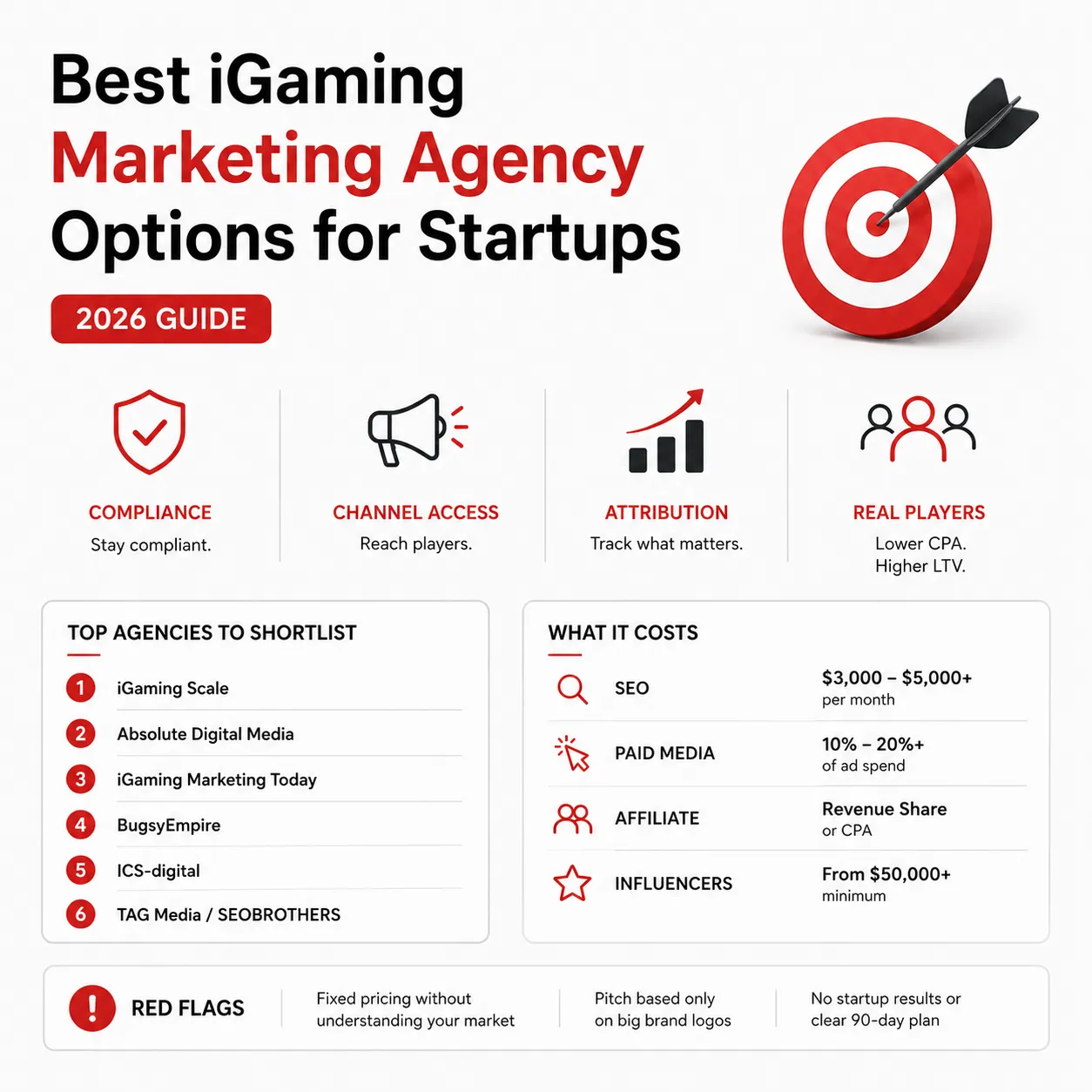
A new operator faces three problems a generalist agency is rarely built to solve: compliance, channel access, and attribution. A specialist iGaming marketing agency exists precisely to close those three gaps.
Compliance comes first. Gambling advertising is regulated differently in every jurisdiction, and one prohibited campaign can put your license at risk. Channel access comes second. Platforms like Google and Meta require whitelisting and approved accounts before a gambling brand is allowed to advertise at all. Attribution comes third. Traffic on its own is close to worthless. What matters is your cost per first-time depositor and the lifetime value of that player.
If a gambling marketing agency can't speak to all three with confidence, cut it early.
Why this matters, in numbers
To put the stakes in context, here's what the gap between a specialist and a generalist setup tends to look like at the startup stage, based on patterns we see repeatedly with pre-launch operators:
- A generalist campaign launched without platform whitelisting is often rejected within days, costing 3 to 6 weeks of lead time before a single compliant impression runs.
- Cost per first-time depositor on a poorly attributed campaign can read 40 to 60 percent lower than reality, because deposits get credited to the wrong channel and budget flows to the wrong place.
- Operators who set up SEO and whitelisting before launch typically reach their first stable cohort of depositors months ahead of those who wait until go-live, and at a materially lower blended acquisition cost.
The takeaway isn't the exact figures, which move by market. It's that the cost of choosing the wrong iGaming marketing agency shows up in weeks lost and budget misread, not just in the retainer.
How This Shortlist Was Built
These aren't ranked by size or ad-spend headlines. The filter was simple: real track record with early-stage or regulated operators, clear specialism, and a scope that fits a startup rather than a $50M incumbent. Each pick below is framed by what it's actually best for, so you can match it to your stage instead of chasing the biggest logo.
The iGaming Marketing Agencies Worth Shortlisting
iGaming Scale Built specifically around the pre-launch and startup stage. It runs a hybrid model that blends consulting, execution, and operational outsourcing, and it takes on operators who sit below the minimum thresholds larger agencies set. Best for founders who need strategy and delivery from a single partner.
Absolute Digital Media A UK agency with a team of 35-plus specialists and deep regulated-market knowledge. It has worked with brands including 888 Casino and Jackpot247, and has invested early in LLM and AI-search optimisation. Best for operators targeting the UK market with a long-term organic focus.
iGaming Marketing Today A sector-focused agency running out of Tbilisi and Dubai, covering paid media, SEO, social, website management, and UI/UX for operators, platforms, and affiliates. Its work includes whitelisted ad accounts and compliant campaign setup. Best for startups that need early, rules-compliant visibility on the major ad platforms.
BugsyEmpire A paid media and creative specialist managing more than $150M in annual ad spend across 100-plus brands. Its focus sits on MarTech setup, whitelisting, and full-funnel optimisation, with real strength in social, sweepstakes, and real-money gaming. Best for operators pushing into the US market.
ICS-digital The multilingual specialist of the group, with two decades serving operators, affiliates, and studios across many markets. It supports startups alongside clients like bet365 and Betway. Best for operators planning international expansion from the outset.
TAG Media and SEOBROTHERS For affiliate-led growth, still one of the most cost-efficient acquisition routes in iGaming, both are credible, award-winning options with genuine affiliate-network depth. Best for startups that want to pay for performance rather than upfront spend.
What It Costs
Pricing in this sector isn't standardised. Any agency willing to quote a fixed figure before it understands your target market is a red flag, not a convenience.
As a rough guide, dedicated iGaming SEO engagements often start around $3,000 to $5,000 a month, with senior or multi-market scopes running higher. Paid-media management usually works on a percentage of ad spend, commonly 10 to 20 percent of the monthly budget, on top of a base retainer. Affiliate deals run on revenue-share or CPA terms. Influencer and creator campaigns at the larger agencies can carry minimum commitments in the region of $50,000.
A startup doesn't need the biggest retainer. It needs the right scope, and an agency honest enough to tell you where not to spend.
Red Flags Founders Should Watch For
Plenty of founders choose on client logos alone.
A wall of recognisable casino brands looks reassuring. But servicing a $50M operator and launching a startup are completely different jobs, and an agency built for the first often has no patience for the constraints of the second. A better signal is client retention paired with named startup outcomes: an agency that can point to a specific brand it took from launch to traction, not just a grid of logos.
One question tends to separate strategists from order-takers. Ask what they'd advise an operator not to do in its first 90 days. The answer tells you whether they think, or just execute.
What to Watch in 2026
The ground is shifting. AI Overviews and LLM-powered search are changing how players find brands, and Google has started openly classifying attempts to game generative-AI results as spam. An agency still running a 2019 playbook of keyword stuffing and directory submissions will slowly erode your visibility rather than build it.
The agencies set to win the next cycle are the ones already building for three things at once: AI search, regulated-market compliance, and deposit-level attribution. For a startup choosing a partner this year, that combination isn't a nice-to-have to weigh up. It's the line your shortlist should be drawn on.
The real question for any new operator in 2026 is which capability matters more to you: an agency with a deep command of your target market, or one that can scale spend fastest once you go live.
Wherever you land, start with a scoped audit and a clear 90-day plan before you commit to any iGaming marketing agency retainer.
Frequently Asked Questions
When should an iGaming startup hire a marketing agency?
Before launch, not after. Whitelisting on Google and Meta, compliance approval, and SEO foundations all take time to set up. An operator who waits until go-live gives away its earliest and most valuable months, and usually pays more later to make up the lost ground.
How much should a new iGaming operator budget for marketing?
It depends mostly on your channel mix. SEO retainers commonly start between $3,000 and $5,000 a month. Paid-media management often runs at 10 to 20 percent of ad spend on top of a base fee. Affiliate deals work on revenue-share or CPA. A leaner startup is almost always better served by one focused channel than by spreading a thin budget across several.
Is a specialist iGaming marketing agency better than a general digital agency?
For a regulated gambling brand, the specialist wins almost every time. Compliance, platform whitelisting, and affiliate-network access all depend on industry-specific knowledge a generalist rarely has, and mistakes in those areas can put your license at risk.
What's the single biggest warning sign when choosing an agency?
Two, really. A fixed price quoted before the agency understands your market, and a pitch built entirely on big-brand logos with no startup outcomes behind them. Both mean your actual stage and constraints haven't been taken seriously.
Do iGaming startups still need affiliates in 2026?
Yes. Affiliate marketing is still one of the most cost-efficient acquisition channels in the sector because it pays for performance, not upfront spend. For a startup with limited capital, that risk profile is hard to beat.






















Sign in to leave a comment.