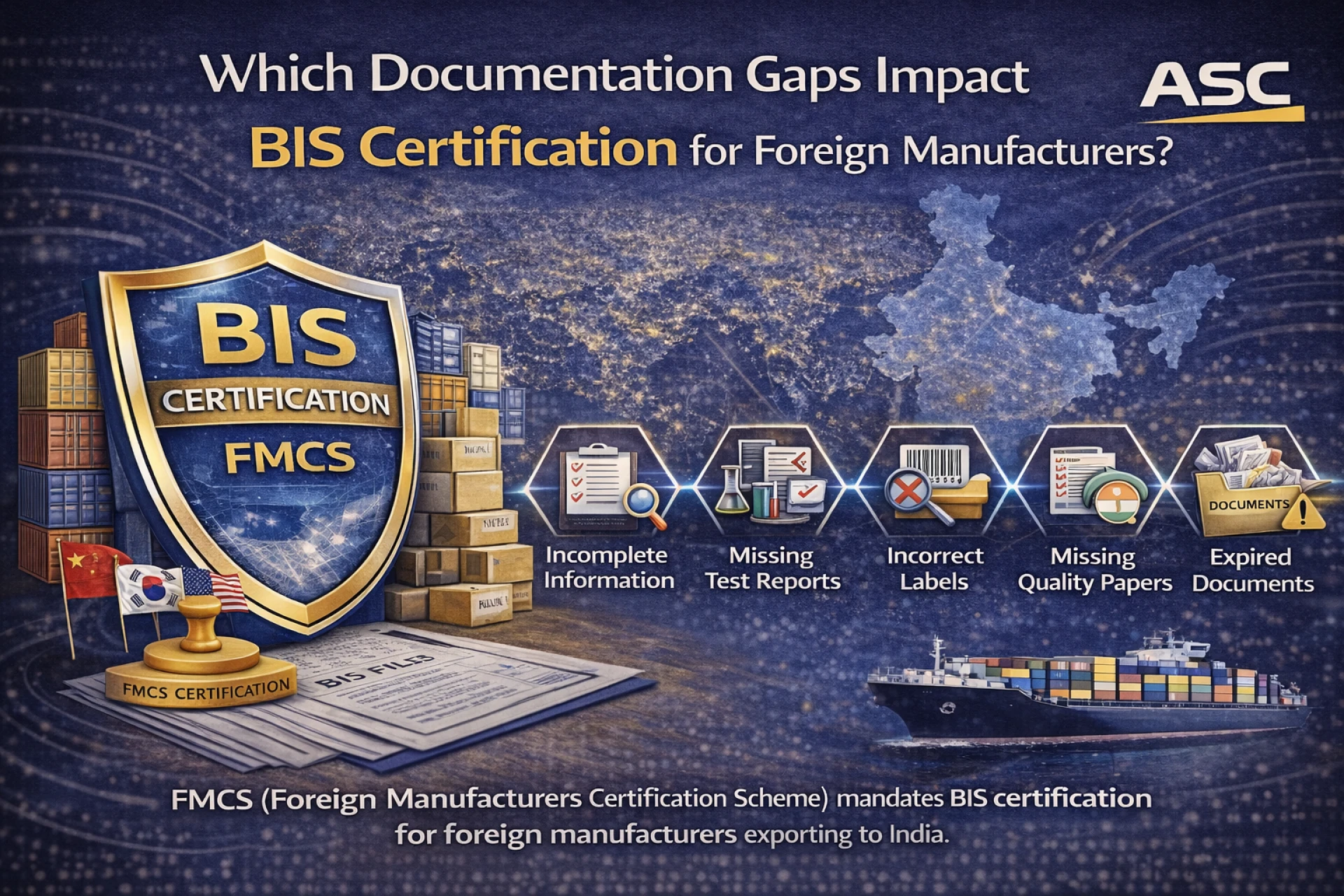

In 2026, bis certification for foreign manufacturers, FMCS Certification has become a critical regulatory requirement for overseas companies exporting regulated products to India. Under the BIS FMCS framework (Foreign Manufacturer Certification Scheme), manufacturers must meet strict documentation, inspection, and quality compliance standards before receiving approval.
However, documentation gaps remain one of the leading causes of delay and rejection under FMCS BIS applications. Industry observations suggest that nearly 30% of FMCS applications face clarification notices due to incomplete or inconsistent documentation. Without structured support from experienced FMCS Consultants, foreign manufacturers may experience extended approval timelines and additional compliance costs.
This blog outlines the key documentation gaps that impact approval and explains how ASC Group addresses them.
Why Documentation Accuracy Matters in FMCS Certification
Before exploring specific gaps, it is important to understand the consequences of poor documentation:
- Delay in scheduling factory inspections
- Additional queries from BIS authorities
- Rejection of application under BIS FMCS
- Increased re-testing and administrative costs
- Loss of distributor confidence in India
- Shipment delays affecting market entry
Proper documentation is not just procedural—it determines approval efficiency.
Common Documentation Gaps Affecting BIS Certification for Foreign Manufacturers
1. Incomplete Authorized Indian Representative (AIR) Documents
The Gap
Foreign manufacturers must appoint an Authorized Indian Representative with valid authorization documents.
Common errors include:
- Missing notarized authorization letter
- Incorrect contact details
- Incomplete legal agreements
Impact
Applications cannot proceed without valid AIR documentation.
ASC Group Solution
ASC Group ensures proper drafting, validation, and submission of AIR documents aligned with BIS FMCS requirements.
2. Inconsistent Factory Address Details
The Gap
Mismatch between:
- Business registration certificates
- Factory licenses
- Test reports
- Application forms
Impact
Triggers clarification notices and inspection delays.
ASC Group Solution
Cross-verification of all corporate and factory documents before submission prevents inconsistencies.
3. Missing Quality Control Documentation
The Gap
BIS requires detailed quality system records, including:
- Process flow charts
- In-house testing reports
- Calibration certificates
- Quality manuals
Many foreign manufacturers overlook Indian documentation format expectations.
Impact
Inspection readiness concerns and approval delays.
ASC Group Solution
ASC Group conducts pre-inspection documentation audits and aligns global quality systems with FMCS Certification requirements.
4. Expired or Incomplete Test Reports
The Gap
Test reports must:
- Be from BIS-recognized laboratories
- Match exact product models
- Remain within validity period
Impact
Invalid reports lead to re-testing and extended timelines.
ASC Group Solution
Technical verification of reports and coordination with approved labs ensure compliance accuracy.
5. Incorrect Product Labeling & Marking Artwork
The Gap
Label samples often fail to reflect:
- Proper ISI Mark placement
- Manufacturer details
- Country of origin
- BIS license number format
Impact
Market surveillance issues and approval hold-ups.
ASC Group Solution
ASC Group reviews and aligns labeling artwork with BIS FMCS marking guidelines before submission.
6. Lack of Production Capacity Evidence
The Gap
Authorities require proof of consistent manufacturing capability.
Common omissions include:
- Machinery lists
- Production flow documentation
- Batch testing records
Impact
Inspection concerns about production readiness.
ASC Group Solution
Structured documentation preparation demonstrating capacity and quality consistency.
7. Incomplete Legal Declarations & Undertakings
The Gap
Affidavits and declarations confirming compliance are often improperly drafted.
Impact
Procedural delays and resubmission requirements.
ASC Group Solution
Preparation of legally sound declarations aligned with FMCS BIS norms.
Key Question
Why Do Foreign Manufacturers Face Higher Documentation Scrutiny?
The reason lies in cross-border regulatory coordination. Authorities must ensure that overseas factories meet Indian safety standards consistently. Documentation serves as proof of compliance and traceability.
Without structured preparation, gaps become compliance obstacles.
Strategic Documentation Roadmap for FMCS Certification
To minimize risk, foreign manufacturers should follow:
- Early regulatory gap analysis
- Centralized documentation compilation
- Quality system alignment review
- Pre-inspection readiness audit
- Continuous compliance monitoring
Structured planning significantly improves approval timelines.
Risks of Inadequate FMCS Documentation
Without professional support, companies may experience:
- 20–40% increase in approval timelines
- Additional inspection costs
- Re-testing expenses
- Import shipment delays
- Regulatory enforcement exposure
Preventive compliance reduces financial and operational uncertainty.
How ASC Group Supports BIS FMCS Compliance
ASC Group provides comprehensive support for bis certification for foreign manufacturers under the FMCS Certification framework, including:
- Complete documentation review and validation
- AIR appointment assistance
- Laboratory coordination
- Pre-inspection preparation
- Labeling and marking alignment
- Ongoing compliance advisory
As experienced FMCS Consultants, ASC Group bridges international manufacturing practices with Indian regulatory expectations.
Why Professional Guidance Is Essential
The BIS FMCS process involves:
- Cross-border legal documentation
- Technical product evaluation
- Inspection coordination
- Continuous compliance monitoring
Expert support ensures faster approvals and reduced rejection probability.
Conclusion
Documentation gaps are one of the most significant barriers to successful bis certification for foreign manufacturers, FMCS Certification approval. From AIR authorization errors to incomplete quality records, even minor inconsistencies can delay the issuance of approval under FMCS BIS.
With structured support from ASC Group, foreign manufacturers can eliminate documentation risks, strengthen inspection readiness, and achieve timely BIS FMCS approval. Proper documentation is not merely administrative—it is the foundation of successful market entry into India.


























Sign in to leave a comment.