
The Aircraft Crashes, but the Memory Board Survives Here Is Why
You are sitting across an exam table, staring at a Science and Technology statement in Prelims. It asks about modern aviation safety devices and how underwater locator beacons function after an impact. You remember reading news headlines about aviation accidents, but when UPSC frames a multi-statement conceptual question, the surface-level facts vanish from your head.
That scenario happens to thousands of aspirants every year. Science and Tech questions in UPSC Prelims rarely ask for basic definitions; they focus on operational mechanisms, material properties, and regulatory bodies.
When you analyze any black box upsc topic, you realize it isn't just about aviation history it sits right at the intersection of physics, material science, and international aviation standards. Understanding how a black box flight recorder upsc theme can be tested will help you clear up confusion and secure crucial marks in your GS Paper 1.
What Exactly Is a Flight Recorder? (And Why Isn't It Black?)
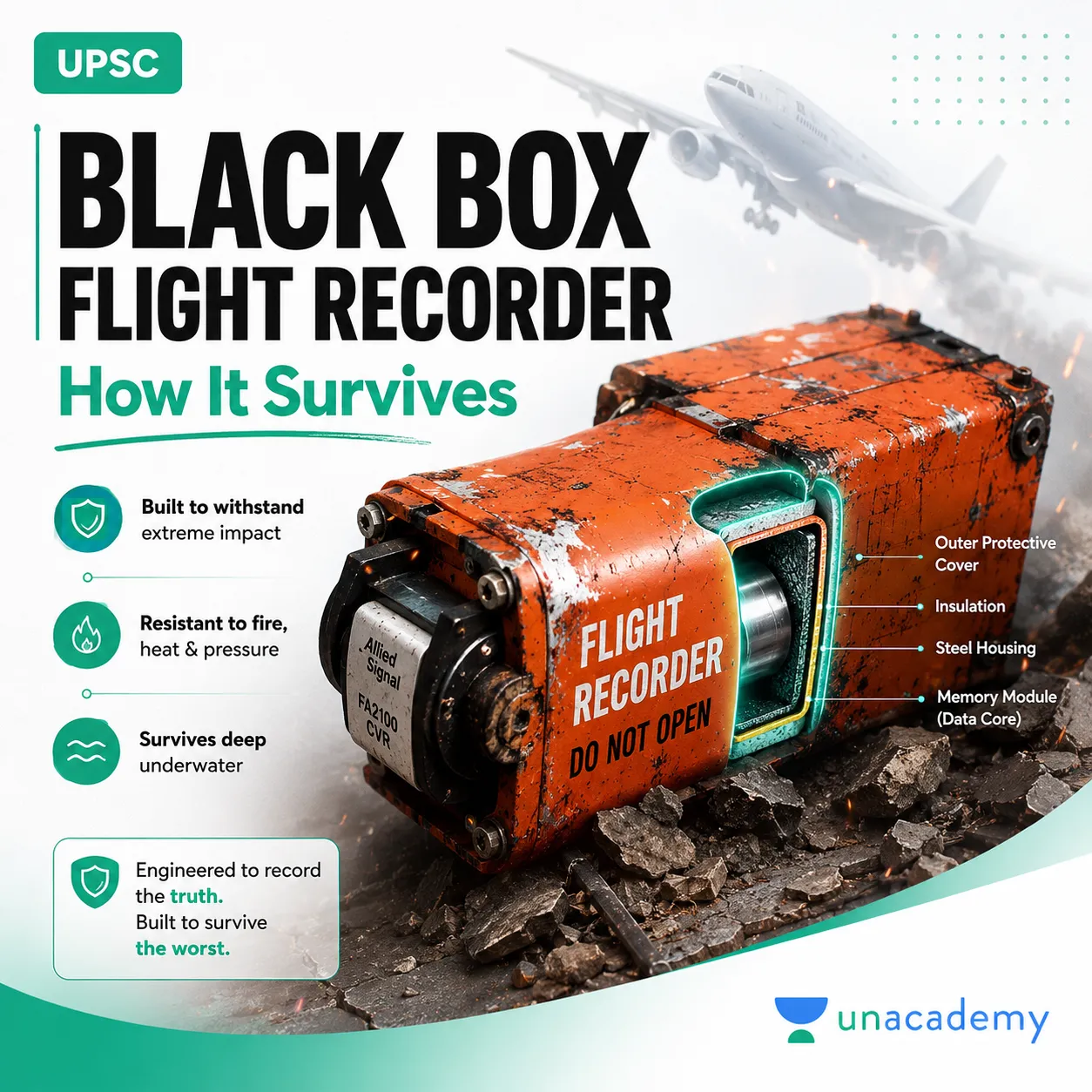
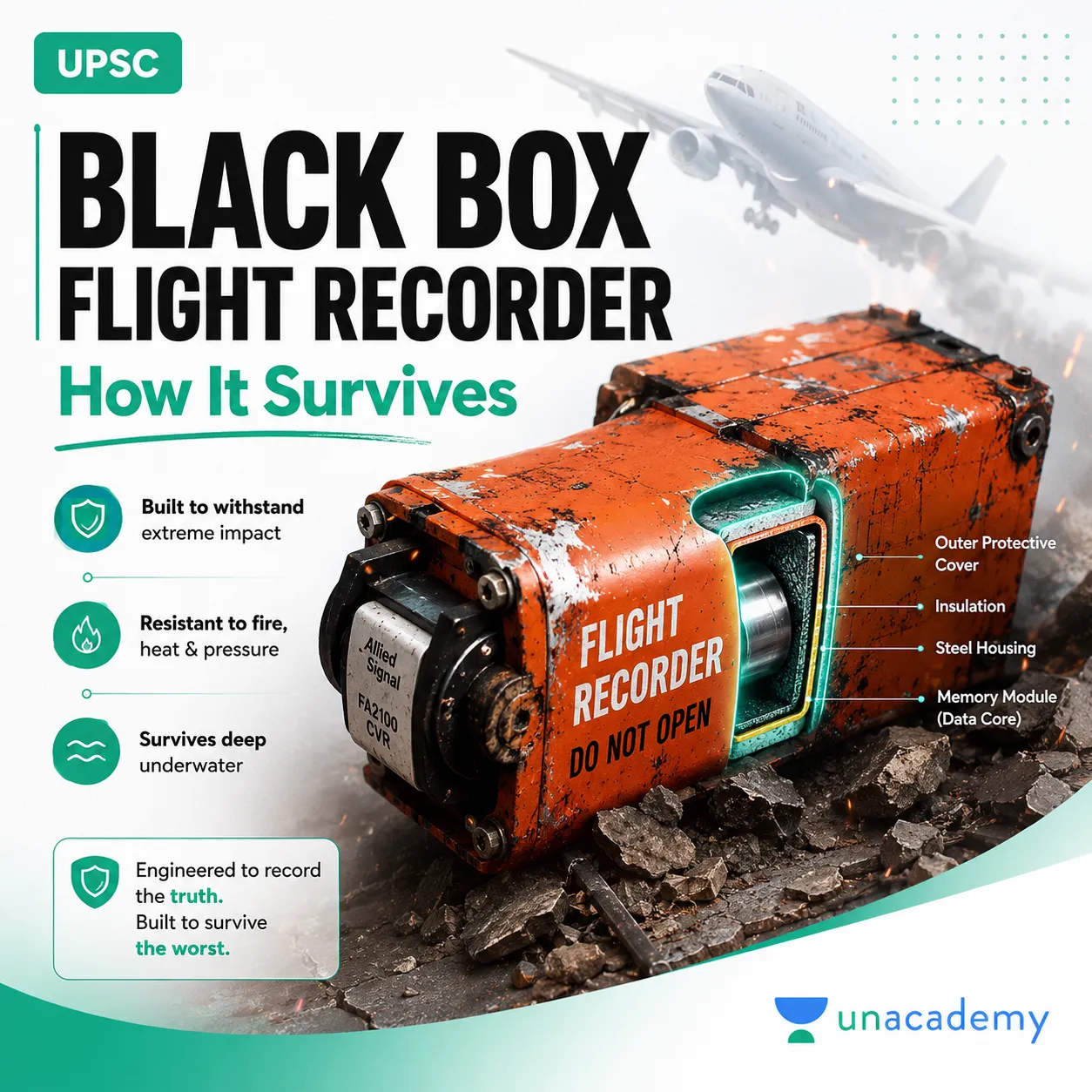
Despite its famous nickname, a flight recorder is bright international orange. The bright color makes it visible to search and rescue teams amid dark ocean trenches, dense forest canopies, or charred wreckage.
The Dual Architecture: CVR vs. FDR
Every commercial aircraft carries two separate recording units, though modern planes sometimes combine them into a single Cockpit Voice and Data Recorder (CVDR).
- Cockpit Voice Recorder (CVR): Captures ambient noise, radio communications, cockpit conversation, and engine sounds. Older tape based CVRs recorded 30 minutes on a loop, but modern solid-state units retain at least 2 hours and often up to 25 hours of high-quality audio.
- Flight Data Recorder (FDR): Records technical operational parameters. We are talking about pitch, roll, altitude, airspeed, engine performance, flap positions, and autopilot status. Modern FDRs monitor over 1,000 distinct data streams simultaneously.
To tackle a potential black box prelims question, you must remember that both devices store data in solid-state memory boards rather than mechanical tapes, eliminating moving parts that could break during impact.
How Does It Survive Extreme Heat, Pressure, and Water?
How does delicate electronic memory survive a 500-knot crash, a fuel fire burning at $1,100^\circ\text{C}$, and pressure at the bottom of the sea? Engineering design makes this possible through three layers of protection wrapped around the Crash-Survivable Memory Unit (CSMU).
1. The Armor Stack
- Outer Housing: Heavy-duty stainless steel or titanium alloy protects the internal electronics from sharp fragments and crushing force.
- Thermal Insulation: High-density dry thermal insulation surrounds the memory unit. During an intense fuel fire, this layer absorbs heat so the internal temperature around the memory chips remains safe.
- Impact Shield: A thick aluminum housing sits directly inside the outer wall to absorb kinetic impact energy.
2. The Testing Standards
To receive aviation certification, a recorder must endure extreme conditions:
- Impact Shock: 3,400\ g of force for 6.5 milliseconds (equivalent to hitting a concrete wall at hundreds of miles per hour).
- Penetration Resistance: A 227 kg drop-weight with a hardened steel pin dropped from 3 meters directly onto the unit.
- Static Crush: Continuous compressive pressure of 22.25 kN (approx. 5,000 lbs) applied across all axes.
- High-Temperature Fire: Continuous exposure to 1,100 \circ\C open flame for 60 minutes, followed by 260 circ\C heat for 10 hours.
- Deep-Sea Pressure: Submersion in salt water up to a depth of 6,000 meters (approx. 20,000 feet), where pressure exceeds 60 MPa.
3. The Underwater Locator Beacon (ULB)
When immersed in water, the recorder's Underwater Locator Beacon activates automatically. A water sensor touches liquid, completing a circuit that powers an acoustic pinger. The beacon emits an ultrasonic pulse at 37.5 kHz once every second for up to 90 days. Humans cannot hear this frequency, but specialized hydrophones mounted on search ships can detect it from miles away.
How UPSC Frames Questions on Aviation & Defense Tech
When solving any black box upsc question, don't just memorize the parameters. UPSC test writers test your ability to spot subtle misdirection.
Key Exam Dimensions
| Feature | Technical Reality | Common Test Distractor |
|---|---|---|
| Color | Bright International Orange | Stated as "matte black for stealth" |
| Placement | Tail / Rear section of aircraft | Stated as "inside the main cockpit" |
| Pinger Activation | Water contact completes acoustic circuit | Stated as "GPS-based satellite transmission" |
| Regulatory Authority | DGCA (India) / ICAO (Global) | Stated as "ISRO / DRDO defense protocol" |
The location of the recorder matters significantly. Aircraft tails experience the lowest impact forces during a nose-first crash, which is why technicians mount both units near the tail assembly.
Things You Should Know: Common UPSC Pitfalls
When tackling a black box upsc query, keep these common traps in mind:
Pitfall 1: Confusing GPS signal with Acoustic Pingers.
GPS signals cannot travel through miles of ocean water. The beacon uses sound waves (37.5 kHz} acoustic pulses), not radio waves or satellite signals, to locate submerged wreckage.
Pitfall 2: Assuming real-time cloud data streaming is mandatory globally.
While satellite streaming of telemetry data is being introduced under ICAO’s Global Aeronautical Distress and Safety System (GADSS), full real-time cloud streaming for every commercial flight is not yet universal due to bandwidth and cost limits.
Pitfall 3: Mixing up regulatory jurisdiction.
In India, the Aircraft Accident Investigation Bureau (AAIB) operating under the Ministry of Civil Aviation handles accident investigations, while the Directorate General of Civil Aviation (DGCA) manages regulatory compliance.
Aspirant Experiences: Connecting Theory to the Prelims Paper
Here is how fellow aspirants approached Science and Tech topics during their preparation:
"I used to skip hardware details in tech news, thinking UPSC only asked about AI or biotechnology. But in Prelims, statement-based options test the underlying mechanics—like frequency bands, material properties, or energy sources. Drawing a simple block diagram of CVR vs. FDR during my revision made all the difference."
— Rohan V., Clearer of CSE Prelims 2025
"When solving previous year papers, I realized UPSC loves testing 'counter-intuitive facts'. Everyone knows the term 'black box', but knowing it's orange, placed in the tail, and uses sound pulses underwater is what actually earns you the two marks."
— Priya M., UPSC Candidate (2026 Attempt)
Frequently Asked Questions (FAQs)
1. Why is it called a black box if it is bright orange?
Early flight recorders in the 1950s were painted black or housed in dark metal casings to prevent internal light leakage on film-based units. The term stuck in popular media, even though aviation authorities standardized international orange for visibility decades ago.
2. Where is the flight recorder located in an airplane?
It is installed in the tail section (empennage) of the aircraft. Statistical analysis of plane crashes shows the tail suffers the least structural deformation during impact, maximizing survival odds.
3. How does the Underwater Locator Beacon (ULB) work underwater?
The ULB features a water-sensitive trigger switch. When submerged, saltwater completes the circuit, activating an internal battery that sends out 37.5 kHz ultrasonic pings every second for approximately 90 days.
4. What is the difference between CVR and FDR?
The Cockpit Voice Recorder (CVR) captures audio from cockpit microphones, crew headsets, and radio transmissions. The Flight Data Recorder (FDR) logs operational flight parameters such as speed, altitude, heading, control surface angles, and engine thrust.
5. What role does ICAO play in flight recorder standards?
The International Civil Aviation Organization (ICAO), a specialized UN agency, sets global standards and recommended practices (SARPs) under Annex 6 for flight recorder duration, impact tolerance, and beacon specifications.
Grounded Summary
Understanding aviation technology for UPSC GS Paper 1 comes down to looking past popular terminology and mastering the functional science. When you break down topics into physics principles, material properties, and institutional roles, the questions become much easier to navigate.






























Sign in to leave a comment.