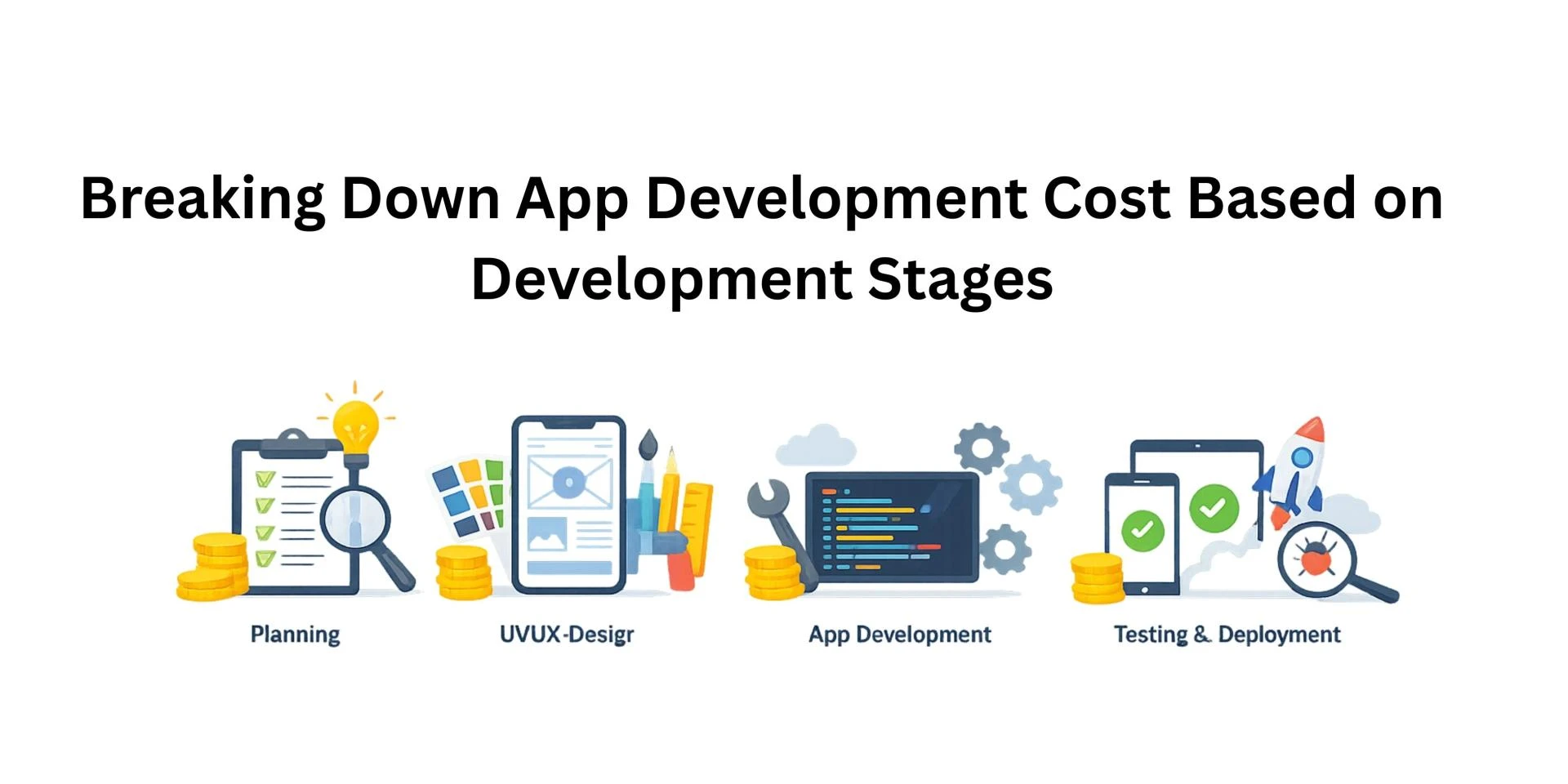

When businesses talk about app development cost, the conversation often jumps straight to numbers. What usually gets missed is how those numbers are formed. App development pricing is not a flat quote. It is the sum of several decisions made across different stages of development.
Each stage carries its own cost logic. Understanding those stages helps enterprises plan realistically, avoid late surprises, and protect long-term ROI.
This breakdown walks through where the money actually goes and why each phase matters.
Discovery and Planning
This stage decides whether the project stays controlled or slowly drifts.
Discovery is where business goals are translated into technical direction. It focuses on clarity, not output.
Typical work at this stage includes:
- Defining business objectives and success metrics
- Identifying user types and usage scenarios
- Mapping core features versus future enhancements
- Evaluating technical feasibility and constraints
Cost perspective:
Discovery usually represents a small portion of the overall app development cost, but it influences every stage that follows. Poor planning here often leads to scope changes, delays, and budget overruns later.
For enterprises, this stage aligns product vision with operational reality.
UI and UX Design
Design determines how easily users adopt the product.
This stage is less about visuals and more about structure, flow, and usability. Especially for enterprise apps, clarity often matters more than creativity.
Design work typically includes:
- User flow mapping
- Wireframes and clickable prototypes
- Visual styling and brand alignment
- Usability validation
Cost perspective:
Design generally takes a moderate share of app development costs. Apps with complex workflows, multiple roles, or compliance requirements require more design effort.
Skipping design shortcuts development time only on paper. In practice, it increases rework.
Frontend Development
Frontend development turns designs into working interfaces.
This stage focuses on performance, responsiveness, and consistency across devices and platforms.
Cost is influenced by:
- Platform selection (mobile, web, cross-platform)
- Interaction complexity
- Accessibility standards
- Performance expectations
Cost perspective:
Frontend work often accounts for a significant portion of app development cost, particularly for customer-facing or feature-rich products.
Backend Development
The backend handles logic, data, and integrations.
For many enterprise apps, this is the most technically demanding phase. Scalability, security, and reliability are decided here.
Backend development usually involves:
- Database design and optimization
- API development
- Third-party and internal system integrations
- Authentication and permission management
- Infrastructure setup
Cost perspective:
Backend development often forms the largest share of app development cost. Complexity increases with real-time data handling, compliance needs, and system integrations.
This is rarely the place to reduce scope aggressively.
Testing and Quality Assurance
Testing protects the investment already made.
QA ensures the app behaves correctly under real-world conditions, not just ideal scenarios.
Common testing activities include:
- Functional validation
- Cross-device and platform testing
- Performance and load testing
- Security checks
Cost perspective:
Testing represents a meaningful but controlled portion of app development cost. Cutting corners here often results in higher post-launch expenses and user dissatisfaction.
Deployment and Release
Launching an app is a controlled process, not a single click.
This stage ensures the app meets platform requirements and performs reliably in production.
Typical tasks include:
- Release configuration
- App store or internal deployment approvals
- Monitoring initial usage and stability
Cost perspective:
Deployment costs are usually lower compared to development, but delays at this stage can affect business timelines.
Ongoing Maintenance and Updates
App development does not end at launch.
Operating systems change. User needs evolve. Security risks emerge. Maintenance keeps the product relevant and stable.
Ongoing work includes:
- Bug fixes
- Compatibility updates
- Performance tuning
- Feature improvements
Cost perspective:
Maintenance is an ongoing part of app development cost and should be planned annually rather than treated as an exception.
Why Stage-Level Cost Understanding Matters
When enterprises understand app development cost by stage, they gain:
- Better budget forecasting
- Fewer last-minute changes
- Clearer vendor discussions
- More predictable delivery
For a deeper breakdown of pricing models and cost factors, please read more about this in our complete app development cost guide.
Final Thoughts
There is no universal price for building an app. But there is a structure behind every cost estimate.
Businesses that understand how app development cost is built stage by stage make better decisions. Not just financially, but strategically.
That understanding is often the difference between an app that struggles after launch and one that scales with confidence.























Sign in to leave a comment.