

If you have been putting off getting an ESA letter because you assumed the only real way to do it involved finding a therapist who accepts new patients, waiting six weeks for an appointment, paying out of pocket for a session your insurance probably will not cover, and then hoping the letter you come away with is formatted the way your landlord needs you are not alone. That assumption is extremely common. It is also, thankfully, wrong.
Getting an ESA letter from a licensed therapist online is completely legal, fully valid under federal housing law, and in most cases significantly faster and more affordable than the in-person route. In 2026, it is also the way most people choose to do it and for good reason. This article explains everything you need to know, including how to tell a legitimate service from a scam, what the process actually looks like, and what your rights are once you have the letter in hand.
Yes, It Is Completely Legal
The first thing to understand is that the Fair Housing Act does not care whether your ESA letter was issued in person or online. What it cares about is whether the letter comes from a licensed mental health professional who has genuinely evaluated you. That is the legal standard and a legitimate telehealth evaluation meets it just as fully as a face-to-face appointment in a therapist's office.
HUD, which is the federal agency responsible for enforcing the Fair Housing Act, has been clear on this point. An ESA letter is valid for housing purposes if it is issued by a licensed mental health professional an LMHC, LCSW, LPC, LMFT, or licensed psychologist who has conducted a real evaluation of the applicant. The location of that evaluation, whether a clinic or a video call, does not change its legal standing.
This means that when you hand a properly issued online ESA letter to your landlord, you have exactly the same federal protection as someone who got their letter after three in-person therapy sessions. The law makes no distinction. The only thing that matters is whether a real licensed professional evaluated you and stands behind the documentation.
Why Online Has Become the Preferred Route in 2026
Telehealth has changed a lot of things in mental health care over the past several years, and ESA evaluations are no exception. The practical advantages of the online route are real and significant especially for people who are dealing with anxiety, depression, or other conditions that can make scheduling and attending in-person appointments genuinely difficult.
You do not need to wait weeks for an opening with a therapist who accepts new patients. You do not need to take time off work, arrange transportation, or sit in a waiting room. You can complete the process from your home, at a time that works for you, in a setting where you are already comfortable. For many people, that accessibility is not just convenient it is the difference between finally doing this and continuing to put it off while paying pet fees every month.
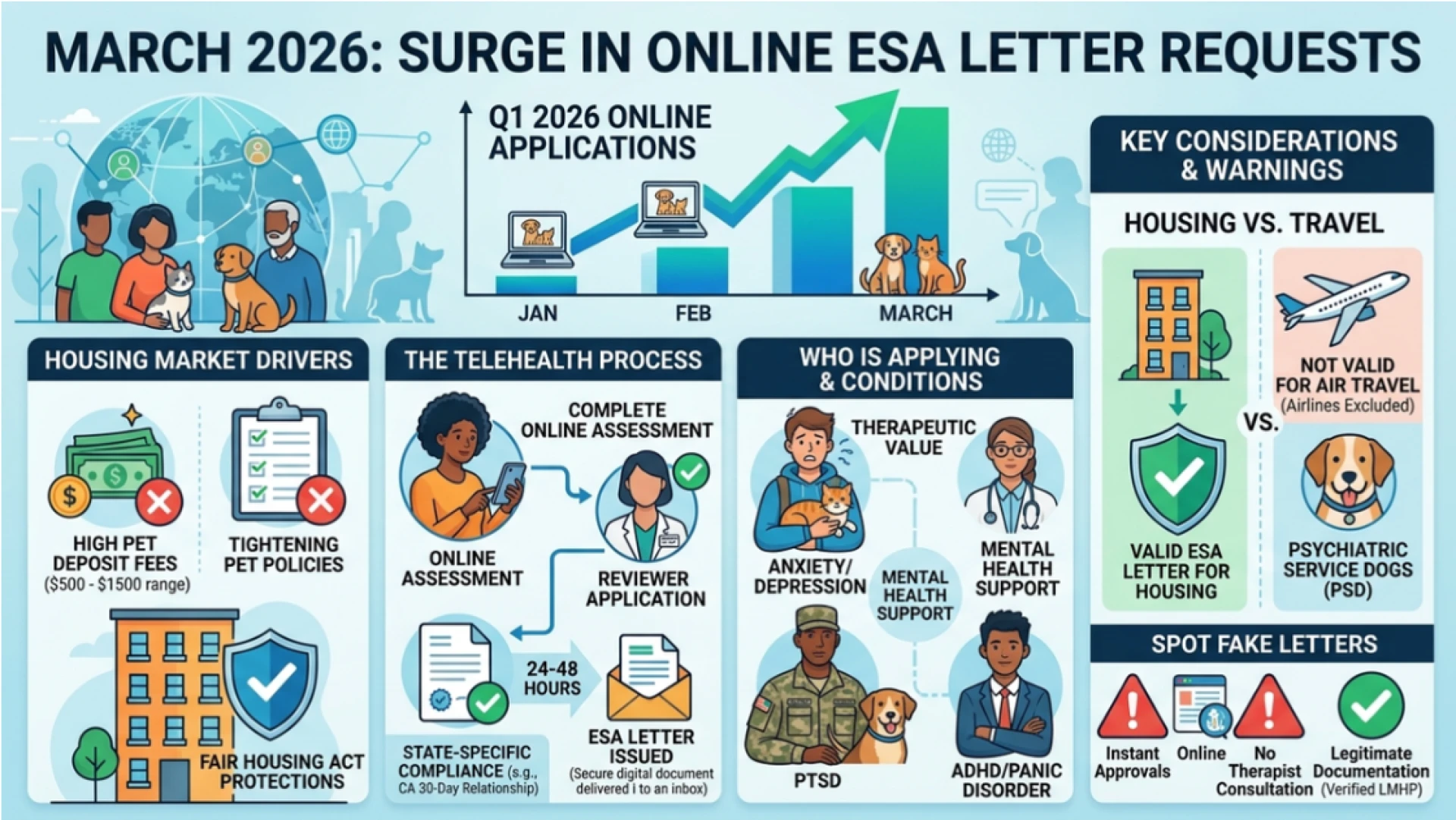
The turnaround is also faster. A legitimate online ESA service can have a letter in your inbox within 24 hours of approval compared to the days or weeks it might take to schedule, attend, and receive documentation from an in-person appointment. When you are dealing with a lease renewal deadline or a landlord who has just raised your pet deposit, that speed matters.
And the cost is typically lower. In-person therapy appointments not covered by insurance can run $150 to $300 per session. A legitimate online ESA evaluation and letter through a reputable service costs a fraction of that without sacrificing the clinical validity that makes the letter worth having.
The Difference Between a Legitimate Service and a Scam
Here is where the caution is warranted because not everything sold as an "ESA letter online" is the same thing.
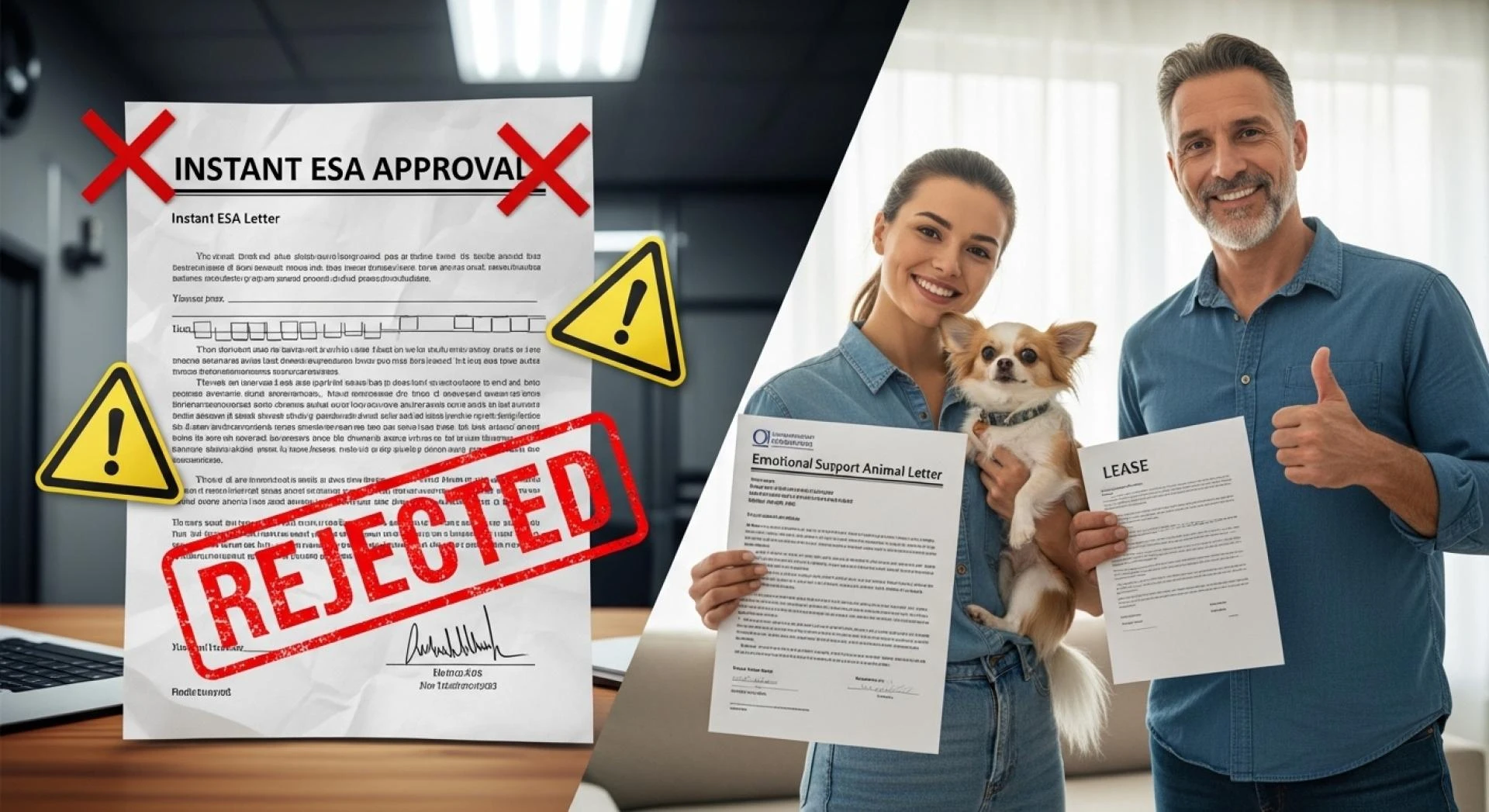
The internet is full of services that will take a small fee, ask you to fill out a basic form, and generate an official-looking certificate or letter in minutes with no actual therapist ever reviewing your information. These products are worthless in a housing context. A landlord who knows what they are looking at will recognize them immediately, and a letter with no verifiable licensed professional behind it carries no legal weight under the Fair Housing Act. Worse, in some states, knowingly presenting fraudulent ESA documentation can carry legal penalties.
The red flags are usually easy to spot once you know what to look for. Instant approvals with no consultation. No way to verify the therapist's license. A focus on selling you an "ESA registration number" or an ID card rather than a clinical letter. Prices so low that no real professional evaluation could possibly be involved. Any of these should send you elsewhere.
A legitimate online ESA service looks fundamentally different. It involves a real clinical evaluation by a licensed professional. It takes more than five minutes. It results in a letter on official letterhead with the therapist's verifiable credentials not a certificate or a card. And it comes with accountability, such as a money-back guarantee, that a fraudulent operation would never be able to sustain.
What a Legitimate Online ESA Process Actually Looks Like
For people who have never done this before, the actual process through a legitimate service is usually a pleasant surprise. It is simpler and less intimidating than most people expect.
It typically starts with a free questionnaire a series of questions about your mental health background, your relationship with your animal, and your living situation. This takes around five to eight minutes and carries no commitment. It is designed to help the service understand your situation before connecting you with an appropriate licensed professional.
A real licensed mental health professional then reviews your responses. In many cases, this review is sufficient for them to make a clinical determination. In others, they will schedule a brief phone or video consultation typically 15 to 20 minutes to ask a few follow-up questions and confirm their assessment. This is a normal part of a clinical evaluation, and virtually everyone who goes through it describes it as much more relaxed than they expected. No judgment, no pressure, no lengthy intake process.
If you are approved, your ESA letter is delivered as a PDF within 24 hours. It arrives on official clinical letterhead and includes the therapist's full name, license type, license number, state of licensure, and signature everything a landlord needs to verify the letter is real. A physical copy is also mailed to you. If you are not approved, you are not charged.
RealESALetter.com: What a Legitimate Service Looks Like in Practice
RealESALetter.com is one of the clearest examples of what a legitimate online ESA service should look like, and it is worth walking through why specifically.
Their network of licensed mental health professionals covers all 50 states. Every applicant is evaluated by a professional licensed specifically in their state not just licensed somewhere which matters because some states require the issuing professional to hold an in-state license. Their letters are FHA-compliant, formatted to meet HUD's documentation guidelines, and issued on official clinical letterhead with fully verifiable credentials.
The platform is HIPAA-compliant, meaning your mental health information is handled with the same privacy protections that apply in any clinical setting. The letter your landlord receives does not include your diagnosis or clinical history only the professional determination that you benefit from an emotional support animal, which is all federal law requires them to be told.
RealESALetter.com holds a 4.9-star rating from thousands of verified customers, with a consistent pattern of landlords accepting letters immediately, pet fees being waived, and breed restrictions being lifted. They back every letter with a full money-back guarantee a clean, no-conditions refund if a landlord rejects the letter. That accountability reflects genuine confidence in the legitimacy of what they provide.
If you are in Michigan, for instance, the ESA letter Michigan outlines exactly what to expect in that state. If you are in Illinois, the ESA letter Illinois covers the state-specific details that apply to renters there. RealESALetter.com provides this kind of state-level guidance for all 50 states, which makes a meaningful difference when you are dealing with a landlord who is familiar with local housing law.
Who Qualifies for an ESA Letter
This is the question a lot of people are quietly most worried about, often because they are not sure their situation is "serious enough" to qualify. Let me say this clearly: the threshold for qualifying is not as high as most people assume, and the determination is made by a licensed professional not an automated form and not you second-guessing yourself.
To qualify for an ESA letter, you need to have a recognized mental or emotional health condition as defined by the DSM-5, the clinical reference used by mental health professionals that genuinely benefits from the presence of an emotional support animal. Common qualifying conditions include anxiety disorders, depression, PTSD, panic disorder, OCD, phobias, bipolar disorder, and related mood or stress-related conditions.
You do not need a prior formal diagnosis. You do not need to currently be seeing a therapist. You do not need to have been hospitalized or medicated. What you need is a genuine condition and an honest account of how your animal helps you manage it. The licensed professional who reviews your application makes the clinical determination independently. If your situation is real, the evaluation is designed to identify and document it appropriately.
It is also worth knowing that ESA letters are not just for dogs and cats, though those are by far the most common. The Fair Housing Act can extend to a range of animals depending on the specifics of the situation and the housing context. RealESALetter.com has written about the nuances of emotional support cats specifically including what owners of cats need to know about housing documentation and how landlords typically respond to ESA letters for feline companions.
State-Specific Rules You Should Know
Federal law the Fair Housing Act applies in all 50 states and establishes the baseline protection. But some states have added their own requirements on top of federal law, and it is worth knowing whether any of them apply to you.
The most significant state-level requirement is the 30-day provider-client relationship rule. California, Arkansas, Iowa, Louisiana, and Montana all require that a therapeutic relationship between the provider and the client exist for at least 30 days before an ESA letter is considered valid under state law. If you live in one of these states and receive a letter from a service that skips this requirement, your landlord may have grounds to reject it even if the letter looks otherwise legitimate.If you are relocating or considering a stricter housing market,Planning to Move to California? is a helpful resource for understanding how ESA rules work there and what you should prepare in advance.
In Iowa, for example, the Iowa ESA laws are specific about this provider relationship requirement and what it means in practice for tenants. In Arkansas, the Arkansas ESA laws similarly reflect how the state has added compliance layers that a legitimate ESA service needs to account for. Choosing a service that is aware of and compliant with your state's specific rules is not optional it is what makes the difference between a letter that works and one that does not.
Legitimate services like RealESALetter.com handle this automatically. They know the rules that apply in each state and build them into their process. You do not need to research your state's requirements yourself but knowing they exist helps you understand why the process takes the time it does, and why that time is worth it.
What Your Letter Protects You From and What It Does Not
Once you have a legitimate ESA letter, the Fair Housing Act gives you meaningful, enforceable protections. Your landlord cannot deny your housing application because of your ESA. They cannot refuse to renew your lease because of one. They cannot charge you pet fees, pet deposits, or monthly pet rent. They cannot enforce breed restrictions or weight limits against your ESA. These protections apply in private rentals, apartment complexes, federally subsidized housing, and Section 8 properties.
It is also worth being clear about what the letter does not cover. ESA protections apply to housing not to public spaces. Under the Americans with Disabilities Act, only trained service animals have public access rights. An ESA letter will not allow your animal into a restaurant, store, or office that does not permit pets. And since 2021, airlines have been permitted to treat emotional support animals as regular pets rather than service animals, so the letter will not waive airline pet fees either.
For renters who are curious about how ESA protections apply in specific retail or public settings like whether a store allows emotional support animals the breakdown of Walmart ESA rules is a useful example of how these distinctions play out in practice. And for those wondering about travel options beyond housing, the guide on flying with a psychiatric service dog explains the difference between ESA and service dog protections in the context of air travel.
A Note on Why Some Applications Are Declined
This is something legitimate services are honest about, and it is worth raising because it is part of what distinguishes a real clinical process from a rubber-stamp operation. Not every application is approved. If a licensed professional reviews your situation and determines that the criteria for an ESA letter are not met, they will decline to issue one and a legitimate service will not charge you in that case.
This is actually a feature, not a bug. The fact that approvals are not guaranteed is what gives the letters their legal weight. A letter issued to everyone who applies regardless of their situation is not a clinical document it is a product. Landlords, housing authorities, and courts know the difference.
RealESALetter.com has published a candid piece on why some ESA letter requests are declined that explains the kinds of situations that do not meet the clinical threshold and why. It is an honest, unusually transparent piece for a company in this space and reading it before you apply can help you understand what the evaluation is actually assessing.
What Independent Reviewers Have Said
For anyone who wants third-party confirmation before committing to a service, there is a solid body of independent coverage to draw from. Reviews at Woolrec and Reels Media have both evaluated RealESALetter.com's clinical process, compliance standards, and customer outcomes, highlighting the combination of legitimate credentials and real-world results that distinguishes it from lower-quality competitors.
Regional reporting from LaGrange News and Natchez Democrat has also covered how tenants across different housing markets are using online ESA letters effectively and what separates documentation that works from documentation that wastes everyone's time.
The Answer to the Question
Yes you can absolutely get an ESA letter online in 2026. It is legal, it is valid, and when done through a legitimate service it is exactly as effective as any in-person letter for protecting your housing rights under the Fair Housing Act.
The key and the only real catch is choosing a service that does it correctly. A real licensed professional needs to evaluate you. The letter needs to be properly formatted and include verifiable credentials. The service needs to comply with any state-specific rules that apply where you live. And ideally, the service needs to stand behind the letter with a money-back guarantee that gives you a safety net if something goes wrong.
RealESALetter.com checks every one of those boxes. If you have a genuine mental or emotional health condition and your animal is genuinely part of how you manage it, you have housing rights available to you and getting the documentation you need to exercise those rights does not require weeks of waiting, expensive in-person appointments, or navigating a confusing system on your own. It requires a legitimate online service, an honest conversation with a licensed professional, and about 24 hours. That is it.
You have been wondering whether this is really possible. It is.
Frequently Asked Questions
Is an online ESA letter legally the same as one from an in-person therapist?
Yes. The Fair Housing Act and HUD guidelines do not distinguish between letters issued in person and letters issued through a legitimate telehealth evaluation. The legal standard is whether the letter comes from a licensed mental health professional who has genuinely evaluated the applicant and a proper online evaluation meets that standard fully. A landlord cannot legally reject a valid online ESA letter simply because it was issued through a telehealth process.
How long does the online process take from start to finish?
The initial questionnaire takes around five to eight minutes. The licensed professional reviews your responses shortly after, and a brief consultation call is scheduled only if needed to clarify anything. Once approved, your letter is delivered digitally within 24 hours. Most people complete the entire process from starting the questionnaire to having a letter ready to send to their landlord within one to three days.
Will my landlord know the letter came from an online service?
The letter your landlord receives is formatted as a professional clinical document on official letterhead, signed by a licensed therapist. It does not indicate whether the evaluation was conducted in person or online. The landlord can verify the therapist's license number through the relevant state licensing board and that verification will confirm the license is real and active. Whether the evaluation happened face-to-face or via telehealth is not relevant to the letter's legal standing.
What information will I need to share during the process?
The questionnaire covers your mental health background, how your condition affects your daily life, your relationship with your animal, and your housing situation. All of this is handled on a HIPAA-compliant platform. The letter your landlord receives does not include your diagnosis or clinical history only the professional determination that you benefit from an emotional support animal. Your private health information is not disclosed to anyone outside the clinical relationship.
Do I need a prior therapist or diagnosis to qualify?
No. The evaluation through a legitimate service like RealESALetter.com is itself a clinical assessment. You do not need an existing diagnosis, a referral, or a prior therapeutic relationship. The licensed professional reviews your situation independently and makes their own determination. If your condition is genuine and your animal genuinely helps you manage it, that is what the evaluation is designed to identify.
What happens if my landlord rejects the letter?
RealESALetter.com offers a full money-back refund if a landlord rejects the letter no questions asked. Beyond the refund, a landlord who unlawfully refuses to accommodate a properly documented ESA is potentially in violation of the Fair Housing Act, which can be reported as a fair housing complaint to HUD. Having a properly issued letter from a licensed professional is the foundation for exercising that right.
Are there any housing types where an online ESA letter would not be valid?
The Fair Housing Act covers the vast majority of rental housing private apartments, apartment complexes, condominiums, federally subsidized housing, and Section 8 properties. The narrow exceptions include owner-occupied buildings with four or fewer units, single-family homes rented without a broker, and housing controlled by religious organizations or private clubs. Outside those specific situations, a valid ESA letter applies regardless of whether it was issued online or in person.
What should I look for when choosing an online ESA letter service?
The most important things to verify are: that a real licensed mental health professional is involved in every evaluation (not just automated approval), that the letter includes a verifiable license number and is on official clinical letterhead, that the service is compliant with your state's specific requirements, and that a genuine money-back guarantee is in place. Avoid any service offering instant approval, ESA registration numbers or ID cards, or prices that make a real professional evaluation economically impossible.




























Sign in to leave a comment.